A Milestone in India’s Journey Towards Inclusive Growth and Social Justice
Why in the News?
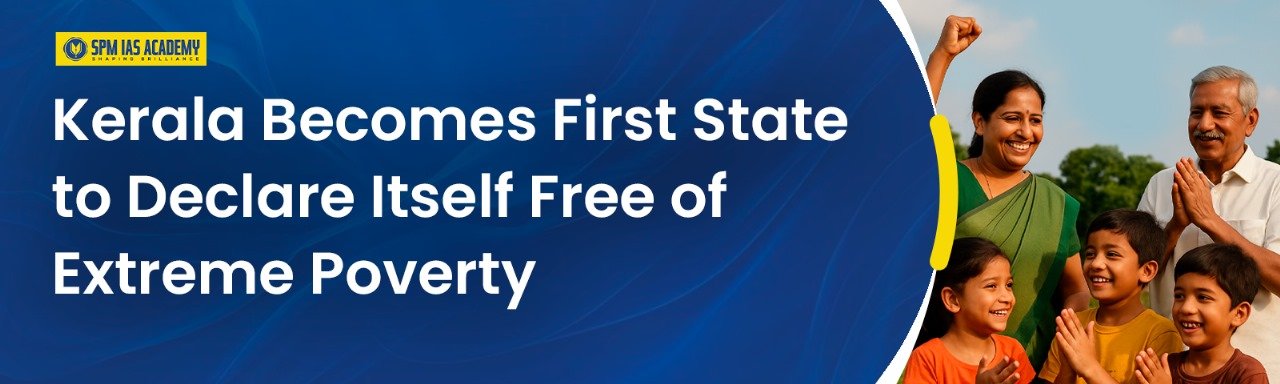
- In a landmark achievement, the State of Kerala has officially declared itself free of extreme poverty, becoming the first Indian state to reach this milestone.
- Kerala government has lifted over 64,000 families out of distress, marking a historic milestone in social development.
- This marks a major success for Kerala’s welfare-oriented governance model, which emphasizes social equity, education, and human development.
- The declaration comes after the completion of the State’s Extreme Poverty Eradication Project (EPEP) under the Nava Keralam Mission.
What Does ‘Extreme Poverty-Free’ Mean?
- A household is considered extremely poor when it lacks access to basic needs such as food, shelter, healthcare, education, and livelihood opportunities.
- Under Kerala’s project, extreme poverty-free status was defined by identifying and supporting families with monthly incomes below ₹1,000 per person, or those deprived of multiple basic amenities.
- The state surveyed 64.55 lakh households and found over 64,000 families living in extreme poverty, all of whom have now been provided targeted assistance.
Global definition:
- According to the World Bank’s revised estimates (June 2025):
- Individuals living on less than $3 per day (2021 PPP) are classified as living in extreme poverty.
- This marks an upward revision from the earlier benchmark of $2.15 per day (2017 PPP), reflecting updated global price and consumption standards.
- Revised Poverty Lines by Income Group:
- Lower-middle-income countries: $4.20 per day
- Upper-middle-income countries: $8.30 per day
According to the latest data from the Global Multidimensional Poverty Index (MPI) 2025, around 1.1 billion people across 109 countries live in acute multidimensional poverty, highlighting that income‑only measures can miss key deprivations.
Key Features of the Extreme Poverty Eradication Project (EPEP):
Announced in 2021, the Local Self-Government Department was the nodal agency.
- Comprehensive Household Survey: Identified vulnerable families across all districts.
- Customized Rehabilitation Plans: Support provided based on family-specific needs – housing, healthcare, education, or skill training.
- Convergence Model: Collaboration between local self-governments, Kudumbashree Mission, and state departments.
- Women-Led Implementation: Kudumbashree neighbourhood groups played a vital role in identification and outreach.
- Sustainable Development Goal (SDG) Alignment: Directly contributes to SDG 1 – No Poverty and SDG 10 – Reduced Inequalities.
Significance of Kerala’s Achievement:
- First Indian State to officially declare freedom from extreme poverty.
- Model for Social Welfare: Demonstrates the success of decentralized governance and community participation.
- Holistic Human Development: Integrates healthcare, education, and livelihood as pillars of poverty alleviation.
- Inspires Other States: Sets an example for evidence-based, people-centric welfare planning.
- Sustainable Impact: Focuses not just on short-term relief but long-term socio-economic empowerment.
India’s Position in the Global Context:
According to the World Bank (2025) estimates:
- Around 838 million people worldwide lived in extreme poverty in 2022, based on the $3 per day international poverty line.
- In India, the decline has been remarkable —
- Extreme poverty reduced from 16.2% in 2011–12 to just 2.3% in 2022–23.
- Nearly 171 million Indians have successfully moved out of extreme poverty during this period.
- Key Drivers of Improvement:
- Rising employment opportunities and rapid urbanization have played a crucial role.
- Urban unemployment dropped to 6.6% in Q1 FY 2024–25, the lowest since 2017–18, reflecting improved labour market conditions.
- Persistent Challenges: Despite the progress, several structural issues continue to hinder inclusive growth:
- Youth unemployment remains high at 13.3%, with a sharper rate of 29% among graduates.
- Gender disparity persists – only 31% of women are engaged in the workforce.
- In India, informality dominates the labour market. About 77% of non-farm jobs along with most agricultural employment remain informal and unprotected.
- Critics caution that official poverty estimates may not fully capture multidimensional deprivation, including access to healthcare, education, and quality living conditions.
Conclusion:
Kerala’s achievement in becoming India’s first state to eliminate extreme poverty reflects the success of grassroots governance, women-led initiatives, and inclusive policy design.
It shows that with the right mix of political will, data-driven planning, and community participation, sustainable poverty eradication is not a distant dream — but a reachable goal.
For UPSC aspirants, this development offers a model case study on poverty reduction, social welfare, and SDG implementation at the state level — all key areas for Mains and Essay preparation.
Sources:
- Kerala now India’s first ‘extreme poverty-free’ state, declares CM Pinarayi Vijayan
- Kerala’s growth story – how the state ended extreme poverty
FAQs:
Kerala’s declaration means that no family in the state lives without access to basic needs such as food, shelter, healthcare, education, and livelihood — marking total eradication of extreme poverty under the Extreme Poverty Eradication Project (EPEP).
The EPEP, launched in 2021 under the Nava Keralam Mission, identified and rehabilitated over 64,000 families through a data-driven survey, women-led outreach, and convergence of local government programs.
Kerala’s success directly contributes to SDG 1 (No Poverty) and SDG 10 (Reduced Inequalities), setting an example of localized and inclusive implementation of global development goals.
Strong decentralized governance, women-led Kudumbashree initiatives, universal education, accessible healthcare, and people-centric welfare programs were crucial to Kerala’s success.
While global extreme poverty affects around 838 million people, India’s rate fell to 2.3% in 2022–23. Kerala has gone a step further by achieving zero extreme poverty, setting a national benchmark for inclusive growth.

Behind every article at SPM IAS Academy is a team of skilled content writers and subject experts committed to making preparation easier for aspirants. From answering common doubts to breaking down complex issues and current affairs, we create content that is accurate, easy to understand, and directly useful for UPSC, APSC, and other competitive exams.