
Context:
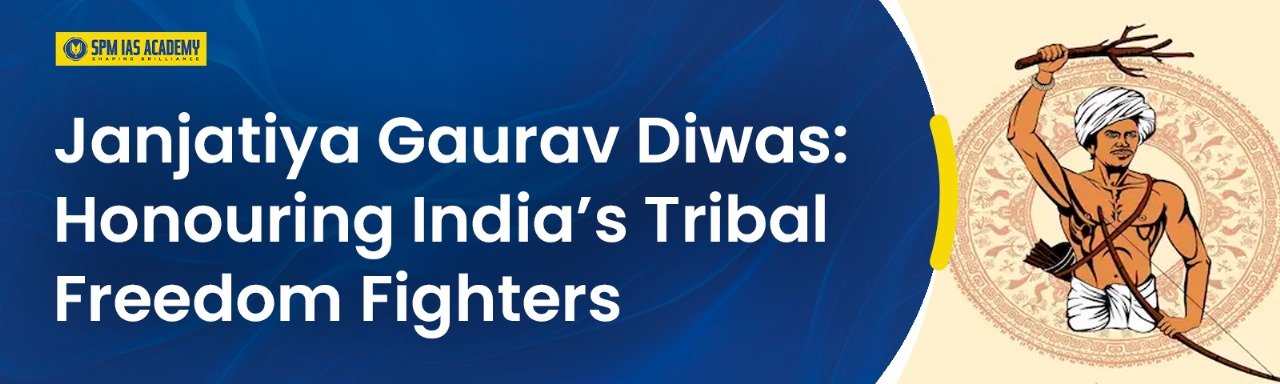
- India celebrates Janjatiya Gaurav Diwas (Tribal Pride Day) every year on 15th November.
- This year marks the 150th Birth Anniversary celebration of Dharti Aaba Bhagwan Birsa Munda.
- The Union Cabinet approved this day in 2021. This day marks the birth anniversary of the tribal freedom fighter Birsa Munda.
- It also recognises their rich culture, heritage, and continuous role in nation-building.
- The Ministry of Tribal Affairs is establishing 11 museums to commemorate various tribal movements and uprisings against British rule and promote their cultures and histories.
.
For UPSC aspirants, this topic holds high relevance for GS I (History, Society) and GS II (Governance). Therefore, understanding its background and significance becomes essential.
Why 15th November?
- The date marks the birth anniversary of Dharti Aaba Bhagwan Birsa Munda, one of the greatest tribal freedom fighters in Indian history.
- He is revered as ‘Bhagwan Birsa’ by tribal communities across the country.
- Birsa Munda fought courageously against the exploitative policies of British colonial rule. He mobilised the tribal population and sparked a powerful movement against British oppression.
- His clarion call for ‘Ulgulan’, meaning ‘Revolution’, inspired thousands to resist injustice.
- Therefore, 15th November symbolises courage, unity, and tribal pride.
Who Was Birsa Munda?
- Born in 1874, Birsa Munda was a revolutionary tribal leader from the Munda community of present-day Jharkhand.
- He opposed the British land policies that displaced tribal families from their traditional forest lands.
- His movement challenged the British administrative system and oppressive practices.
- Birsa Munda emphasised self-rule, social reform, and tribal identity.
- His leadership transformed the tribal resistance into a mass movement.
- Although he lived only 25 years, his impact continues to inspire India.
Munda Revolt (Ulgulan) – Key Points:
- The Munda Revolt, also called Ulgulan, emerged in 1890s in the Chotanagpur region.
- Birsa Munda led the movement to challenge British exploitation and oppressive zamindari practices.
- The Mundas resisted forced labour imposed by British officials and local landlords.
- The revolt grew rapidly as tribal communities suffered displacement from their ancestral lands.
- British forest laws restricted traditional rights, creating severe livelihood issues for the Mundas.
- Birsa Munda mobilised his followers with the idea of a return to a free Munda Raj.
- He organised guerrilla-style attacks against British officers and exploitative landlords.
- The movement spread strongly between 1894 and 1900 due to rising repression.
- However, British troops suppressed the revolt in 1900 after Birsa Munda’s arrest.
- Birsa Munda died in jail, but his movement created lasting resistance consciousness among tribes.
- The revolt forced the colonial government to reconsider land policies for tribal communities.
- Consequently, the Chotanagpur Tenancy Act, 1908 protected tribal land rights more effectively.
Tribal Contribution to India’s Freedom Struggle:
India’s freedom struggle was not limited to mainstream political leaders. Tribal communities across India fought vigorously to protect their land, culture, forests, and rights. Several tribal uprisings played a crucial role in weakening British rule:
- Pahariya Rebellion, 1778
- Santhal Rebellion (1855–56) – Led by Sidhu and Kanhu Murmu
- Tamar Revolt, 1783
- Kol Uprising, 1831
- Bhil Revolts, 1817-19
- Khasi Rebellion, 1829-33
These revolts reflected courage, collective identity, and a strong desire for freedom. They also highlighted the role of indigenous systems of governance and social organisation.
Why Janjatiya Gaurav Diwas Matters Today:
- Janjatiya Gaurav Diwas reminds us of the sacrifices made by tribal leaders.
- It also recognises the cultural and historical identity of tribal communities.
- Additionally, the day encourages awareness about tribal struggles and contributions. It motivates people to value inclusivity and respect diversity.
- Therefore, the celebration helps promote national unity.
- The Government of India also uses this day to highlight development initiatives for tribal welfare.
- These efforts include education, healthcare, livelihood support, forest rights, and digital inclusion.
Conclusion:
Janjatiya Gaurav Diwas stands as a tribute to the courage and sacrifice of India’s tribal freedom fighters. It honours Birsa Munda and acknowledges tribal contributions to the nation. Moreover, it reminds citizens of India’s cultural diversity and collective strength.
For UPSC aspirants, this day provides valuable insights into history, governance, culture, and social justice. Therefore, studying the significance of Janjatiya Gaurav Diwas becomes essential for both Prelims and Mains.
Sources:
- https://www.pib.gov.in/PressReleasePage.aspx?PRID=2189915
- https://www.pib.gov.in/PressReleasePage.aspx?PRID=2189915
FAQs:
Janjatiya Gaurav Diwas is celebrated on 15 November to honour India’s tribal freedom fighters and their cultural heritage.
It marks the birth anniversary of Birsa Munda, the iconic tribal leader who led the Ulgulan movement against British rule.
Birsa Munda was a revolutionary tribal leader who fought British exploitation and inspired a mass movement for tribal rights.
The government is establishing 11 tribal freedom fighter museums and promoting welfare initiatives in education, health, and forest rights.
Janjatiya Gaurav Diwas honours Birsa Munda, whose Ulgulan (Munda Revolt) challenged British exploitation and became a symbol of tribal resistance.

Behind every article at SPM IAS Academy is a team of skilled content writers and subject experts committed to making preparation easier for aspirants. From answering common doubts to breaking down complex issues and current affairs, we create content that is accurate, easy to understand, and directly useful for UPSC, APSC, and other competitive exams.