
Democracy stands today as the most accepted system of governance in the world. However, it did not emerge overnight. It evolved through centuries of political experimentation, philosophical debate, and institutional reform. Therefore, UPSC aspirants must understand the long historical journey of democracy – from its origins in ancient Athens to its modern expression in the world’s largest democracy – India.
This blog explains the evolution, key milestones, scholarly perspectives, and India’s democratic contribution.
1. Democracy in Ancient Athens: The First Experiment:
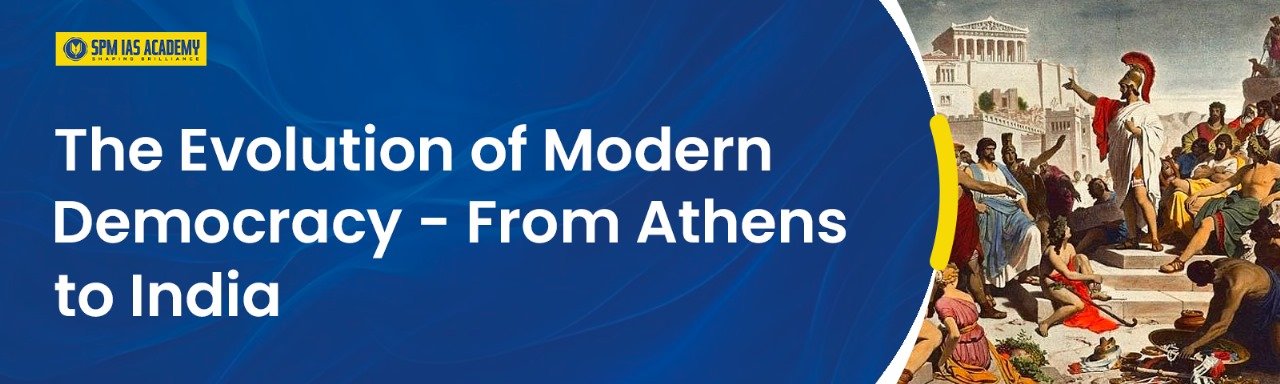
Ancient Athens created the earliest known democratic system around the 5th century BCE. Citizens participated directly in decision-making. They met in assemblies and voted on laws. They elected officials and served on juries.
Key Features of Athenian Democracy:
- It functioned as a direct democracy.
- Citizens discussed policies openly.
- Random selection of officials ensured fairness.
- Political participation was considered a civic duty.
However, Athenian democracy excluded women, slaves, and foreigners. Therefore, it was democratic only for a small population.
Scholarly Opinion:
- Political philosopher J.S. Mill admired Athens for fostering free thought and public debate. He argued that Athens created “the earliest schooling in civic responsibility.”
- Historian George Grote called Athenian democracy “a triumph of collective political learning.”
Thus, Athens provided the philosophical foundation for modern democratic thought.
2. Republicanism in Rome: Rule Through Representation:
The Roman Republic (509–27 BCE) added new elements to governance. Citizens did not manage daily affairs directly. Instead, they elected representatives.
Roman Contributions:
- Rule of law became a central political principle.
- Separation of powers emerged in primitive form.
- Institutions like the Senate influenced later constitutions.
- Citizenship rights expanded gradually.
- Roman governance shaped many modern constitutional ideas. Therefore, the Roman Republic served as a bridge between ancient and modern political structures.
- Political theorist Hannah Arendt argued that the Roman Republic introduced “durable institutions” that protected public freedom.
- Legal scholars note that Roman law influenced modern constitutional frameworks, especially in Europe and the United States.
3. Medieval Period: Decline and Survival of Democratic Ideas:
The medieval era witnessed the decline of democratic participation in Europe. Monarchies dominated governance. However, democratic ideas survived in certain practices.
Examples:
- The Magna Carta (1215) limited royal power.
- Town councils permitted limited self-governance.
- Guilds protected economic rights.
These developments planted seeds for future constitutionalism.
Scholarly Opinion:
- Historian Eric Hobsbawm argued that medieval charters preserved “embryonic democratic safeguards” against arbitrary power.
- Therefore, democracy survived symbolically even during monarchical rule.
4. Renaissance and Reformation: Birth of New Political Thought:
The Renaissance marked a shift from medieval scholasticism to humanism, reasons, individual dignity, scientific inquiry and secular learning. Humanism and reasoning encouraged free inquiry. The Reformation challenged religious authority.
Impact on Democracy:
- Individual freedom gained prominence.
- People questioned absolute religious and political power.
- Literacy expanded through printing technology. Thus, democracy found new philosophical ground.
- Philosopher Charles Taylor noted that the Renaissance enabled “moral individualism,” which strengthened democratic values.
- This period also prepared Europe for major political revolutions.
5. Enlightenment: The Intellectual Foundation of Modern Democracy:
- The Enlightenment (17th–18th centuries) shaped the modern democratic world.
- Thinkers emphasized liberty, equality, and rational governance.
- It emphasized reason, scientific thinking, individual rights, and rational questioning of traditional authority.
- It sought to reform society through logic, freedom of thought, and human progress.
Key Thinkers and Ideas:
- John Locke promoted natural rights and consent of the governed.
- Montesquieu developed the idea of separation of powers.
- Rousseau advocated popular sovereignty.
These ideas influenced constitutional democracies worldwide.
Scholarly Opinion:
- Political scientist Robert Dahl claimed that modern democracy “rests fundamentally on Enlightenment values of equality and participation.”
- Therefore, this era remains the philosophical pillar of modern politics.
6. Democratic Revolutions: From Theory to Practice:
Two major revolutions converted democratic theory into political institutions.
- American Revolution (1776):
- It produced a written constitution.
- It established checks and balances.
- It protected individual rights.
- It reflected Enlightenment principles.
- French Revolution (1789):
- It proclaimed liberty, equality, and fraternity.
- It challenged hereditary rule.
- It inspired democratic movements worldwide.
- These revolutions demonstrated that democratic governance could replace monarchy.
- Historian Alexis de Tocqueville observed that the American experiment proved democracy could endure in a large nation. Thus, the revolutions marked a turning point.
7. Industrial Revolution and Social Democracy:
The Industrial Revolution changed economic and social structures. Workers demanded rights and new political parties emerged.
Democratic Changes:
- Universal adult suffrage expanded gradually.
- Labour movements gained political influence.
- Welfare states reduced inequality.
- Social democracy emerged as a response to capitalism’s challenges.
Sociologist Karl Polanyi argued that democracy grew stronger when societies protected citizens from market excesses.
Therefore, industrialization reshaped democracy into a more inclusive system.
8. Decolonization and Democratic Aspirations:
The 20th century witnessed the collapse of colonial empires. Newly independent nations adopted democratic systems.
Why Countries Chose Democracy:
- Nationalism encouraged self-rule.
- Colonial exploitation created demand for accountable governance.
- International norms supported democratic transitions.
- Thus, democracy expanded across Asia, Africa, and Latin America.
Political scientist Samuel Huntington described this period as the “third wave of democratization.” India became one of the most successful examples.
9. India: The World’s Largest Democracy:
India adopted democracy after independence in 1947. Despite poverty and diversity, India embraced universal adult franchise.
Why India’s Democracy Is Unique:
- It granted equal voting rights from the beginning.
- It established a sovereign, socialist, secular, democratic republic.
- It adopted strong institutions like Parliament and judiciary.
- It promoted federalism to manage diversity.
- It protected fundamental rights and adopted affirmative action for social justice.
Scholar’s Views on Indian Democracy:
- Amartya Sen called India’s democracy “a constant public argument” that enriches political culture.
- Granville Austin described the Constitution as a “seamless web of rights and responsibilities.”
- Sunil Khilnani argued that India turned democracy into a mass experiment unmatched in history.
Therefore, India shaped democracy with its own values.
Challenges to Modern Democracy:
Despite growth, democracy faces several challenges:
- Rising polarization threatens public trust.
- Disinformation spreads quickly through digital platforms.
- Populism challenges institutional checks.
- Inequality weakens representation.
- Authoritarian trends weaken democratic norms.
India confronts similar challenges but continues to uphold democratic values through reforms and public participation.
The Future of Democracy: Trends and Possibilities:
Democracy continues to evolve globally. Digital governance expands participation. Youth involvement grows and social movements strengthen accountability.
Possible Trends:
- More countries may adopt hybrid democratic models which blends elements of democracy with features of authoritarianism.
- Technology may shape public decision-making.
- Global institutions may push greater transparency.
- Civic education may strengthen democratic culture.
Therefore, democracy will continue adapting to new challenges.
Conclusion:
Democracy evolved over more than 2,500 years – from ancient Athens to modern India. Each era added new ideas, institutions, and values. Today, India represents one of the strongest democratic experiments in the world. It demonstrates the power of inclusive governance and public participation. For UPSC aspirants, understanding this evolution is essential for GS, Essay, and PSIR optional preparation.
Sources:
- https://www.britannica.com/topic/democracy
- https://www.history.ox.ac.uk/re-imagining-democracy-1750-1860
FAQs:
Modern democracy traces its roots to ancient Athens (5th century BCE), where citizens practiced direct participation. Over centuries, ideas from Rome, the Enlightenment, and democratic revolutions shaped today’s democratic systems.
Enlightenment thinkers like Locke, Rousseau, and Montesquieu promoted natural rights, popular sovereignty, and separation of powers—principles that form the core of modern democratic constitutions.
India adopted universal adult franchise from independence, built strong democratic institutions, protected civil liberties, and practiced federalism, making it the world’s largest and most diverse democratic nation.
Major milestones include Athenian democracy, the Roman Republic, Magna Carta, Renaissance and Reformation, Enlightenment, American and French Revolutions, Industrial-era reforms, and global decolonization.
Modern democracies face rising polarization, digital misinformation, populism, inequality, and hybrid authoritarian trends. Strengthening institutions and civic education is key to safeguarding democratic values.

Behind every article at SPM IAS Academy is a team of skilled content writers and subject experts committed to making preparation easier for aspirants. From answering common doubts to breaking down complex issues and current affairs, we create content that is accurate, easy to understand, and directly useful for UPSC, APSC, and other competitive exams.