
The Ganga River is one of the longest, most revered, and most important river systems in India. It flows through the heart of the Indian subcontinent, providing sustenance, water, and cultural significance to millions of people. For UPSC, APSC, and other state PCS aspirants, understanding the Ganga River system is crucial for various geography and environment related topics in the Civil Services Examination.
This article discusses the Ganga River system’s origin, course, tributaries, significance, and ecological challenges, making it an essential topic for those preparing for the UPSC and other state-level civil services exams.
The Ganga River System:
- The Ganga River is not only a river but a lifeline for millions of people across India. It is known for its cultural, historical, and geographical importance.
- Flowing across diverse terrains, the Ganga traverses 2,525 kilometres, making it one of the longest rivers in the world.
- The river basin spans over 1 million square kilometres, covering around 26% of India’s total area.
- It plays a significant role in shaping the socio-economic and agricultural landscapes of the country.
- The Ganga Basin is home to over 500 million people, making it one of the most densely populated river basins globally.
Origin of the Ganga River:
- The Ganga River originates from the Gangotri Glacier in the Himalayan Mountains near Gomukh. It is in the district of Uttarkashi in the state of Uttarakhand.
- The river begins its journey as Bhagirathi. At Devaprayag, Bhagirathi meets Alakananda. From this point of confluence, the river is named as the Ganga.
- The Ganga River leaves the mountains and enters the plains near Haridwar.
Key Points:
- Origin: Gangotri Glacier, Uttarakhand.
- Source Name: Bhagirathi.
- Confluence: Bhagirathi and Alaknanda rivers.
Course of the Ganga River:
The Ganga travels across a vast part of the northern Indian plain. It is joined by several major tributaries along its path.
- The Ganga flows initially in the southern direction, then in the south-east and again in the east.
- In Uttarakhand, the river flows from the Gangotri Glacier, passing through cities like Haridwar and Rishikesh, before entering Uttar Pradesh.
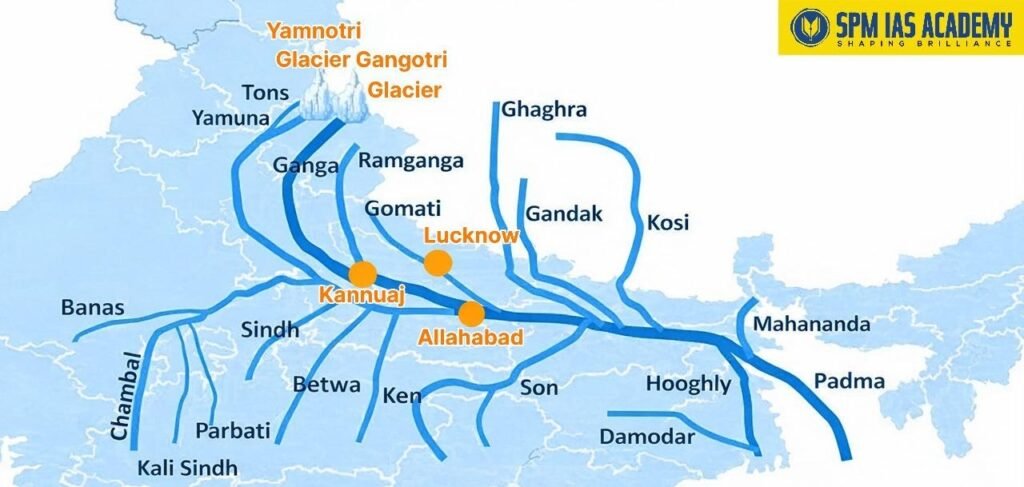
- In Uttar Pradesh, it flows through key cities like Kanpur, Allahabad, and Varanasi. In Prayagraj/Allahabad, Yamuna merges with Ganga.
- In Bihar, the river flows through cities such as Patna located along its banks. From Haridwar to Bihar, it is joined by many other tributaries such Ramganga, Gomti, Ghaghara, Gandak and Kosi.
- When it reaches West Bengal, it gets divided into two main distributaries called the Bhagirathi and the Hugli.
- The main river goes to Bangladesh where it is firstly called the Padma and then the Meghna which flows into the Bay of Bengal.
Tributaries of Ganga River:
| Left Bank Tributaries | Right Bank Tributaries |
| Ramganga | Yamuna |
| Gomati | Tons (Tamsa) |
| Ghaghara (Karnali) | Karamnasa |
| Gandak | Son |
| Kosi | Punpun |
| Mahananda | Kiul |
| Sarda | Chandan |
| Baghmati | Phalgu (Niranjana) |
Major Tributaries of the Ganga:
The Ganga River is fed by a variety of tributaries that contribute to its volume and spread. These tributaries originate from both the Himalayan and Peninsular regions. Some of the major tributaries of the Ganga river are –
- Yamuna River: Originates from the Yamunotri Glacier and is the Ganga’s longest tributary. It joins the Ganga on its right bank near Allahabad. The Tons originating from the Himalayan range is the largest tributary of the Yamuna in the Himalayan region. In the plains, four main rivers originating from the Vindhyas join the Yamuna on its right bank. These are Chambal, Sind, Betwa and Ken (from west to east). The main left bank tributaries are Tons, Hindon, Karen, Sangar and Rind.
- Ramganga: Originating in the Doodhatoli range of Uttarakhand, it flows through the Jim Corbett National Park before entering the plain. It joins the Ganga River near Kannauj.
- Ghaghara (Karnali) River: The river Ghaghara originates from Himalayan glacier ‘Mapchachungo glacier’ near Mansarovar lake in Tibet. In Tibet, it is known as Mapcha Tsangpo. The lower part of Ghaghara in Awadh called as ‘Sarayu’ which mentioned in Ramayana. It is a transboundary river and it is known as ‘Karnali’ in Nepal. Joins the Ganga in Uttar Pradesh.
- Kosi River: Kosi river is known as “Sorrow of Bihar” due to its sedimentation issues and frequent course shift. River Kosi is a transboundary river. Originating in Tibet, it flows through Nepal and then enters India and joins the Ganga near Kursela in Bihar.
- Son River: Sone or Son River is a perennial river and originates near Amarkantak Hill. It is the second largest southern tributary of the Ganges after Yamuna. India’s oldest river bridge ‘Koilwar Bridge’ is over this river which connects Arrah with Patna in Bihar. It joins the Ganga near Maner in Patna, Bihar. It is mentioned in Ramayana and mentioned as SoNai in Sangam Tamil literature ‘Kuruntokai’.
- Gomti: This river originates from ‘Gomat Taal’ (Fulhar Jheel) in Pilibhit. It flows entirely through Lucknow before merging with the Ganga near Varanasi.
- Gandak: The river originates from the ‘Nhubine Himal Glacier’ near the Tibet border. The river is also known as ‘Narayani’ in Nepal. It is the source of sacred ‘Shaligrama stones’ in Hinduism.
- Mahananda: Mahananda river originates from ‘Paglajhora falls’ in the Mahaldiram range, Darjeeling district, West Bengal. It is a transboundary river and one of the significant tributaries of the Ganga river. It merges with the Ganga near Godagari in Bangladesh.
Ecological Importance of the Ganga River System:
The Ganga plays a vital role in maintaining ecological balance across the Indian subcontinent. Its basin supports an array of biodiversity and is an essential source of water for agriculture and human consumption.
Ecological Contributions:
- Agriculture: The fertile floodplains of the Ganga are ideal for growing crops such as rice, wheat, and sugarcane.
- Biodiversity: The river supports species like the Ganga river dolphin, migratory birds, and diverse aquatic life.
- Wetlands: The river basin contains wetlands that are crucial for maintaining water cycles and filtering pollutants.
Economic Significance of the Ganga river system:
The economic significance of the Ganga extends far beyond water supply. The river has played a crucial role in the economic development of India, especially in agriculture, transportation, and trade.
- Agriculture: The river basin is one of India’s most fertile agricultural regions.
- Transportation: The Ganga serves as an important waterway for the transportation of goods like coal, agricultural products, and minerals. The Ganga-Bhagirathi-Hooghly stretch forms the National Waterway (NW)- 1. This part covers from Haldia to Prayagraj stretching around 1,620 km.
- Tourism: The river is a prime tourist destination, especially in cities like Varanasi, Haridwar, and Allahabad, where millions gather for religious pilgrimages.
Cultural and Religious Significance of the Ganga river system:
The Ganga holds immense religious significance in Hinduism. It is considered the most sacred river and is worshipped as the goddess Ganga Maa.
- Religious Pilgrimages: People from across India visit the banks of the Ganga for sacred rituals, such as Ganga Aarti at Varanasi.
- Festivals: The river is central to several Hindu festivals, including the Kumbh Mela, which is held at Allahabad, Haridwar, and other locations.
- Symbol of Purity: The Ganga is believed to purify souls and is central to Hindu spiritual beliefs.
Environmental Challenges Facing the Ganga River:
While the Ganga is vital for India’s ecology, its river system faces significant environmental challenges.
Key Environmental Issues:
- Pollution: The Ganga is one of the most polluted rivers in the world, with sewage, industrial waste, and religious offerings contributing to its contamination.
- Over-extraction: Excessive water extraction for agricultural, industrial, and domestic use is putting strain on the river.
- Ecosystem Degradation: Deforestation and unplanned urbanization along its banks have led to habitat loss for several species.
Ganga River Conservation Efforts:
To protect and rejuvenate the Ganga, several initiatives have been launched over the years.
Major Initiatives:
- Namami Gange Programme: The Government of India launched this programme in 2014. This initiative aims to reduce pollution, restore the river’s flow, and ensure sustainable water usage. It also covers sewage treatment, river front development, afforestation along riverbank etc.
- Ganga Action Plan: Started in the 1980s, this was the first national effort to clean the Ganga River.
- National Ganga River Basin Authority: The Government of India established this body in 2009 under the Ministry of Environment and Forests. Its objectives are coordinated management, pollution control of the Ganga Basin. Its responsibility includes policy implementation, monitoring water quality etc.
Various River Valley Project related to the Ganga River System:
- The Tehri Project – India’s tallest dam and it is on the Bhagirathi River. Its location is in Tehri, Uttarakhand. Its purposes are – generation of 2,400 MW hydropower, irrigation, drinking water.
- Ramganga Project (Kalagarh dam) – It is on the Ramganga river, located in Kalagarh, Uttarakhand. It is a multipurpose dam – irrigation, hydropower, flood control. It is located near Corbett National Park.
- The Gandak Project – It is a joint project of Bihar, Uttar Pradesh and Nepal. It is on the Gandak river in Bihar. Its purpose includes irrigation, flood control and hydropower.
- The Kosi project – It is on Kosi River, Bihar. It is also an Indo-Nepal project for the purpose of flood control, irrigation system and hydro-electric production.
- The Rihand Project – It is on the river Rihand, a tributary of Son. This dam is also known as Govind Ballabh Pant Sagar. It is a multipurpose project in Uttar Pradesh but Bihar and Madhya Pradesh also get its benefits. Its purposes are – hydro-electric power generation, irrigation, flood control, and support industries like aluminum, chemical and cement.
- The Bansagar project – The dam is located on the Son river at Shahdol, Madhya Pradesh. It is a joint MP-UP-Bihar irrigation project. Other purposes are – hydropower generation, water management.
- Matatila Dam – It is a joint project of Madhya Pradesh and Uttar Pradesh on the river Betwa. It is on the Betwa river in Uttar Pradesh. Its purposes are hydropower generation, irrigation, regional water supply.
- The Chambal Project – Initiated in 1950s, it is a joint project of Rajasthan and Madhya Pradesh. Under this project, there are three dams – Gandhi Sagar, Rana Pratap Sagar and Jawahar Sagar Dam. Its purposes are hydropower, irrigation, and flood/soil erosion control.
- The Damodar valley project – Initiated in 1948, it is a project of undivided Bihar and West Bengal. It is India’s first multipurpose river valley project covering areas like flood control, hydroelectric and thermal power generation, irrigation facilities etc. The model of this project is based on Tennessee River Valley Corporation of the USA.
Conclusion:
The Ganga River system is more than just a physical waterway. It is the backbone of India’s cultural, economic, and ecological framework. Understanding its origin, course, tributaries, and significance is essential for students preparing for UPSC, APSC, and other state PCS exams. Not only is the Ganga central to India’s geography, but its role in governance, policy, and environmental sustainability is equally important.
For aspirants aiming for the Civil Services Examination, a detailed understanding of the Ganga River system will help in answering questions related to geography, ecology, economics, and Indian history effectively.
Sources:
FAQs:
The Ganga River System originates from the Gangotri Glacier in Uttarakhand and flows into the Bay of Bengal. It supports agriculture, water supply, and livelihoods across northern India and is vital for the Indo-Gangetic Plain.
Major tributaries of the Ganga River System include the Yamuna, Ghaghara, Gandak, Kosi, Gomti, and Son. The Yamuna is the longest tributary, while the Ghaghara carries the maximum water.
The Ganga is worshipped as the goddess Ganga Maa and is believed to purify the soul. Its waters are used for religious rituals and pilgrimages.
The tributaries of the Ganga, such as the Yamuna, Ghaghara, and Son rivers, help increase its water volume and sustain agriculture, transportation, and ecosystems.
The Ganga is crucial for agriculture, transportation, tourism, and industrial development in India, directly impacting millions of lives.

Behind every article at SPM IAS Academy is a team of skilled content writers and subject experts committed to making preparation easier for aspirants. From answering common doubts to breaking down complex issues and current affairs, we create content that is accurate, easy to understand, and directly useful for UPSC, APSC, and other competitive exams.