
India has become the 4th largest economy in the world, with an economy size of USD 4.18 trillion. Notably, India has surpassed Japan’s economy. Furthermore, India’s economy grew by 8.2% in the second quarter of the financial year 2025-26. This growth is an increase from 7.8% in the first quarter.
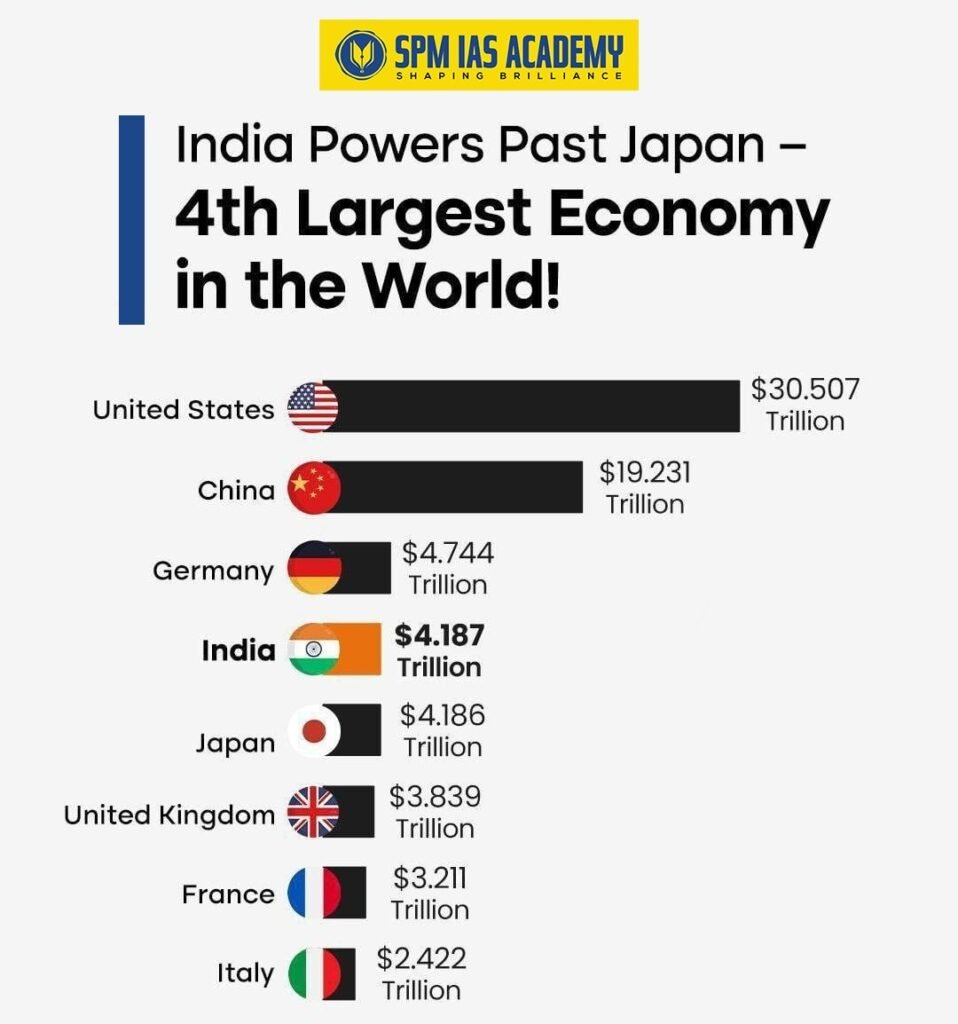
Additionally, India is poised to overtake Germany, which would make it the third-largest economy. It is projected that India’s GDP will reach $7.3 trillion by 2030. This trend highlights India’s ongoing economic growth and development as one of the fastest-growing economies in the world.
In this article, we will look into the 4th largest economy, i.e., India.
India: Fourth-Largest Economy in the World
India has reached a significant milestone by becoming the fourth-largest economy in the world. This shift marks a substantial change in the global economic hierarchy. Consequently, India’s economic growth is driven by robust domestic demand.
Furthermore, the country benefits from a consistent ‘Goldilocks’ economy, characterized by high growth alongside stable inflation. As a result, India now stands behind only the United States, China, and Germany in terms of nominal GDP, valued at $4.18 trillion.
4th Largest Economy in the World: Key Highlights
India is ranked as the 4th largest economy in the world. The latest data comes from the Ministry of Statistics and Programme Implementation (MoSPI). It also includes information from the Press Information Bureau (PIB). These sources released several critical indicators of India’s economic growth.
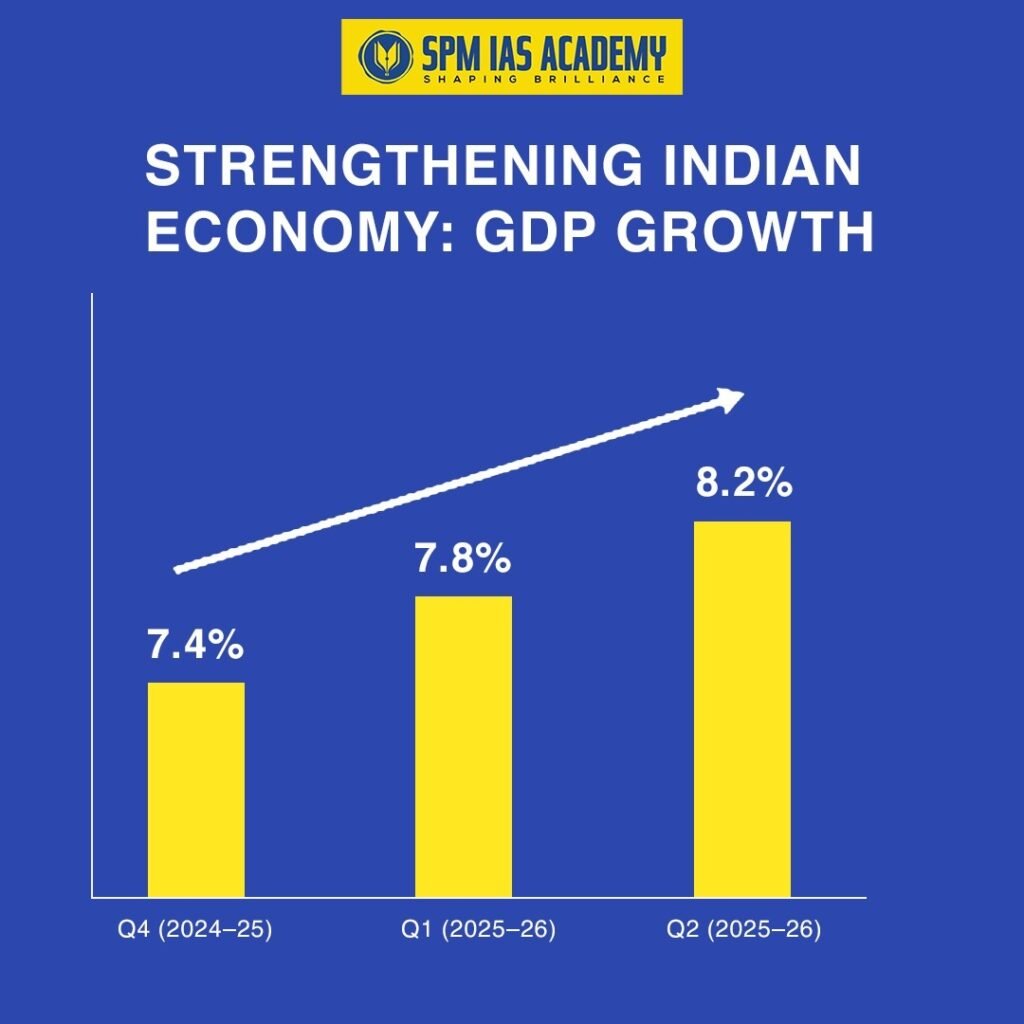
1. Real GDP has been estimated to grow by 8.2% in the second quarter of the financial year 2025-26, up from 7.8% in the first quarter.
2. Nominal GDP growth witnessed a growth rate of 8.7% in the second quarter of the financial year 2025-26.
3. India’s secondary and tertiary sectors show growth of 8.1% and 9.2%, respectively, which has significantly boosted the real GDP growth rate in the second quarter of the financial year 2025-2026.
4. Financial, Real Estate & Professional Services (10.2%) in the tertiary sector has sustained a substantial growth rate at constant prices in Q2 of FY 2025-26.
5. Agriculture and Allied (3.5%) and Electricity, Gas, Water Supply and Other Utility Services Sector (4.4%) have seen moderated real growth rates during Q2 of FY 2025-26.
6. Real Private Final Consumption Expenditure (PFCE) has reported a 7.9% growth rate during Q2 of FY 2025-26 as compared to the 6.4% growth rate in the corresponding period of the previous financial year.
7. According to the MoSPI, the unemployment rate also stood at 4.7% in November 2025, which is the lowest in recent months, supported by a surge in Artificial Intelligence (AI), Machine Learning (ML) and manufacturing sectors.
8. India also witnessed the increment in the merchandise exports to $38.13 billion in November 2025, led by electronics, pharmaceuticals and engineering goods.
World’s Top 5 Economies (2025 Estimates)
| Rank | Country | Estimated GDP (USD) | Economy Status |
| 1 | United States | $31.8 Trillion | First largest |
| 2 | China | $19.5 Trillion | Second Largest |
| 3 | Germany | $5.01 Trillion | Third Largest |
| 4 | India | $4.18 Trillion | Fourth Largest |
| 5 | Japan | $4.11 Trillion | Fifth Largest |
What is India’s Vision 2030?
India is the fourth-largest economy globally. It has a nominal GDP of approximately $4.18 trillion. Furthermore, current projections from the International Monetary Fund’s World Economic Outlook report and S&P Global suggest that India is on track to overtake Germany’s economy. This is expected to happen within the next 2.5 to 3 years. Additionally, India’s GDP is projected to reach $7.3 trillion by 2030. This growth will solidify its economic position as the world’s third-largest economy by that time.
The key driving growth is supported by:
1. Strong Domestic Demand: Strong private consumption and resilient urban demand are the primary drivers of the Indian economy, due to one of the highest demographic dividends, with a population of 1.4 billion, which also possesses a massive productive workforce.
2. Infrastructure and Manufacturing: India’s infrastructure and manufacturing sector are also steadily showing growth in recent years, supported by government initiatives like Make in India and significant capital expenditure (CAPEX) to boost industrial output.
3. According to the State of India’s Digital Economy, India’s digital economy is also rapidly growing, which is expected to account for nearly 20% of the GDP by 2029-30.
4. Robust growth (9%) from the services sector contributes 55%, and moderate growth (3.5%) from agriculture contributes 16-18% to the GDP of India.
Students inspired by India’s growth can begin civil services early by planning UPSC During Graduation with the right strategy.
Conclusion
In conclusion, India has become the fourth-largest economy, boasting a GDP of $4.18 trillion. Furthermore, it is projected to reach $7.3 trillion by 2030. This impressive growth is supported by strong economic trends and various government initiatives. In addition, India’s Vision 2030 highlights its potential for sustained economic advancement.
A strong economy needs capable administrators, and choosing the UPSC & APSC Coaching in Guwahati helps build that leadership.
Frequently Asked Questions
Strong domestic demand, growth in manufacturing, and initiatives like “Make in India” have been key.
India is the fourth-largest economy at around $4.18 trillion, having surpassed Japan, and aims to overtake Germany soon, while the U.S. and China lead.
India’s GDP is expected to reach $7.3 trillion by 2030, making it the third-largest economy, supported by robust domestic demand and advancements in the digital and manufacturing sectors.

Behind every article at SPM IAS Academy is a team of skilled content writers and subject experts committed to making preparation easier for aspirants. From answering common doubts to breaking down complex issues and current affairs, we create content that is accurate, easy to understand, and directly useful for UPSC, APSC, and other competitive exams.