
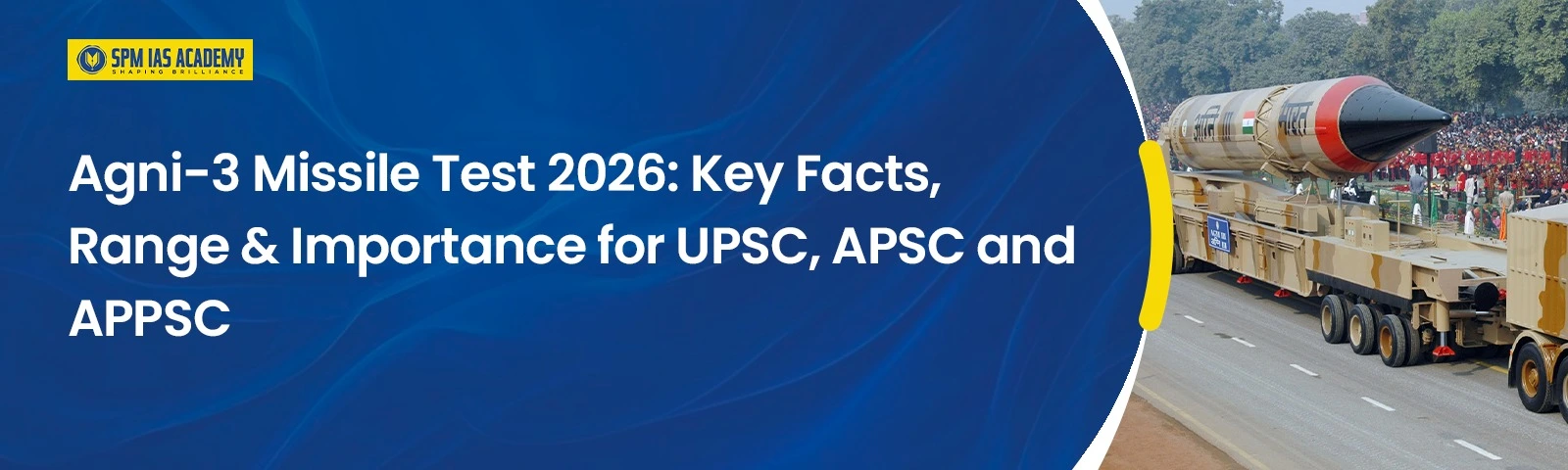
India has once again strengthened its strategic defence capability with the successful test-firing of the Agni-3 Ballistic Missile. The test is highly important for UPSC, APSC, APPSC, and other competitive exams. It covers defence technology, internal security, and nuclear deterrence all key syllabus areas.
Agni-3 Missile Test 2026:
The Intermediate Range Ballistic Missile (IRBM) Agni-3 was successfully test-fired on 06 February 2026 from the Integrated Test Range (ITR), Chandipur, Odisha. Conducted by the Strategic Forces Command, the launch validated all operational and technical parameters, confirming the missile’s reliability as part of India’s nuclear deterrence.
What Is Agni-3 Ballistic Missile?
The Agni-3 missile is an intermediate-range, surface-to-surface ballistic missile. The Defence Research and Development Organisation (DRDO) has developed this missile indigenously. Moreover, its primary purpose is to act as a nuclear delivery system. Therefore, it will play a critical role in India’s strategic defence posture.
Agni-3 Missile Test 2026: Key Highlights:
Test Details at a Glance:
- This ballistic missile was successfully test-fired on 06 February 2026. It marked another important milestone in India’s strategic missile programme.
- The launch was conducted from the Integrated Test Range (ITR) at Chandipur, Odisha. This is a premier missile testing facility that enables precise monitoring and evaluation of flight performance.
- Importantly, the Strategic Forces Command (SFC) used road-mobile launcher to launch the missile. It highlights the operational readiness of India’s nuclear forces during routine training exercises.
- Moreover, the road-mobile launcher significantly enhances survivability, flexibility, and rapid deployment capability during real-time operational scenarios.
- After launch, the missile followed its designated trajectory and accurately homed onto a pre-identified target area in the Bay of Bengal, thereby demonstrating high precision.
- Most importantly, the test aimed to validate all critical operational and technical parameters. Similarly, it also included flight stability, navigation accuracy, propulsion performance, and overall system reliability.
Together, these highlights confirm that this missile system remains fully operational, reliable, and combat-ready. Overall, it will reinforce India’s strategic deterrence capability.
Technical Specifications of Agni-3 Missile:
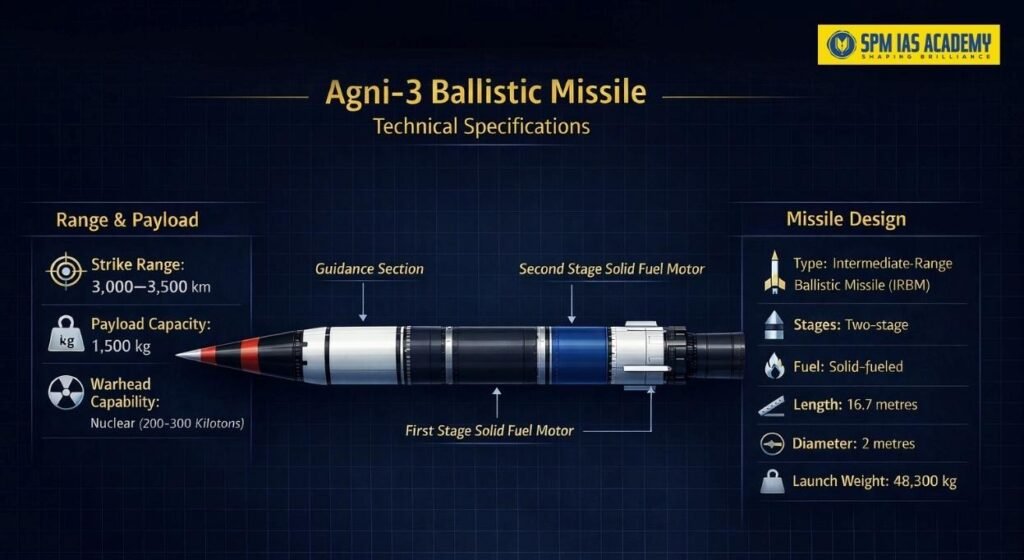
These features allow this missile system to deliver heavy payloads over long distances with high reliability.
Navigation and Accuracy:
According to CSIS, this missile uses a strapdown inertial navigation system (INS) supported by GPS. As a result, the missile achieves an accuracy of around 40 metres Circular Error Probable (CEP), which is extremely precise for a ballistic missile.
Propulsion Technology:
- First Stage: Maraging steel motor case
- Second Stage: Carbon-fibre motor case
- Control System: Thrust Vector Control (TVC)
Together, these technologies improve stability, accuracy, and performance.
What Is Strategic Forces Command (SFC)?
Created on 4th January, 2003, the Strategic Forces Command (SFC) is responsible for managing India’s strategic weapons systems. Furthermore, it also includes nuclear-capable missiles. Also known as Strategic Nuclear Command, it operates under the Nuclear Command Authority. Most importantly, the Indian Nuclear warheads stockpile is under its command. Moreover, it is also responsible for launching the nuclear missile upon the clearance of Nuclear Command Authority.
Why Agni-3 Is Important for India:
First of all, Agni-3 has been in service with the Strategic Forces Command since 2011. Furthermore, it forms a crucial pillar of India’s nuclear deterrence, especially for long-range strike capability. Moreover, its successful test reflects India’s growing indigenous defence technology and strategic autonomy.
Conclusion:
In conclusion, the successful Agni-3 ballistic missile test 2026 from Chandipur highlights India’s robust strategic missile capability. At the same time, it also highlights advanced navigation systems and strong nuclear deterrence framework. Therefore, for the aspirants preparing for UPSC, APSC, APPSC, and other competitive exams, this topic is a must-study topic under defence technology, internal security, and current affairs. Understanding its range, payload, accuracy, and role of Strategic Forces Command will significantly strengthen exam preparation.
Sources:
https://www.pib.gov.in/PressReleasePage.aspx?PRID=2224636®=3&lang=2
Agni-3 is an Intermediate Range Ballistic Missile (IRBM) developed indigenously by India. It is a surface-to-surface, nuclear-capable missile designed to strengthen India’s strategic nuclear deterrence.
India successfully test-fired the Agni-3 missile on 06 February 2026 from the Integrated Test Range (ITR), Chandipur, Odisha, validating all operational and technical parameters.
The missile has a strike range of 3,000–3,500 km and can carry a payload of up to 1,500 kg, making it suitable for long-range strategic missions.
The Strategic Forces Command (SFC) controls and operates the Agni-3 missile. It functions under India’s Nuclear Command Authority and manages the country’s nuclear-capable weapons systems.
This nuclear capable missile is important for UPSC, APSC, and APPSC because it covers defence technology, internal security, nuclear deterrence, DRDO achievements, and current affairs, which are frequently asked in prelims and mains.

Behind every article at SPM IAS Academy is a team of skilled content writers and subject experts committed to making preparation easier for aspirants. From answering common doubts to breaking down complex issues and current affairs, we create content that is accurate, easy to understand, and directly useful for UPSC, APSC, and other competitive exams.