
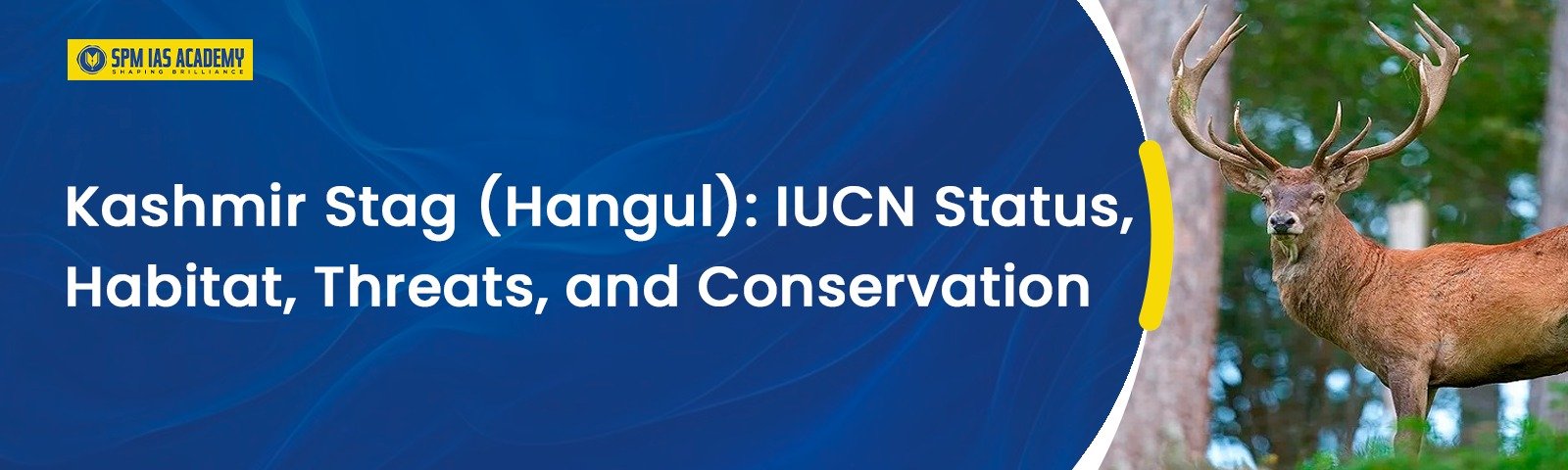
The Kashmir Stag, commonly known as the Hangul, is a critically endangered deer species found only in the Kashmir Valley of India. It is the state animal of Jammu and Kashmir. Scientifically named Cervus hanglu hanglu, the Hangul belongs to the family Cervidae. The Kashmir Stag IUCN status is Critically Endangered (CR) on the IUCN Red List. With a population of fewer than 300 individuals remaining in the wild, the Hangul is one of India’s most endangered large mammals. For UPSC CSE, APSC, and other state PCS aspirants, the Kashmir Stag (Hangul) is an essential topic under Environment, Ecology, and Biodiversity.
Prepare effectively with UPSC & APSC coaching in Assam for strong conceptual clarity in environment and biodiversity topics.
What is Kashmir Stag (Hangul)?
The Kashmir Stag, or Hangul, is a subspecies of the Central Asian Red Deer. It is the only surviving member of the red deer group in the Indian subcontinent. The word Hangul comes from the Kashmiri language, where it means deer. This magnificent animal holds deep cultural and ecological significance for the people of Kashmir.
Furthermore, the Hangul serves as the state animal of Jammu and Kashmir (UT). It is a symbol of the rich biodiversity of the Kashmir Himalaya. However, due to rapid population decline over the past century, conservationists and the government now treat it as a priority species for protection.
Scientific Classification of the Kashmir Stag (Hangul)
- Common Name: Kashmir Stag, Hangul
- Scientific Name: Cervus hanglu hanglu
- Kingdom: Animalia
- Phylum: Chordata
- Class: Mammalia
- Order: Artiodactyla
- Family: Cervidae
- Genus: Cervus
- Species: C. hanglu
- Subspecies: C. h. hanglu (Kashmir Hangul)
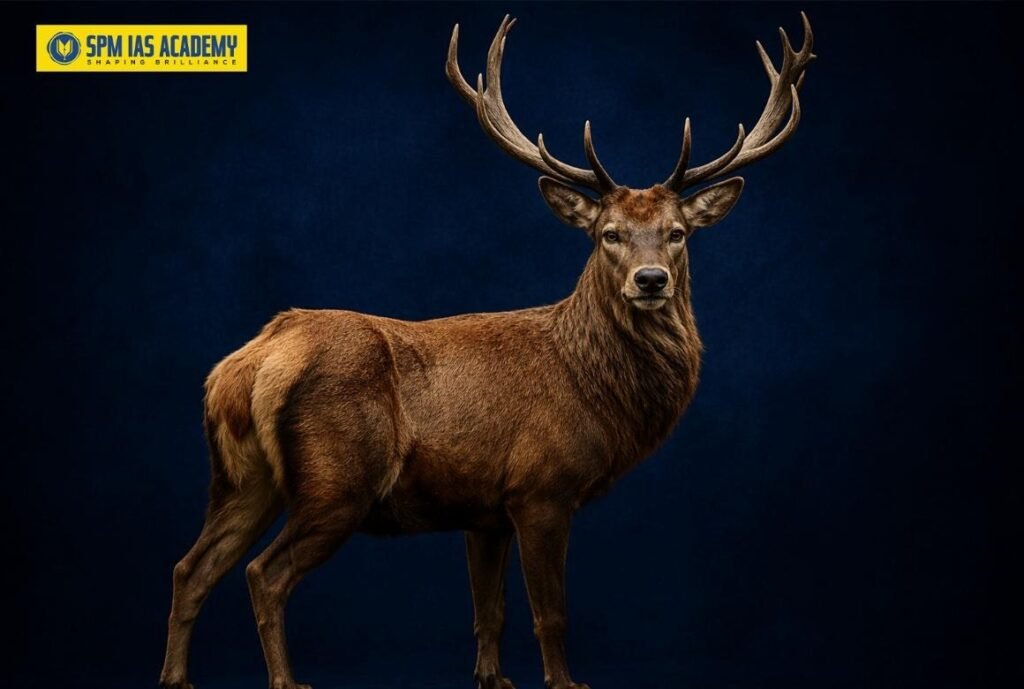
Kashmir Stag IUCN Status: Critically Endangered
The Kashmir Stag IUCN status is Critically Endangered (CR). The International Union for Conservation of Nature (IUCN) lists the Hangul under the Critically Endangered category in its Red List of Threatened Species. This is the highest level of threat for a species that still survives in the wild, just one step away from Extinct in the Wild.
Moreover, the Wildlife Protection Act, 1972 of India also protects the Hangul under Schedule I. Schedule I provides the highest level of legal protection to a species in India. Killing or harming a Schedule I species is a serious criminal offence under Indian law.
Kashmir Stag Population: A Declining Story
The population of the Kashmir Stag has declined drastically over the decades. Here is a brief timeline of the Hangul population trend:
- Early 1900s: Estimated population was over 5,000 individuals.
- 1940s: Population dropped to around 3,000-4,000 due to hunting.
- 1970: Population fell sharply to approximately 150 individuals.
- 2019-2020: The population showed a slight recovery to around 237-289 individuals.
As per recent estimates, approximately 261-289 individuals remain in the wild. This alarming decline in population makes the Kashmir Stag one of the most threatened deer species in Asia. Therefore, urgent conservation action is essential to prevent its extinction.
Physical Features and Appearance of the Kashmir Stag (Hangul)
The Kashmir Stag is a large and majestic deer. Its physical appearance makes it easy to identify in the wild. Here are the key physical features of the Hangul:
Body Size and Weight
- Body Length: 170 to 230 cm (approximately 5.5 to 7.5 feet)
- Shoulder Height: 110 to 120 cm (approximately 3.5 to 4 feet)
- Weight: 170 to 220 kg for males; 100 to 130 kg for females
Distinctive Antlers of the Hangul
The male Kashmir Stag (stag) grows impressive antlers that are one of its most distinctive features. The antlers of the Hangul typically have five or more tines (points). The antlers can span up to 110 cm in large males. Only male Hangul grow antlers. The stags shed and regrow their antlers every year. The Hangul is identifiable by the fact that its antlers have a crown-like structure at the top, which separates it from other deer species.
Coat Colour and Seasonal Changes
Hangul’s coat changes with the seasons. During summer, the coat is reddish-brown with a light yellowish patch on the rump. In winter, the coat becomes greyish-brown and much thicker to protect against the harsh Himalayan cold. This seasonal adaptation helps the animal survive the extreme weather conditions of the Kashmir Valley.
Habitat of the Kashmir Stag (Hangul): Where Does It Live?
The Kashmir Stag (Hangul) lives exclusively in the Kashmir Valley in the Union Territory of Jammu and Kashmir, India. This makes it an endemic species of the region. Historically, the Hangul also existed in parts of Himachal Pradesh and Pakistan-occupied Kashmir. However, today its range has shrunk drastically to only a few protected areas.
Dachigam National Park: The Last Stronghold of the Hangul
- The primary stronghold of the Kashmir Stag is the Dachigam National Park, located just 22 km from Srinagar city.
- The name Dachigam means ten villages in Kashmiri, as the government relocated ten villages to create this protected area. The park covers an area of 141 sq km and lies at altitudes ranging from 1,700 to 4,300 metres above sea level.
- Additionally, Dachigam National Park has two main zones. The Lower Dachigam zone serves as a winter habitat for the Hangul. The Upper Dachigam zone serves as a summer habitat. The deer migrate between these two zones with the change of seasons, following the snowline.
- Besides Dachigam, small populations of the Hangul also exist in the Overa-Aru Wildlife Sanctuary and the Baltal-Sonamarg area in Jammu and Kashmir.
Preferred Habitat Type and Terrain
- The Hangul prefers dense riverine forests, alpine meadows, and subalpine scrub forests. It lives in areas with rich ground vegetation, including grasses, sedges, and shrubs.
- The deer is particularly fond of areas near rivers and streams. It also inhabits mixed conifer and broadleaf forests, especially where willow, maple, walnut, and oak trees grow.
Diet and Feeding Habits of the Kashmir Stag
The Kashmir Stag is a herbivore. It feeds on a wide variety of plant matter depending on the season and availability. Here is what the Hangul eats:
- Grasses and sedges (primary food source in meadows)
- Leaves and shoots of willow, maple, and walnut trees
- Aquatic vegetation near rivers and streams
- Fallen fruits, bark, and twigs during winter when food is scarce
- Flowering plants and herbs during summer in alpine meadows
The Hangul is a ruminant animal. Like cows and buffaloes, it chews its cud. It spends most of the morning and evening hours feeding, and rests during the midday in dense vegetation.
Behaviour and Reproduction of the Hangul
Social Structure and Group Behaviour
The Kashmir Stag is a social animal. Females (hinds) and their young live in groups called herds. Adult males (stags) generally live alone or in small bachelor groups. The stags join the female herds only during the mating season (rutting season).
Hangul is most active during the early morning and late evening hours. During the day, it stays hidden in thick forest cover to avoid predators such as leopards and wolves. It is a shy and alert animal, always vigilant against danger.
Rutting Season and Mating
The rutting (mating) season of the Hangul occurs from September to November each year. During this period, male stags become very active and competitive. They produce loud roaring calls to attract females and warn rival males. Dominant stags fight each other by interlocking their antlers to win the right to mate with females. These fights can be intense but rarely result in serious injury.
Calving Season and Gestation Period
After a gestation period of approximately 242 days (about eight months), female Hangul give birth to a single calf. The calving season falls between May and June each year. Newborn calves have spotted coats, which help them camouflage in dappled forest light. The spots disappear as the calf grows older. The mother nurses the calf for several months before it becomes independent.
Major Threats to the Kashmir Stag (Hangul)
Several serious threats push the Kashmir Stag toward extinction. Understanding these threats is important for UPSC Mains (GS Paper III) and APSC exams, especially for questions on conservation and biodiversity.
1. Poaching and Illegal Hunting
Historically, poaching and illegal hunting caused the greatest damage to the Hangul population. Hunters targeted the Hangul for its antlers, meat, and skin. Even though Schedule I protection under the Wildlife Protection Act, 1972 now makes hunting illegal, sporadic poaching still occurs in remote areas.
2. Habitat Loss and Degradation
The natural habitat of the Hangul has shrunk drastically. Human encroachment, deforestation, and the expansion of agricultural land eat into the forest areas where the deer lives. Additionally, the construction of roads, tourism infrastructure, and military installations near Dachigam National Park disturbs the Hangul’s habitat.
3. Livestock Grazing and Competition for Food
Large numbers of domestic livestock, including sheep, goats, and cattle, graze in and around the Hangul’s habitat. This overgrazing by livestock directly competes with the Hangul for food. Furthermore, livestock also bring diseases that can infect the wild Hangul population. This dual threat of food competition and disease transmission is a serious concern for conservationists.
4. Civil Unrest and Disturbance in Kashmir Valley
The prolonged civil unrest in the Kashmir Valley has also affected the Hangul population. During periods of conflict, armed groups used the forests of Dachigam, leading to disturbance and poaching. Moreover, the movement of security forces and the general disruption of normal life in the region made it difficult to implement effective conservation measures.
5. Climate Change and Changing Snowfall Patterns
Climate change is an emerging threat to the Kashmir Stag. Changes in snowfall patterns affect the seasonal migration of the Hangul between lower and upper Dachigam. Reduced snowfall can alter the availability of food plants in alpine meadows. Additionally, rising temperatures affect the composition of forest vegetation on which the Hangul depends.
Conservation Efforts to Save the Kashmir Stag (Hangul)
Both the government of India and conservation organisations actively work to protect the Kashmir Stag. Here are the major conservation measures in place:
1. Dachigam National Park Protection
The government established Dachigam National Park in 1981 specifically to protect the Hangul and its habitat. The park provides a fully protected area where hunting and human disturbance are strictly prohibited. The J&K Wildlife Protection Department regularly monitors the Hangul population through annual census surveys inside the park.
2. Project Hangul
The government launched Project Hangul as a special conservation initiative for the Kashmir Stag, similar to Project Tiger and Project Elephant. Under this project, authorities work on habitat restoration, anti-poaching measures, and reduction of human-wildlife conflict. The project also includes awareness campaigns for local communities living around Dachigam National Park.
3. Legal Protection Under Wildlife Protection Act, 1972
The Wildlife Protection Act, 1972 places the Hangul in Schedule I, which provides the strongest legal protection. Any person found hunting, capturing, or harming a Hangul faces severe punishment including imprisonment and heavy fines. This legal framework acts as a strong deterrent against poaching.
4. Role of WWF-India and Other Organisations
WWF-India has actively supported Hangul conservation for several decades. The organisation works on habitat management, anti-poaching patrolling, and engaging local communities in conservation. Additionally, organisations like the Wildlife Institute of India (WII) conduct scientific research on Hangul ecology and population dynamics to guide conservation planning.
5. Community-Based Conservation
Involving local communities is one of the most effective ways to protect the Hangul. Conservation programmes now educate villagers living near Dachigam National Park about the importance of the Hangul. Some community members work as wildlife guards and forest watchers, earning a livelihood while protecting the deer. This approach reduces human-wildlife conflict and builds local support for conservation.
Stay updated on wildlife conservation and exam topics through currentaffairs for better preparation and awareness.
Kashmir Stag (Hangul) vs Other Deer Species in India
India is home to several deer species. Students often confuse the Hangul with other deer. Here is a quick comparison to help you distinguish the Kashmir Stag from other important deer species in India:
- Kashmir Stag (Hangul): Found only in Kashmir; IUCN – Critically Endangered; State animal of J&K.
- Barasingha (Swamp Deer): Found in Madhya Pradesh, Assam; IUCN – Vulnerable; State animal of Madhya Pradesh.
- Musk Deer: Found in Himalayan region; IUCN – Endangered; known for musk pod used in perfumes.
- Spotted Deer (Chital): Common across India; IUCN – Least Concern; most widespread deer in India.
- Sambar Deer: Largest deer in India; IUCN – Vulnerable; found across the Indian subcontinent.
- Brow-Antlered Deer (Sangai): Found only in Manipur; IUCN – Endangered; State animal of Manipur.
Conclusion:
The Kashmir Stag (Hangul) is far more than just a state animal of Jammu and Kashmir. It is a symbol of India’s rich biodiversity and the urgent need for wildlife conservation. The Kashmir Stag IUCN status of Critically Endangered (CR) tells us that this magnificent deer stands at the edge of extinction. With fewer than 300 individuals remaining in the wild, every individual Hangul matters for the survival of the species.
For UPSC CSE, APSC, and state PCS aspirants, the Kashmir Stag (Hangul) is a must-know topic. You should remember key facts such as what is Kashmir Stag (Hangul), its scientific name Cervus hanglu hanglu and its habitat. By understanding the Kashmir Stag (Hangul) thoroughly, you not only prepare a single exam topic but also build a strong foundation for questions on endangered species, wildlife sanctuaries, national parks, and biodiversity conservation in India.
Source:
Frequently Asked Questions:
The Kashmir Stag (Hangul) is a critically endangered deer species found only in the Kashmir Valley. Moreover, it serves as the state animal of Jammu and Kashmir and represents the region’s biodiversity. Therefore, conservation of the Hangul is crucial for maintaining ecological balance.
The Kashmir Stag IUCN status is Critically Endangered (CR). As a result, fewer than 300 individuals survive in the wild today. Consequently, it is one of the most endangered deer species in India and requires urgent conservation efforts.
The habitat of the Kashmir Stag (Hangul) is mainly in Dachigam National Park, Jammu and Kashmir. In addition, small populations exist in nearby wildlife sanctuaries. This species prefers dense forests, alpine meadows, and riverine ecosystems.
The major threats to the Kashmir Stag (Hangul) include poaching, habitat loss, livestock grazing, and climate change. Furthermore, human disturbance and declining forest cover significantly reduce its survival chances.
The government has launched Project Hangul and strengthened protection in Dachigam National Park. Additionally, legal protection under the Wildlife Protection Act, 1972 ensures strict action against poaching. Therefore, these combined efforts aim to increase the Hangul population.

Behind every article at SPM IAS Academy is a team of skilled content writers and subject experts committed to making preparation easier for aspirants. From answering common doubts to breaking down complex issues and current affairs, we create content that is accurate, easy to understand, and directly useful for UPSC, APSC, and other competitive exams.