
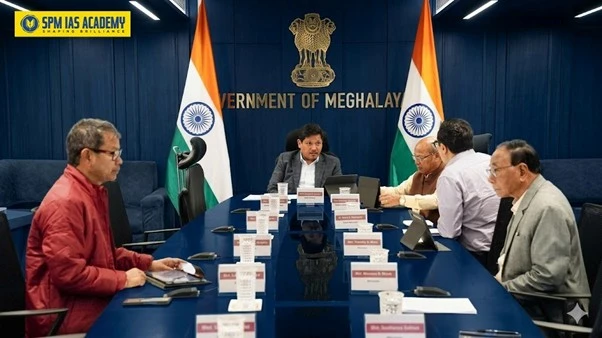
On April 16th, 2026, the Meghalaya cabinet took a decision that many citizens, tribal leaders, and language rights advocates in the state had been waiting for for many years. The cabinet approved the Meghalaya Govt. Language Ordinance, formally known as the Meghalaya Official Languages Ordinance, 2026, grants official language status to Khasi and Garo alongside English. Chief Minister Conrad K. Sangma described the move as historic, and for good reason, it represents the first time both indigenous languages receive full official recognition in the state’s administrative and legislative framework.
This article covers every important aspect of the Meghalaya Govt. Language Ordinance, what the cabinet decided, what changes in governance and education, why it matters politically and constitutionally, and what it means for exam aspirants and citizens across the Northeast.
Key Facts at a Glance
Here are the key facts related to the declaration
| Particulars | Details |
| Date of Cabinet Approval | 16th April 2026 |
| Ordinance Name | Meghalaya Official Languages Ordinance, 2026 |
| New Official Languages | Khasi and Garo (along with English) |
| Act Repealed | Meghalaya State Language Act, 2005 |
| Earlier Status of Khasi & Garo | Associate Official Languages |
| Earlier Status of English | Sole Official Language |
| Constitutional Demand | Inclusion of Khasi and Garo in the Eighth Schedule |
| Chief Minister | Conrad K. Sangma |
| Article Governing State Language Choice | Article 345 of the Constitution of India |
What Is the Meghalaya Govt. Language Ordinance, 2026?
The Meghalaya Govt. Language Ordinance, 2026, is a cabinet-approved ordinance that places Khasi and Garo on the same official footing as English within the state of Meghalaya. Before this ordinance came into force, the Meghalaya State Language Act, 2005, governed the state’s language policy, under which English remained the sole official language while Khasi and Garo carried only the status of associate official languages. The new ordinance repeals that 2005 Act entirely and brings in a broader, more inclusive framework.
The demand for this change had been building for years, particularly among tribal communities who felt that the absence of Khasi and Garo from the state’s official language list was a long-standing gap in recognition. Furthermore, the two languages had also not found a place in the Eighth Schedule of the Constitution of India, which grants national-level recognition to scheduled languages. The Meghalaya Govt. Language Ordinance, 2026, now takes a direct step toward addressing both these concerns at once.
What the Meghalaya Cabinet Decided
Chief Minister Conrad K. Sangma announced the approval of the Meghalaya Govt Language Ordinance in a formal statement, calling it a landmark decision for the people of Meghalaya. Under the new framework, Khasi and Garo can now be used in a much wider range of government communication across the state. However, English will continue to function as the principal link language in state administration. Inter-district communication, file notings, and several formal procedures will largely stay in English even as the scope for using local languages in official settings expands meaningfully.
The chief minister also confirmed that detailed rules will follow, specifying which language will be used in which areas and processes. This phased and structured rollout ensures the transition does not create confusion in day-to-day administration. English, as he put it, will remain a common thread running through state communications while Khasi and Garo take their rightful place alongside it.
What Changes in Governance
The Meghalaya Govt. Language Ordinance opens the door for government notifications and official orders to be issued in all three languages, English, Khasi, and Garo. This is a meaningful shift because it directly improves access to governance for citizens who are more comfortable reading and communicating in their mother tongue rather than in English. For large sections of the population, particularly in rural and tribal areas, this change removes a longstanding communication barrier between the government and the people.
Beyond notifications and orders, the ordinance also sets the stage for changes in the state legislature. The Meghalaya State Legislature (Continuation of the English Language) Act, 1980, will require amendment so that elected representatives can speak and debate in Khasi and Garo during assembly sessions, in addition to English. This is a particularly significant shift because it means that legislators from tribal communities will no longer need to express themselves exclusively in a language that may not be their strongest medium of communication.
Impact on Education and Examinations
One of the most practical and far-reaching effects of the Meghalaya Govt. Language Ordinance is its potential impact on education and competitive examinations. Chief Minister Sangma specifically noted that the move will pave the way for important competitive examinations in the state to be conducted not only in English but also in Khasi and Garo. This has the potential to significantly broaden participation, especially for candidates from rural backgrounds and tribal communities who may have strong subject knowledge but face language-related disadvantages when exams are conducted solely in English.
That said, implementation will take time and will follow a phased approach. Before competitive exams and educational processes can shift meaningfully, the state needs to build robust translation systems, develop bilingual question paper capacities, train manpower, frame detailed rules, and put institutional infrastructure in place. The decision lays the foundation, but the full rollout will happen gradually as these systems come together.
Important Facts for Exams
For students preparing for competitive exams across Assam and the Northeast, the Meghalaya Govt. Language Ordinance is an important current affairs topic. Here is a quick summary of the most exam-relevant facts from this development. The Meghalaya cabinet approved the Meghalaya Official Languages Ordinance, 2026, on April 16th, 2026. Before this ordinance, Khasi and Garo carried only associate official language status, while English was the sole official language of the state. The ordinance repeals the Meghalaya State Language Act, 2005. The move directly strengthens Meghalaya’s long-standing demand to include Khasi and Garo in the Eighth Schedule of the Constitution of India, which would grant them national-level recognition. These are the kinds of specific, date-linked facts that frequently appear in General Awareness sections of state and national competitive exams.
Why the Meghalaya Govt. Language Ordinance Matters Politically
Beyond the immediate administrative changes, the Meghalaya Govt. Language Ordinance carries deep political, constitutional, and cultural significance. Meghalaya has pushed for years to get the Khasi and Garo included in the Eighth Schedule of the Constitution. Inclusion in the Eighth Schedule brings with it national-level recognition, the right of citizens to address Union government offices in these languages, and a stronger institutional standing for the languages in competitive exam frameworks at the national level.
By first elevating Khasi and Garo to full official status within the state, the Meghalaya government is building a stronger case to present to the Union government and Parliament. As Chief Minister Sangma explained, this step sends a clear message to the Government of India that Meghalaya has already accorded its highest state-level recognition to both languages, and therefore, the next logical step is their inclusion in the Eighth Schedule. In this sense, the ordinance is both a language policy reform and a constitutional and political statement about federal recognition, tribal identity, and cultural preservation.
What Are Official State Languages?
It helps to understand the broader constitutional framework around official state languages to fully appreciate why the Meghalaya Govt Language Ordinance matters. Official languages are the languages that a state government uses for administration, legislation, and official communication. Under Article 345 of the Constitution of India, every state has the right to choose its own official language or languages. This is different from the languages listed in the Eighth Schedule, which receive recognition at the national level. A language can be an official state language without being in the Eighth Schedule, and that is precisely the situation Khasi and Garo now find themselves in after this ordinance, they have full official state status but are still awaiting their place in the Eighth Schedule.
Official Languages of Assam
Since this development is closely connected to the broader language rights landscape in Northeast India, it is useful to understand the official language framework in the neighbouring state of Assam as well. Here is a quick look at how Assam structures its official language recognition across regions:
| Language | Status / Region |
| Assamese | Official language of the state |
| Bodo | Official language of the Bodoland Territorial Region (Kokrajhar, Baksa, Udalguri, Chirang, Tamulpur) |
| Bengali | Official language in Barak Valley (Cachar, Karimganj, Hailakandi) |
| Manipuri | Associate Official Language in Cachar, Karimganj, Hailakandi, Hojai |
Note: Assamese received the status of a classical language of India in October 2024, joining Tamil, Sanskrit, Telugu, Kannada, Malayalam, Odia, Marathi, Pali, and Prakrit in this category.
Conclusion
The Meghalaya Govt Language Ordinance, 2026, marks a turning point in the state’s language history. By giving Khasi and Garo full official status alongside English, Meghalaya takes a step that is long overdue and deeply meaningful for its tribal communities. The ordinance sets in motion a gradual but fundamental shift in how governance, legislation, education, and examinations will work in the state. Beyond Meghalaya’s borders, it strengthens the constitutional argument for including both languages in the Eighth Schedule, a demand that now carries far more weight with state-level official recognition behind it. For students, citizens, and policymakers alike, the Meghalaya Govt. Language Ordinance is a development worth understanding closely.
You can also check out SPM IAS Academy for UPSC preparation.FAQs
The correct answer is Article 345 of the Constitution of India. Under Article 345, a state legislature has the authority to adopt by law any one or more languages used in the state, or Hindi, as the official language or languages of that state for all or any official purposes. This is the constitutional provision that gives states the power to choose which languages govern their official communication and administration. It is important to note that Article 343 deals with the official language of the Union (Hindi and English), Article 351 gives directives for the development of the Hindi language, and Article 370 relates to special provisions for Jammu and Kashmir. So, Article 345 is specifically the provision that allows Meghalaya, and every other state to decide its own official languages, which is exactly what the Meghalaya Govt Language Ordinance exercises.
Assamese was officially declared a Classical Language of India in October 2024, when the Union Cabinet approved classical language status for Assamese along with five other languages, which is Marathi, Pali, Prakrit, Bengali, and Odia joining the earlier list that already included Tamil, Sanskrit, Telugu, Kannada, Malayalam, and Odia. Classical language status is granted to languages that have a long documented history and a rich body of ancient literature. For Assam, this recognition was a significant cultural and linguistic milestone, as it placed Assamese alongside some of the oldest and most historically significant languages of the Indian subcontinent. The recognition also brings with it government support for the promotion, preservation, and scholarly study of the language at the national level.

Behind every article at SPM IAS Academy is a team of skilled content writers and subject experts committed to making preparation easier for aspirants. From answering common doubts to breaking down complex issues and current affairs, we create content that is accurate, easy to understand, and directly useful for UPSC, APSC, and other competitive exams.