
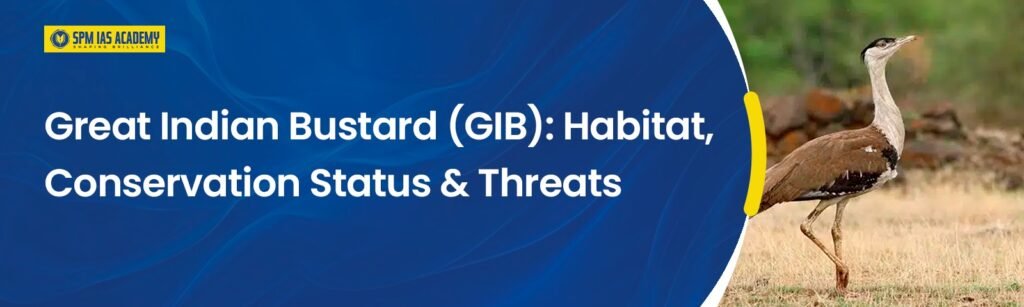
The Great Indian Bustard (GIB) is one of India’s most iconic yet critically endangered bird species. Often referred to as the flagship species of India’s grassland ecosystem, the Great Indian Bustard holds immense ecological, conservation, and examination significance. For aspirants preparing for UPSC, APSC, and other State PSC examinations, this species frequently appears in Prelims, GS Paper III, and Environment sections.
Aspirants preparing Environment topics can strengthen concepts through UPSC coaching in Assam with expert guidance.
About Great Indian Bustard (GIB):
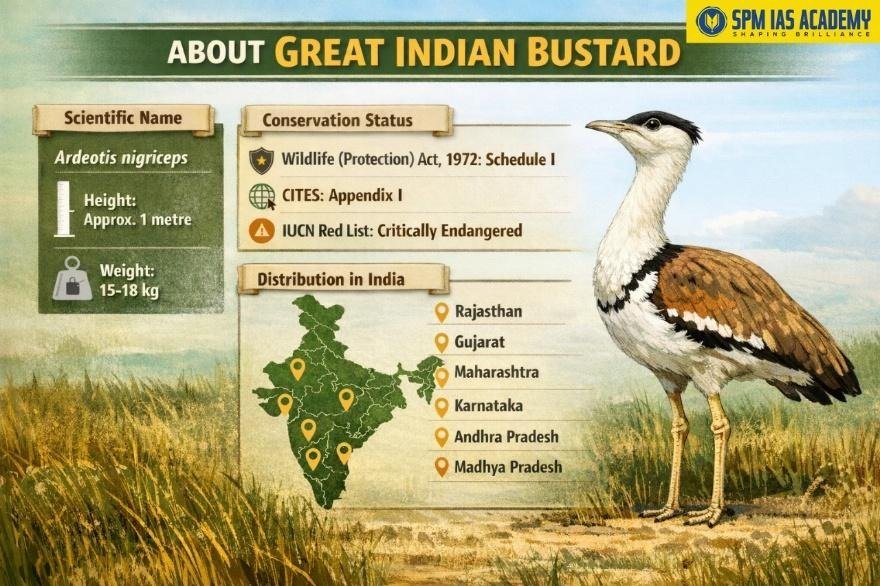
The Great Indian Bustard (Ardeotis nigriceps) is among the heaviest flying birds in the world. India hosts the largest remaining population of this species. It is the state bird of Rajasthan. Historically, the bird occupied vast grassland and semi-arid regions across the Indian subcontinent. However, due to rapid habitat loss and human-induced threats, its population has declined sharply. As a result, conservation of the Great Indian Bustard has become a national and international priority.
Scientific Classification:
- Kingdom: Animalia
- Class: Aves
- Order: Otidiformes
- Family: Otididae
Habitat and Distribution of the Great Indian Bustard (GIB):
The Great Indian Bustard prefers open grasslands, scrublands, and semi-arid landscapes. These habitats allow the bird to spot predators easily and forage efficiently.
Present Distribution of Great Indian Bustard in India:
Currently, the species survives in fragmented pockets across:
- Rajasthan (largest population)
- Gujarat
- Maharashtra
- Karnataka
- Andhra Pradesh (very small numbers)
The most important stronghold of the species lies within Desert National Park, which supports the only viable wild breeding population.
Physical Characteristics:
The Great Indian Bustard has a tall posture and a robust body. It displays:
- A black crown and pale neck
- Brownish body with white underparts
- Long legs adapted for terrestrial movement
Notably, males grow significantly larger than females. During the breeding season, males perform elaborate courtship displays to attract females.
Diet and Behaviour:
The Great Indian Bustard is omnivorous by nature. It feeds on:
- Grass seeds and grains
- Insects such as beetles and grasshoppers
- Small reptiles and rodents
Importantly, the bird spends most of its time walking rather than flying. Consequently, it becomes extremely vulnerable to ground-level and overhead human activities.
Conservation Status:
- IUCN Red List: Critically Endangered
- Wildlife Protection Act, 1972: Schedule I
- CITES: Appendix I
These classifications provide the highest level of legal protection. Despite this, the species continues to face existential threats.
Major Threats to the Great Indian Bustard:
- Habitat Loss: First and foremost, rapid conversion of grasslands into agricultural fields, infrastructure projects, and industrial zones has destroyed the bird’s natural habitat.
- Power Transmission Lines: Power lines pose the single biggest threat to the species today. Due to poor frontal vision, Great Indian Bustards often collide with overhead wires, leading to fatal injuries.
- Renewable Energy Expansion: Although renewable energy is environmentally beneficial, large-scale wind and solar projects installed in bustard habitats have fragmented grasslands and increased mortality risks.
- Low Reproductive Rate: The species lays only one egg per breeding season. As a result, population recovery remains extremely slow even under conservation protection.
Conservation Efforts in India:
- Species Recovery Programme:
- The Government of India has included the Great Indian Bustard under its Species Recovery Programme, which aims to stabilize and increase its population.
- Captive Breeding Programme:
- India launched a conservation breeding initiative in Rajasthan and Gujarat. The programme focuses on Artificial incubation, Controlled rearing and Future reintroduction into the wild.
- Supreme Court Intervention:
- The Supreme Court of India directed authorities to:
- Underground power lines in priority bustard habitats.
- Install bird diverters where undergrounding is not feasible
- The Supreme Court of India directed authorities to:
This landmark intervention strengthened species-specific conservation in India.
Why the Great Indian Bustard Matters Ecologically:
The Great Indian Bustard acts as an umbrella species. When authorities protect its habitat, several other grassland species benefit simultaneously. Therefore, conserving the Great Indian Bustard indirectly preserves India’s fast disappearing grassland ecosystems.
Conclusion:
In conclusion, the Great Indian Bustard symbolizes the fragile state of India’s grassland biodiversity. While India has taken strong legal and institutional measures, long-term survival of the species depends on habitat protection, scientific planning, and sustainable development models. For civil services aspirants, understanding the Great Indian Bustard goes beyond memorization. It offers a powerful case study of conservation vs development, making it a high-value topic for both Prelims and Mains.
Improve biodiversity and conservation preparation through UPSC coaching in north east India with structured mentorship.
Sources:
Frequently Asked Questions:
The Great Indian Bustard is critically endangered due to rapid grassland habitat loss, frequent collisions with overhead power transmission lines, expansion of renewable energy projects in its habitat, and its very low reproductive rate of laying only one egg per breeding season.
The Great Indian Bustard is found in fragmented populations across Rajasthan, Gujarat, Maharashtra, Karnataka, Andhra Pradesh, and Madhya Pradesh, with its most important breeding stronghold located in Desert National Park.
The Great Indian Bustard is listed as Critically Endangered on the IUCN Red List, placed under Schedule I of the Wildlife (Protection) Act, 1972, and included in Appendix I of CITES, providing it the highest level of legal protection.
The Great Indian Bustard is important for UPSC and State PSC exams because it links biodiversity conservation, grassland ecosystems, renewable energy challenges, Supreme Court interventions, and species recovery programmes, making it relevant for Prelims and GS Paper III.
India has launched a Species Recovery Programme, initiated captive breeding projects in Rajasthan and Gujarat, and implemented Supreme Court directions to underground power lines and install bird diverters in priority Great Indian Bustard habitats.