
The India–AI Impact Summit 2026 is a landmark global event that places Artificial Intelligence (AI) at the centre of India’s development journey. Scheduled from 16 to 20 February 2026 at Bharat Mandapam, New Delhi, the summit will be the first global AI summit hosted in the Global South. It will focus on inclusive growth, responsible AI governance, and practical AI deployment aligned with India’s vision of Viksit Bharat 2047.
For UPSC, APSC, and Arunachal Pradesh PCS aspirants, this topic is extremely important for Science & Technology, Governance, Economy, and Ethics, as well as for essay and interview preparation.
What is the India–AI Impact Summit 2026?
The India–AI Impact Summit 2026 is a high-level, five-day global conference dedicated to exploring the transformative potential of Artificial Intelligence (AI) in shaping governance, economic growth, and sustainable development. Scheduled to be held from 16–20 February 2026 at Bharat Mandapam, New Delhi, the summit marks a historic milestone. It will be the first global AI summit hosted in the Global South.
The summit will serve as a comprehensive international platform that brings together a wide spectrum of stakeholders, including:
- Global political leaders and government representatives
- Policymakers and regulators
- Leading technology companies and startups
- Researchers, academicians, and AI innovators
- Industry experts and institutional stakeholders
Through structured discussions, exhibitions, policy dialogues, and collaborative sessions, the summit will examine how AI can strengthen governance systems, enhance public service delivery, accelerate innovation, and drive inclusive economic growth. It aims to move beyond theoretical discussions and focus on practical, development-oriented applications of AI that can deliver measurable social and economic outcomes.
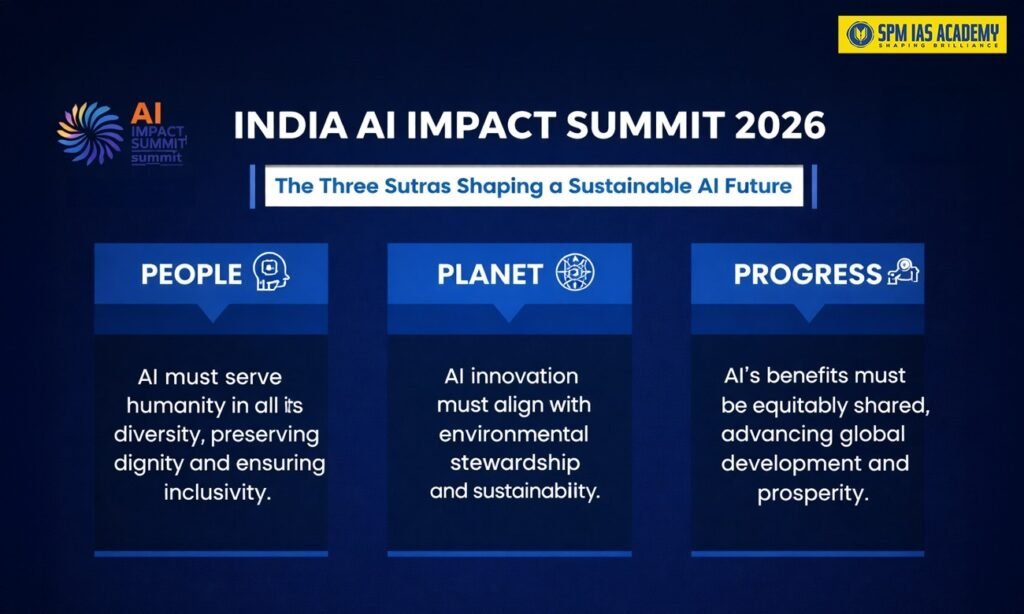
A defining feature of the summit is its guiding framework based on three foundational pillars, referred to as the “Sutras” — a Sanskrit term meaning guiding principles. These Sutras provide a philosophical and strategic direction to the summit:
- People – Prioritising human-centric AI that empowers citizens, enhances access to services, and promotes social inclusion.
- Planet – Ensuring that AI development supports environmental sustainability and responsible resource use.
- Progress – Leveraging AI to drive economic advancement, technological innovation, and institutional efficiency.
Together, these three Sutras establish a balanced and inclusive vision for AI development. Moreover, this aligns technological advancement with social welfare, environmental responsibility, and long-term national progress.
Key Highlights of the India–AI Impact Summit 2026:
- First global AI summit hosted in the Global South.
- Organised under the IndiaAI Mission and Digital India Initiative.
- India AI Impact Expo with 300+ exhibitors from 30+ countries.
- 10+ thematic pavilions covering governance, industry, research and public engagement.
- Focus on ethical, inclusive and responsible AI.
Why is AI Important for India?
Artificial Intelligence is not just a technology trend. It is a strategic enabler of development. Artificial Intelligence supports India in three major ways:
1. AI for People:
AI empowers citizens by:
- Expanding healthcare access through telemedicine.
- Personalizing education with adaptive learning platforms.
- Securing digital payments through fraud detection systems.
- Delivering services in regional languages.
Moreover, AI improves last-mile delivery and strengthens citizen-centric governance.
2. AI for Planet:
AI promotes sustainable development by:
- Enabling precision farming.
- Predicting crop diseases and weather patterns.
- Supporting climate modelling.
- Optimizing energy and resource usage.
Thus, AI supports environmental sustainability along with economic growth.
3. AI for Progress:
AI enhances governance and economic productivity by:
- Translating court judgments into regional languages.
- Improving case management in judiciary.
- Optimizing traffic and waste management in smart cities.
- Enhancing logistics, mobility and digital services.
Therefore, AI drives inclusive and technology-enabled progress.
What is the Sector-Wise Impact of AI in India?
AI in Healthcare:
AI strengthens healthcare access, especially in rural and underserved areas.
- Remote diagnostics and portable tools detect diseases early.
- AI-based medical imaging identifies TB and cancer quickly.
- Predictive analytics forecast disease outbreaks.
- AI accelerates drug discovery and personalized treatment.
As a result, AI reduces costs and improves healthcare outcomes.
AI in Agriculture and Rural Economy:
AI transforms farming practices through data-driven insights.
- Weather prediction and pest alerts guide farmers.
- Drones monitor crop health.
- Satellite data supports harvest forecasting.
- Market prediction models help farmers plan better.
Initiatives like Kisan E-Mitra provide localized agricultural advisories in regional languages. This strengthens rural income and food security.
AI in Education and Learning:
AI makes education more inclusive and personalized.
- Adaptive learning platforms support individual student needs.
- AI-based translation removes language barriers.
- AI tutoring systems provide 24/7 support.
- Platforms like DIKSHA deliver accessible content.
Thus, AI democratizes quality education.
AI in Finance and Commerce:
AI strengthens financial inclusion and digital security.
- Real-time fraud detection protects transactions.
- AI credit scoring expands loan access.
- Chatbots provide instant banking services.
- Personalized financial advice improves customer experience.
Consequently, AI deepens digital financial inclusion in India.
AI in Governance and Public Services:
AI improves transparency and efficiency.
- Moreover, translation of court judgments enhances access to justice.
- On the other hand, AI streamlines scheme approvals and service delivery.
- Smart city systems optimize traffic and waste management.
- AI supports policy decisions through data analytics.
Therefore, AI strengthens digital governance.
Foundational Framework: Three Sutras and Seven Chakras
The India-AI Impact Summit 2026 will follow a structured framework based on:
The Three Sutras:
- People – Empowering citizens through AI.
- Planet – Ensuring sustainability.
- Progress – Driving economic and governance transformation.
These Sutras guide AI development for collective global benefit.
The Seven Chakras of Global AI Collaboration:
The summit discussions will be structured around seven Chakras, which translate the guiding Sutras into clear and actionable areas of multilateral cooperation. In essence, these Chakras convert broad principles into practical themes for implementation. They focus on key dimensions such as human capital development, social inclusion, trust and safety in AI systems. Together, these interconnected themes will guide global collaboration and ensure that AI initiatives deliver measurable and inclusive outcomes.
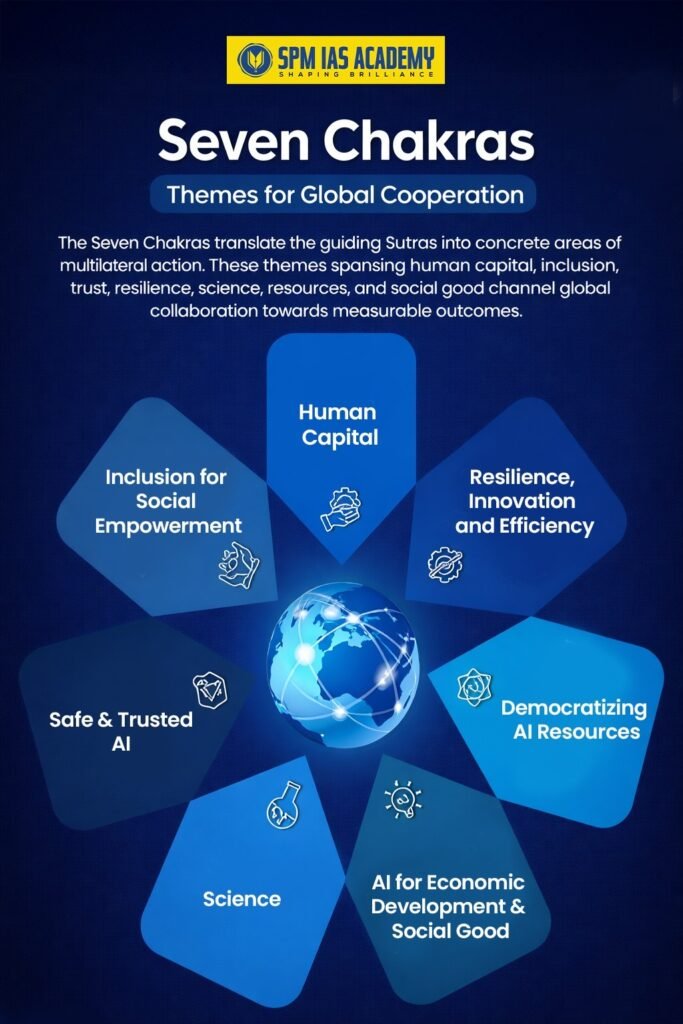
1. Human Capital:
Focuses on AI skilling and reskilling to prepare India’s workforce for the AI economy.
2. Inclusion for Social Empowerment:
Promotes citizen-centric AI solutions and last-mile service delivery.
3. Safe and Trusted AI:
Strengthens responsible AI governance and public trust.
4. Resilience, Innovation and Efficiency:
Ensures environmentally sustainable AI growth.
5. Science:
Uses AI to accelerate research in health, agriculture, and climate science.
6. Democratizing AI Resources:
Expands access to compute infrastructure, datasets, and AI tools for startups and researchers.
7. AI for Economic Growth & Social Good:
Promotes inclusive economic growth and socially impactful AI use cases.
Together, these Chakras provide a structured framework for global cooperation.
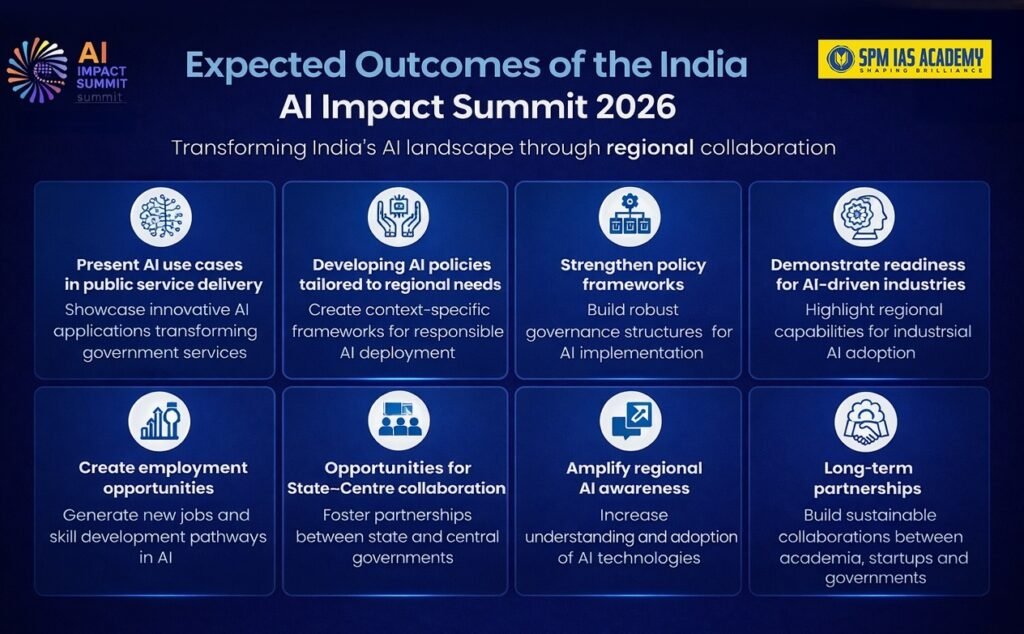
Expected Outcomes of the India-AI Impact Summit 2026:
- Firstly, showcasing AI use cases in public service delivery: The summit will present innovative and practical AI applications that are already transforming governance, improving efficiency, and enhancing citizen-centric services.
- Secondly, developing region-specific AI policy frameworks: It will encourage the creation of context-driven AI policies tailored to regional needs, ensuring responsible, inclusive, and sustainable deployment.
- Moreover, strengthening AI governance structures: The summit will work towards building robust regulatory and institutional frameworks to support secure and ethical AI implementation.
- In addition, demonstrating readiness for AI-driven industries: It will highlight regional and national capabilities in adopting AI across manufacturing, services, agriculture, and emerging industrial sectors.
- Furthermore, generating employment and skill opportunities: By promoting AI adoption, the summit aims to create new job roles and expand skilling and reskilling pathways aligned with the future AI economy.
- Simultaneously, fostering State–Centre collaboration: It will provide a platform for enhanced cooperation between central and state governments to align AI strategies and ensure coordinated implementation.
- Additionally, amplifying regional AI awareness: The summit will increase understanding of AI technologies among stakeholders, encouraging broader adoption across sectors.
- Finally, building long-term institutional partnerships: It will promote sustained collaboration between governments, academia, startups, research institutions, and industry to strengthen India’s AI ecosystem over the long term.
Conclusion:
The India-AI Impact Summit 2026 marks a turning point in India’s AI journey. It highlights Artificial Intelligence as a strategic enabler for governance reform, economic transformation, and sustainable development. By focusing on the Three Sutras – People, Planet and Progress, and Seven Chakras of collaboration, the summit promotes responsible, inclusive and development-oriented AI.
For UPSC, APSC and Arunachal Pradesh PCS aspirants, understanding the India AI Impact Summit 2026, IndiaAI Mission, AI in governance and ethical AI frameworks is essential for exam success.
As India moves towards Viksit Bharat 2047, Artificial Intelligence will play a central role in shaping policy, public service delivery, and national competitiveness. Therefore, mastering this topic will give aspirants a strong edge in Prelims, Mains, and Interview stages.
Source:
https://www.pib.gov.in/PressReleasePage.aspx?PRID=2216805®=3&lang=1
The India–AI Impact Summit 2026 is a global AI conference scheduled from 16–20 February 2026 at Bharat Mandapam, New Delhi. It is the first global AI summit hosted in the Global South. The summit focuses on AI in governance, inclusive growth, and sustainable development under the IndiaAI Mission and Digital India initiative.
The summit is highly relevant for UPSC, APSC, and Arunachal Pradesh PCS exams. It covers key topics such as Artificial Intelligence, digital governance, inclusive development, ethical AI, and economic growth. Therefore, it is important for GS Paper 3, essay writing, and interview preparation.
The summit is guided by three foundational pillars called the Three Sutras:
People – Human-centric and inclusive AI.
Planet – Sustainable and environmentally responsible AI.
Progress – AI-driven economic and governance transformation.
These Sutras shape India’s responsible AI development strategy.
The Seven Chakras of AI collaboration include Human Capital, Inclusion, Safe and Trusted AI, Resilience, Science, Democratizing AI Resources, and AI for Economic Growth & Social Good. Together, these Chakras convert AI principles into practical policy and governance actions.
The summit will strengthen AI governance frameworks and promote AI adoption in healthcare, agriculture, education, finance, and public services. Moreover, it will create AI jobs, improve digital public infrastructure, and support India’s vision of Viksit Bharat 2047.