NASA’s Artemis II mission, set to launch on April 1, 2026, will send four astronauts on a 10-day journey around the Moon. This is the first crewed lunar mission in over 50 years. This historic mission is highly relevant for UPSC CSE 2026 Prelims and Mains GS Paper III (Science and Technology) and international affairs.
In this article, we break down everything you need to know about NASA’s Artemis 2 mission.
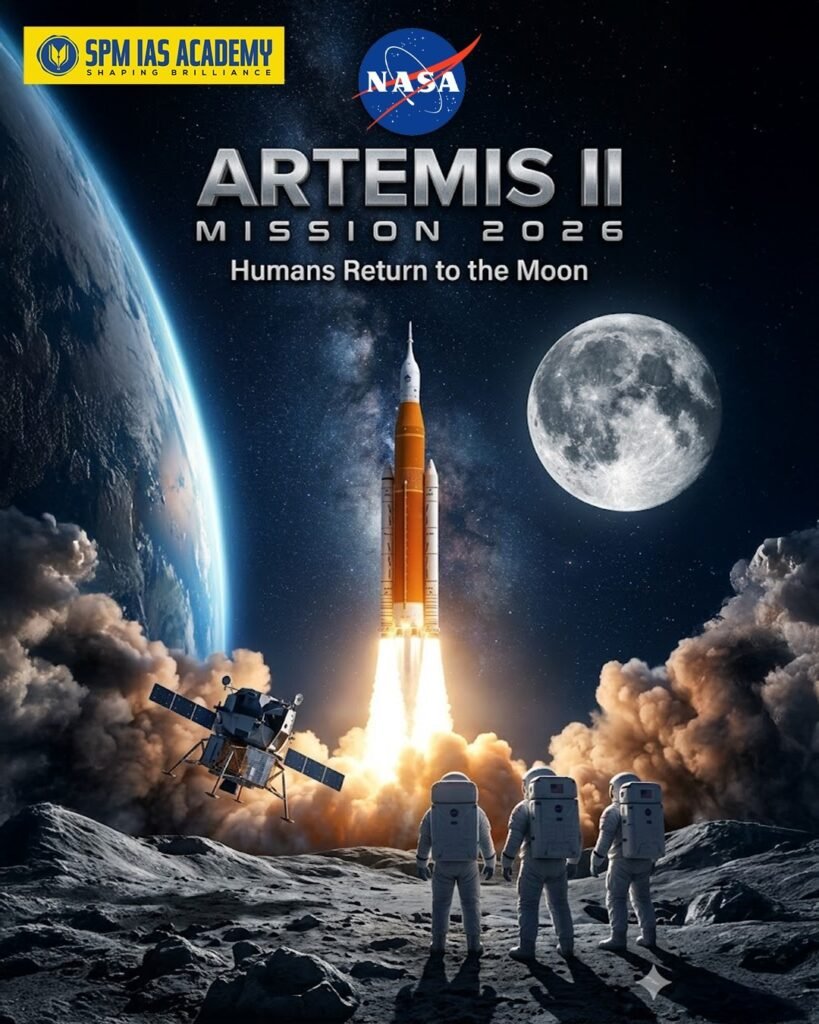
What Is NASA’s Artemis II Mission? — Complete Overview
The Artemis programme is NASA’s flagship human spaceflight initiative. Its ultimate goal is to build a sustainable human presence on and around the Moon, and eventually use that as a stepping stone for crewed missions to Mars.
Key Mission Facts at a Glance:
| Parameter | Details |
| Mission Name | Artemis II (Artemis 2) |
| Launch Date | April 1, 2026 |
| Launch Site | Kennedy Space Center, Florida, USA |
| Mission Type | Crewed Lunar Flyby (not a landing) |
| Mission Duration | Approximately 10 days |
| Crew Size | 4 astronauts |
| Rocket Used | SLS — Space Launch System |
| Spacecraft | Orion Crew Capsule |
| Splashdown | Pacific Ocean, April 10, 2026 |
| Last Crewed Lunar Mission | Apollo 17 — December 1972 |
Artemis II builds directly on the success of the uncrewed Artemis 1 mission in 2022. However, this time, four real astronauts will board the Orion spacecraft. Therefore, it marks NASA’s first crewed test flight of the SLS rocket and Orion capsule. It is the most powerful launch system America has built since the Saturn V of the Apollo era.
Meet the Artemis II Astronauts: Who Are They?
The Artemis II crew consists of four astronauts, each bringing unique expertise to this historic mission. Together, they represent a diverse mix of experience, nationality, and background.
1. Reid Wiseman — Mission Commander
Reid Wiseman is a retired U.S. Navy captain and test pilot. He also served as NASA’s Chief Astronaut before this mission. As commander, he leads the entire crew throughout the 10-day journey.
2. Victor Glover — Pilot
Victor Glover is a Navy captain and experienced test pilot. Notably, he became the first Black astronaut to live and work long-term aboard the International Space Station (ISS). As pilot, he handles the navigation and flight operations of the Orion spacecraft.
3. Christina Koch — Mission Specialist
Christina Koch is an engineer and holds the world record for the longest single spaceflight by a woman. She will be the first woman to travel to the Moon’s vicinity. Her expertise lies in systems operations and scientific experiments.
4. Jeremy Hansen — Mission Specialist (Canadian Space Agency)
Jeremy Hansen is an astronaut from the Canadian Space Agency (CSA). This will be his first spaceflight. His inclusion highlights the role of international partnerships in NASA’s Artemis programme. Importantly, he will become the first non-American to travel to the Moon’s vicinity.
The SLS Rocket: NASA’s Most Powerful Launch Vehicle
The Space Launch System (SLS) is the rocket that will carry the Artemis II crew into space. Standing 322 feet (about 98 metres) tall, it is taller than the Statue of Liberty. Moreover, it is the most powerful rocket NASA has built since the Saturn V rocket that carried Apollo astronauts to the Moon.
The SLS is designed to send astronauts, the Orion spacecraft, and cargo directly to the Moon in a single launch. No other operational rocket in the world currently matches this capability. It uses two solid rocket boosters and four RS-25 main engines, the same engines used on the Space Shuttle programme.
Furthermore, the SLS is part of NASA’s broader deep-space exploration architecture, which will eventually support missions beyond the Moon and toward Mars.
The Orion Spacecraft: Humanity’s New Deep-Space Vehicle
The Orion spacecraft serves as the crew’s home, control room, and lifeboat throughout the entire 10-day journey. It is NASA’s first deep-space crew vehicle since the Apollo capsule of the 1960s and 70s.
Orion is packed with advanced technology, including:
- A Launch Abort System (LAS) that can pull the crew to safety within milliseconds in case of a rocket failure during launch.
- The largest heat shield ever built for a crewed spacecraft, protecting astronauts as they re-enter Earth’s atmosphere at approximately 25,000 miles per hour.
- Advanced life-support systems that will be tested for the first time with a crew on board during Artemis II.
- Radiation shielding designed to protect the crew in the harsh deep-space environment beyond Earth’s protective magnetic field.
- Solar array wings that generate power for the spacecraft after separation from the SLS rocket.
In addition to these safety systems, the Orion capsule will re-enter the atmosphere at lunar return speeds – something no crew spacecraft has done since the Apollo programme. This makes Artemis II a critical proving flight before astronauts attempt an actual lunar landing in Artemis 3.
Artemis II Mission Timeline: Day-by-Day Schedule
The Artemis II mission follows a carefully planned 10-day schedule. Here is a simplified timeline of key events:
| Date | Event |
| April 1, 2026 | Launch from Kennedy Space Centre – SLS lifts off with crew aboard Orion |
| April 2, 2026 | Translunar Injection (TLI) burn – spacecraft heads toward the Moon |
| April 3-5, 2026 | Journey to the Moon – crew conducts experiments, downlink events, and checks life support systems |
| April 6, 2026 | Historic Lunar Flyby – crew surpasses Apollo 13 record (248,655 miles from Earth) as farthest humans from Earth |
| April 7, 2026 | Crew speaks with ISS astronauts via audio call; begins return journey to Earth |
| April 8-9, 2026 | Return trajectory – crew press conference and final mission activities |
| April 10, 2026 | Splashdown in the Pacific Ocean – mission complete |
What Are the Artemis Accords? India’s Role Explained
The Artemis Accords are a set of bilateral agreements led by the United States through NASA. They establish a common framework for peaceful, responsible, and transparent exploration of the Moon, Mars, and beyond. Countries that sign these accords agree to follow shared principles rooted in the 1967 Outer Space Treaty.
Significantly, India signed the Artemis Accords in June 2023. This was a landmark step in Indo-US space cooperation. As a result, India and NASA now work more closely on joint missions, including the NISAR (NASA-ISRO Synthetic Aperture Radar) satellite project. The NISAR satellite, launched in early 2025, will provide detailed data on Earth’s surface for climate and disaster monitoring.
As of 2026, more than 45 countries have signed the Artemis Accords, making it one of the most widely supported space governance frameworks in history.
Why Is the Artemis II Mission Significant?
The Artemis 2 mission breaks several important records and sets powerful precedents:
- Firstly, Artemis II will be the first crewed mission beyond Earth orbit since Apollo 17 in December 1972, ending a gap of more than 53 years.
- Moreover, the mission will mark a historic milestone as Christina Koch becomes the first woman to travel to the Moon’s vicinity.
- In addition, Victor Glover will become the first person of colour to travel to the Moon’s vicinity, highlighting greater diversity in space exploration.
- Furthermore, Jeremy Hansen of Canada will be the first non-American astronaut to travel to the Moon’s vicinity, strengthening international collaboration.
- Notably, the mission will conduct the first live test of the Orion spacecraft’s life-support systems with astronauts onboard, which is crucial for future missions.
- Finally, if launched on April 1, the crew is expected to break the Apollo 13 record by traveling more than 248,655 miles from Earth, making it the farthest distance humans have ever reached.
Additionally, the mission lays the groundwork for Artemis 3, which aims to land astronauts on the lunar South Pole – a region rich in water ice deposits. These deposits could provide drinking water, oxygen for breathing, and hydrogen for rocket fuel, which are essential for long-term lunar habitation.
Beyond the Moon, NASA also plans to use this programme as preparation for future crewed missions to Mars. Therefore, Artemis 2 is not just a Moon mission. It is the foundation of humanity’s multi-planetary future.
Why NASA Artemis II Matters for UPSC 2026
Humanity is going back to the Moon. After more than five decades, NASA is preparing to send astronauts beyond Earth orbit once again. On April 1, 2026, the Artemis II mission will launch from Kennedy Space Centre in Florida. It will carry four astronauts on an approximately 10-day journey that swings around the Moon and returns them safely to Earth.
Furthermore, this mission is not just a scientific milestone. It is a major event in global space policy, international cooperation, and technological advancement. As a result, every UPSC CSE, APSC, and State PCS aspirant must understand the Artemis programme in detail. Space technology, international treaties like the Artemis Accords, and India’s cooperation with NASA through ISRO are all topics that regularly feature in competitive examinations.
India and NASA: Growing Space Cooperation in 2026
India’s relationship with NASA has grown significantly over the past decade. Several milestones mark this strengthening partnership:
- NISAR Satellite (NASA-ISRO): A joint Earth observation satellite using dual-frequency Synthetic Aperture Radar (SAR). It will map Earth’s surface every 12 days and generate massive amounts of data on glaciers, earthquakes, forests, and sea levels.
- Artemis Accords (Signed June 2023): India officially joined the Artemis Accords framework, aligning its space exploration goals with those of the US and 45+ partner nations.
- Chandrayaan-3 and Lunar Cooperation: India’s successful Chandrayaan-3 landing near the Moon’s South Pole in August 2023 positions ISRO as a key partner for future lunar surface missions.
- Astronaut Training Exchange: Indian astronaut Shubhanshu Shukla trained with NASA as part of the Axiom Mission 4 to the ISS in 2025, further deepening human spaceflight ties.
- ISRO’s Vision 2040: India plans to establish a lunar station by 2040, which aligns directly with NASA’s Artemis Base Camp concept.
Conclusion:
To summarise, the NASA Artemis II mission is one of the most important science and technology events of 2026. It represents the return of humans to deep space, the first crewed lunar flyby in over 50 years, and a defining moment in global space exploration history.
For UPSC CSE 2026, APSC, and other State PCS examinations, the Artemis II mission is essential current affairs. It connects directly to GS Paper III (Science & Technology – space exploration, SLS rocket, Orion spacecraft, life-support systems), GS Paper II (International Relations – Artemis Accords, Indo-US space cooperation, NISAR satellite), and Essay papers on space, technology, and India’s global role.
Moreover, India’s growing partnership with NASA through ISRO, the Artemis Accords, the NISAR satellite, and India’s own Chandrayaan and Gaganyaan programmes mean that space policy is increasingly a domestic and foreign policy issue for India. Consequently, aspirants who understand the Artemis programme will be better prepared for interview rounds and essay papers as well.
Source:
FAQ:
The Artemis II mission is NASA’s first crewed lunar mission in over 50 years. It will send four astronauts on a 10-day journey around the Moon without landing. Therefore, it marks a major step in human space exploration.
NASA plans to launch Artemis II on April 1, 2026, from the Kennedy Space Center in Florida. Moreover, this mission will be the first crewed flight of the SLS rocket and Orion spacecraft.
The Artemis II crew includes Reid Wiseman, Victor Glover, Christina Koch, and Jeremy Hansen. Notably, the mission includes the first woman and the first non-American astronaut to travel to the Moon’s vicinity.
The Artemis 2 mission is important because it is the first crewed mission beyond Earth orbit since Apollo 17 in 1972. In addition, it will test life-support systems and prepare for future Moon landings and Mars missions.
India joined the Artemis Accords in 2023, strengthening cooperation with NASA. Furthermore, projects like the NISAR satellite and Chandrayaan missions show India’s growing role in global space exploration.