
The Ravi River is one of the six rivers of the Indus River system and holds great importance for UPSC, APSC, and other state PCS exams. It originates in the Himalayas, flows through Himachal Pradesh and Punjab, and eventually joins the Chenab River in Pakistan.
In this article, you will find complete information about the Ravi River origin, its course, dams on Ravi River, tributaries, and its significance under the Indus Waters Treaty. This is your one-stop study guide for all competitive exam questions related to the Ravi River.
Ravi River: A Quick Overview
The Ravi River is also known as ‘Iravati’ in ancient texts. It is one of the five rivers of Punjab, which gives the state its name (Punj = five, Ab = water). The river plays a central role in the history, culture, and economy of both India and Pakistan. Moreover, it is a vital topic for geography sections of UPSC CSE, APSC, and other state public service commission exams.
For structured preparation, explore the best online upsc coaching for beginners to build strong fundamentals in geography and current affairs.
Here is a quick reference table of the Ravi River:
- Other Names: Iravati, Parushni (mentioned in Rig Veda)
- Origin: Bara Bhangal, Kangra district, Himachal Pradesh
- Total Length: Approximately 725 km
- Flows Through: Himachal Pradesh, Jammu & Kashmir (UT), Punjab (India), Punjab (Pakistan)
- Joins: Chenab River in Pakistan
- Drainage Basin: Approximately 14,442 sq km (in India)
- Treaty Status: Allocated to India under the Indus Waters Treaty, 1960
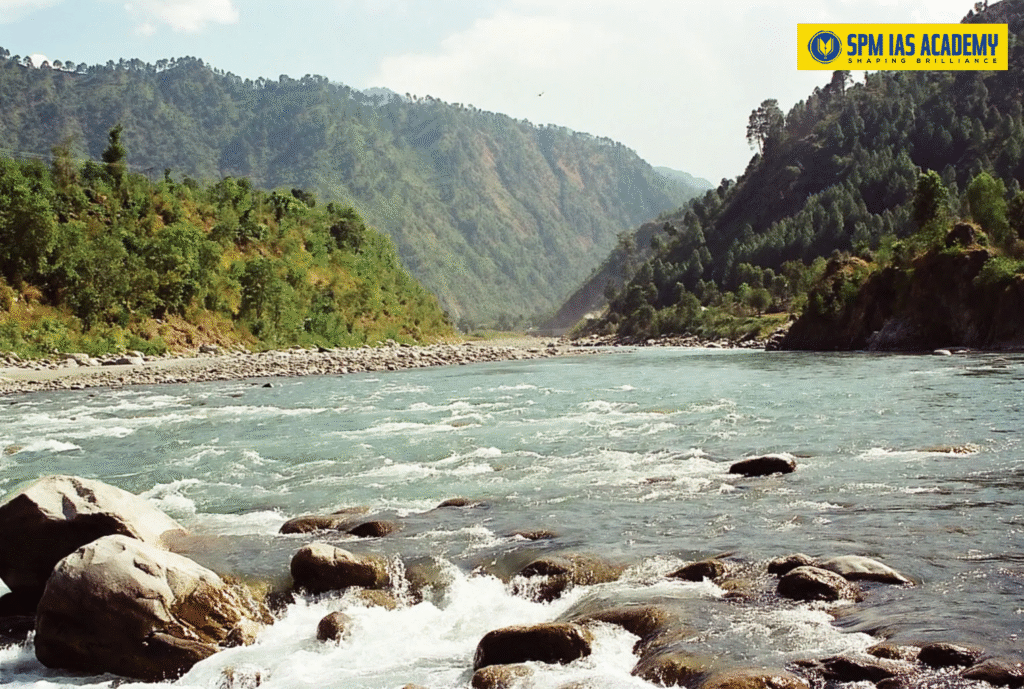
Where is Ravi River located? Location and Geography
The Ravi River begins its journey in the northwestern Himalayas in India. It flows through the states of Himachal Pradesh and Punjab before crossing the international boundary into Pakistan. After entering Pakistan, it continues its journey and finally merges with the Chenab River near Ahmadpur Sial in Punjab, Pakistan.
Additionally, the river passes through the famous city of Lahore in Pakistan. Historically, Lahore stands on the banks of the Ravi River.
Ravi River Origin: Where Does the Ravi River Start?
The Ravi River origin lies in the Bara Bhangal area of the Kangra district in Himachal Pradesh, India. The river rises at an altitude of approximately 4,000 metres above sea level. Specifically, it originates near the Kullu Hills and the Rohtang Pass region.
Furthermore, the Ravi River is a snow-fed and rain-fed river. It gets water from glaciers and snowfields in the Pir Panjal Range and the Dhauladhar Range during the summer season. As it flows westward, it passes through the Chamba valley in Himachal Pradesh, which is a beautiful and historically significant region. Then, it enters the Union Territory of Jammu and Kashmir briefly before flowing into the plains of Punjab.
Ravi River in Vedic Literature
Ancient texts call the Ravi River by the name Parushni or Iravati. The famous Battle of the Ten Kings (Dasarajna War), mentioned in the Rig Veda, took place on the banks of the Parushni (Ravi) River. This battle holds great importance in ancient Indian history and is often asked in UPSC Prelims. Therefore, aspirants must connect this geographical fact with Indian history.
Course of the Ravi River: From Origin to Mouth
The Ravi River follows a long and winding course from its origin to its final destination. Let us understand its journey step by step:
Upper Course: Himalayan Region
In its upper course, the Ravi River flows through the Chamba district of Himachal Pradesh. Here, the river cuts through deep gorges and narrow valleys. The current is fast and the gradient is steep. This stretch is important for hydroelectric power generation. Moreover, the Chamba valley is a popular tourist destination and holds cultural significance.
Middle Course: Pathankot and Punjab Plains
After flowing through the hills, the Ravi River enters the plains near Pathankot in Punjab. Here, the river changes its character. The flow becomes slower and the river spreads wider. It passes through the fertile plains of Punjab, nourishing agricultural land on both its banks. The river irrigates vast tracts of farmland in this region.
Lower Course: Pakistan and Confluence with Chenab
After crossing into Pakistan, the Ravi River flows past the city of Lahore. It then continues its journey southward. Finally, the river merges with the Chenab River near Ahmadpur Sial in the Jhang district of Punjab, Pakistan. The combined stream then joins the Sutlej, and eventually flows into the Indus River.
Tributaries of Ravi River
The Ravi River receives water from several tributaries during its journey. Knowing the tributaries is important for UPSC and state PCS exams. The major tributaries of the Ravi River are:
- Budhil River: A major right-bank tributary originating in Himachal Pradesh
- Siul River: Joins the Ravi from the right bank in Chamba district
- Bairari River: Another tributary from the Himalayan region
- Nai River: A smaller tributary in the lower Himalayan zone
These tributaries add to the volume of water in the Ravi River and support the river’s overall discharge throughout the year.
Dams on Ravi River: Major Projects and Their Importance
The construction of dams on Ravi River serves multiple purposes such as hydroelectric power generation, irrigation, flood control, and water storage. Below are the most important dams on Ravi River that you must know for your exam preparation:
1. Ranjit Sagar Dam (Thein Dam)
The Ranjit Sagar Dam is the largest and most important dam on the Ravi River. It is also called the Thein Dam. The dam stands on the border of Punjab and Jammu & Kashmir (UT) near the town of Pathankot. Construction of this dam began in 1982 and it became fully operational in 2001.
Key facts about Ranjit Sagar Dam:
- Type: Rock-fill dam
- Height: 160 metres
- Power Capacity: 600 MW
- Reservoir: Ranjit Sagar Lake (also known as Thein Lake)
- Purpose: Hydroelectric power generation and irrigation
- States Benefited: Punjab, Jammu & Kashmir, Rajasthan, Himachal Pradesh
2. Shahpurkandi Dam
The Shahpurkandi Dam is another important dam on the Ravi River. It sits downstream of the Ranjit Sagar Dam in Pathankot district of Punjab. This is a run-of-the-river hydroelectric project. The dam utilises the tail water discharged from the Ranjit Sagar Dam.
Key facts about Shahpurkandi Dam:
- Type: Barrage cum Hydroelectric Project
- Power Capacity: 206 MW
- Location: Pathankot, Punjab
- Significance: Helps Punjab utilise its full share of Ravi River water
3. Chamera Dam
The Chamera Dam is located on the upper stretch of the Ravi River in Chamba district of Himachal Pradesh. The National Hydroelectric Power Corporation (NHPC) manages this dam. There are three stages of the Chamera project: Chamera I, Chamera II, and Chamera III.
Key facts about Chamera Hydroelectric Project:
- Chamera I: 540 MW power capacity, located at Chamera village
- Chamera II: 300 MW power capacity, located at Bharari
- Chamera III: 231 MW power capacity
- Operator: NHPC Ltd.
- Purpose: Hydroelectric power generation
Ravi River and the Indus Waters Treaty, 1960
The Indus Waters Treaty is a water-sharing agreement between India and Pakistan. The World Bank brokered this treaty in 1960. Under this treaty, India and Pakistan share the waters of the six rivers of the Indus system.
According to the Indus Waters Treaty, the three eastern rivers – Ravi, Beas, and Sutlej were allocated to India. On the other hand, the three western rivers – Indus, Jhelum, and Chenab were allocated to Pakistan. Therefore, India has the right to use all the water of the Ravi River for its own purposes.
However, India has not been able to fully utilise its share of the Ravi River water. A significant amount of water still flows into Pakistan unused. This is why the Indian government initiated the Shahpurkandi Dam project and other irrigation projects to use the water fully before it crosses the border.
Regularly studying current affairs helps aspirants connect rivers, treaties, and environmental issues with UPSC dynamic questions.
Historical and Cultural Importance of the Ravi River
The Ravi River is not just a geographical entity. It carries deep historical and cultural importance. Here are some key historical facts about the Ravi River:
Battle of the Ten Kings (Dasarajna War)
The Battle of the Ten Kings is one of the oldest battles in Indian history. It took place on the banks of the Ravi River (then called Parushni). King Sudas of the Bharata tribe defeated a confederation of ten tribes in this battle. The Rig Veda describes this event in detail. This battle happened around 1400-1200 BCE.
Lahore and the Ravi River
Lahore, the cultural capital of Pakistan’s Punjab province, stands on the banks of the Ravi River. This city was an important centre of the Mughal Empire. Emperor Jahangir’s tomb and several other Mughal monuments stand near the banks of the Ravi. The historical connection between Lahore and the Ravi River is an important fact for the history and geography sections of competitive exams.
Ravi River During the Partition of 1947
During the partition of British India in 1947, the Ravi River became a boundary marker in some stretches. The river witnessed one of the largest human migrations in history. Millions of people crossed the Ravi and other Punjab rivers during partition. This historical context makes the Ravi River significant from the perspective of modern Indian history.
Environmental Issues Related to Ravi River
The Ravi River faces several serious environmental challenges today. These issues are important from an environment and ecology perspective for UPSC and other exams.
Pollution in the Ravi River
The stretch of the Ravi River near Lahore faces extreme pollution. Industrial waste from factories in the Lahore region flows directly into the river. Additionally, untreated sewage from the city adds to the pollution load. Environmental organisations have flagged the Ravi as one of the most polluted rivers in South Asia. This fact is relevant for questions on transboundary environmental issues.
Reduced Water Flow Due to Dam Construction
The construction of dams and diversion projects on the Ravi River in India has significantly reduced the water flow into Pakistan. As India utilises more of its allocated share, the lower stretch of the river in Pakistan often runs dry during non-monsoon months. This situation has created ecological damage to the riverine ecosystem on the Pakistani side.
Conclusion:
In conclusion, the Ravi River remains a vital component of the Indus River system and holds significant importance for UPSC, APSC, and State PCS exams. Overall, understanding the Ravi River origin, course, tributaries, and dams helps aspirants build a strong foundation in Indian geography and environmental studies. Moreover, its role in the Indus Waters Treaty 1960 highlights its strategic and geopolitical importance.
Furthermore, the historical relevance of the Ravi River, from the Rig Vedic period to the Partition of 1947, adds depth to its study. At the same time, current issues such as Ravi River pollution and water management challenges make it highly relevant for contemporary affairs. Therefore, aspirants should revise the Ravi River thoroughly to connect static geography with dynamic current events.
Ultimately, mastering topics like the Ravi River for UPSC preparation not only improves conceptual clarity but also enhances answer-writing skills in both prelims and mains examinations.
Source:
Frequently Asked Questions:
The Ravi River originates from the Bara Bhangal region in the Kangra district of Himachal Pradesh. Moreover, it rises in the Himalayas at an altitude of around 4,000 metres.
The Ravi River flows through Himachal Pradesh, Jammu & Kashmir (UT), and Punjab in India. Thereafter, it enters Pakistan and joins the Chenab River.
The total length of the Ravi River is approximately 725 km. Therefore, it is one of the important rivers of the Indus River system.
The major dams on the Ravi River include Ranjit Sagar Dam, Shahpurkandi Dam, and Chamera Dam. Additionally, these dams support irrigation, hydroelectric power, and water management.
The Ravi River is one of the eastern rivers allocated to India under the Indus Waters Treaty of 1960. As a result, India has full rights to use its water resources.