

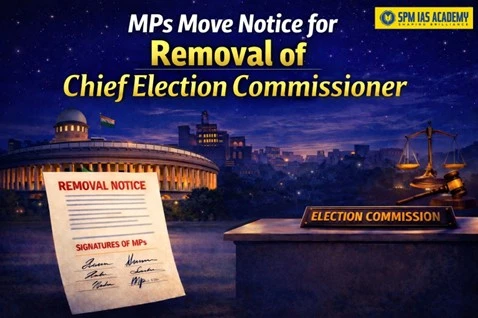
A total of 193 Members of Parliament (130 from Lok Sabha and 63 from Rajya Sabha) have signed a notice seeking the removal of the Chief Election Commissioner (CEC). This is the first time such a motion has been initiated against a sitting CEC.
For aspirants preparing for UPSC, APSC, and other State PCS exams, this development is highly important under Indian Polity, Constitutional Bodies, Governance, and Current Affairs. Therefore, understanding the constitutional provisions, removal process, and broader political implications becomes essential for both Prelims and Mains.
193 MPs Sign Notice for Removal of Chief Election Commissioner
According to reports, members belonging to INDIA bloc parties have signed the notice seeking the removal of Chief Election Commissioner Gyanesh Kumar.
As per parliamentary rules:
- At least 100 Lok Sabha MPs must sign such a notice.
- At least 50 Rajya Sabha MPs must sign it.
In this case, both requirements have been fulfilled.
Importantly, this is the first time in India’s history that a formal notice has been submitted to remove a sitting Chief Election Commissioner.
What Are the Charges Mentioned in the Notice?
Sources indicate that the notice lists seven charges against the Chief Election Commissioner (CEC).
- Among these, there are allegations of partisan and discriminatory conduct in office.
- Additionally, the notice accuses the CEC of deliberately obstructing investigations into alleged electoral fraud.
- Furthermore, it includes claims of mass disenfranchisement of voters.
- Moreover, opposition parties have alleged that the CEC’s actions during the ongoing Special Intensive Revision (SIR) of electoral rolls favour the ruling party.
However, it is important to emphasise that allegations alone do not result in removal. Ultimately, the Constitution mandates that removal can take place only on the ground of proven misbehaviour or incapacity.
Constitutional Status of the Chief Election Commissioner
Article 324 – Election Commission of India
Article 324 of the Constitution establishes the Election Commission of India (ECI). It grants the Commission the power to supervise, direct, and control elections to the Parliament, State Legislatures, Office of the President and Office of the Vice-President.
The CEC holds a highly protected constitutional position to ensure independence and neutrality of elections.
What is the procedure for the removal of the Chief Election Commissioner?
The procedure for the removal of the Chief Election Commissioner is similar to that of a Supreme Court Judge.
Constitutional Provision:
Article 324(5) of the Indian Constitution deals with the removal of CEC. The law clearly states that the CEC shall not be removed from office except in the same manner and on the same grounds as a Judge of the Supreme Court.
This means:
- Removal is possible only on the grounds of proven misbehaviour or incapacity.
- The process resembles impeachment.
Step-by-Step Process for removal of Chief Election Commissioner:
- Firstly, a motion for the removal of the Chief Election Commissioner (CEC) can be introduced in either House of Parliament.
- Subsequently, the motion must be passed by a special majority.
- Specifically, this special majority requires:
- A majority of the total membership of the House, and
- A two-thirds majority of the members present and voting.
- Thereafter, both Houses of Parliament must pass the motion separately.
- Finally, once Parliament approves the motion, the President formally removes the CEC from office.
Therefore, the removal process is intentionally strict, making it extremely difficult and rare.
How Is Removal of Other Election Commissioners Different?
- Firstly, there is an important distinction between the removal process of the Chief Election Commissioner (CEC) and other Election Commissioners.
- Notably, the CEC enjoys constitutional protection similar to that of a Supreme Court Judge.
- In contrast, other Election Commissioners can be removed only on the recommendation of the CEC.
- Therefore, this structured arrangement safeguards the institutional independence of the Election Commission of India.
The Chief Election Commissioner and Other Election Commissioners (Appointment, Conditions of Service and Term of Office) Act, 2023:
- The Parliament enacted the Chief Election Commissioner and Other Election Commissioners (Appointment, Conditions of Service and Term of Office) Act, 2023. It aims to regulate the appointment process of Election Commissioners.
- Earlier, appointments were made solely by the President on the advice of the Council of Ministers, without a formal statutory framework.
- However, following the Supreme Court’s judgment in Anoop Baranwal v. Union of India (2023), the Court directed that appointments should be made by a committee comprising the Prime Minister, Leader of Opposition, and the Chief Justice of India (CJI) — until Parliament enacted a law.
- Subsequently, the 2023 Act replaced the CJI in the selection committee with a Union Cabinet Minister nominated by the Prime Minister.
- Therefore, under the 2023 law, the Selection Committee now consists of:
- The Prime Minister (Chairperson)
- The Leader of Opposition in the Lok Sabha
- A Union Cabinet Minister nominated by the Prime Minister
- Additionally, the Act provides that the Chief Election Commissioner and Election Commissioners shall hold office for a term of six years or until the age of 65 years, whichever is earlier.
- Importantly, the Act also states that the salary, allowances, and conditions of service of the CEC and ECs shall be equivalent to those of the Cabinet Secretary, instead of a Supreme Court judge as earlier provided.
While the law formalises the appointment process, it has generated debate regarding the balance between executive influence and institutional independence of the Election Commission of India.
Broader Constitutional and Democratic Implications
This development raises several larger questions.
Firstly, it tests the strength of constitutional safeguards protecting independent institutions.
Secondly, it highlights the tension between accountability and institutional autonomy.
Thirdly, it brings attention to the need for transparent processes in appointments and functioning of constitutional bodies.
In a democracy, free and fair elections form the foundation of legitimacy. Therefore, the Election Commission must not only be independent but must also appear independent.
Conclusion: Removal Motion Against CEC and Its Constitutional Significance
The notice signed by 193 MPs seeking the removal of the Chief Election Commissioner marks a significant constitutional moment. Although removal requires a special majority and proof of misbehaviour or incapacity, the development has triggered a national debate on the independence of the Election Commission.
For UPSC, APSC, and State PCS aspirants, this issue is highly important under Indian Polity, Article 324, removal of constitutional authorities, Election Commission independence, and parliamentary special majority.
Therefore, candidates must clearly understand the constitutional framework, legal safeguards, and democratic implications of the motion against the CEC. This topic combines current affairs with static polity, making it extremely relevant for Prelims, Mains, and Interview stages.
Source:
FAQ:
Article 324 (5) deals with the removal of CEC. The removal of the Chief Election Commissioner follows the same process as that of a Supreme Court judge. Parliament must pass the motion with a special majority on the grounds of proven misbehaviour or incapacity. Thereafter, the President formally removes the CEC from office.
To initiate the removal of the Chief Election Commissioner, at least 100 Lok Sabha MPs or 50 Rajya Sabha MPs must sign the notice. In this case, 193 MPs signed the motion, fulfilling the required threshold.
The Constitution allows the removal of the Chief Election Commissioner only on the grounds of proven misbehaviour or incapacity. Allegations alone are not sufficient. Parliament must establish proof through a constitutional process.
The Chief Election Commissioner enjoys protection similar to a Supreme Court judge. In contrast, other Election Commissioners can be removed only on the recommendation of the CEC. This distinction protects the independence of the Election Commission of India.