India Co-Sponsors UNSC Resolution against Iran’s Attacks on GCC Nations
India co-sponsored a United Nations Security Council (UNSC) resolution that strongly condemned Iran’s attacks on Gulf Cooperation Council (GCC) countries and Jordan. Notably, Bahrain led the resolution and more than 135 countries backed it.
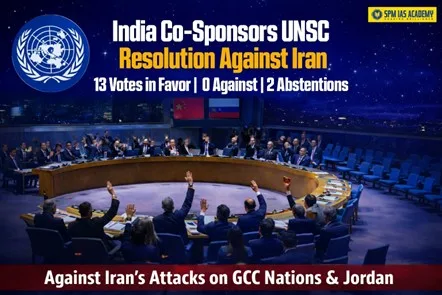
The UNSC adopted the resolution with 13 votes in favour, while China and Russia abstained. Furthermore, the resolution demanded that Iran immediately cease all attacks. It also condemned Tehran’s threats to close the Strait of Hormuz and emphasised the need to protect civilians and uphold international law.
Therefore, this development holds significant importance for UPSC 2026, APSC, and other State PCS examinations. It directly relates to international relations, the functioning of the United Nations Security Council, West Asia geopolitics, and India’s foreign policy stance.
Introduction: Why This Event Matters for India and the World
In a significant diplomatic development, India joined over 130 nations in co-sponsoring a United Nations Security Council (UNSC) resolution against Iran in 2026. The resolution strongly condemned Iranian attacks on Gulf Cooperation Council (GCC) member states – namely Bahrain, Kuwait, Oman, Qatar, Saudi Arabia, and the United Arab Emirates – as well as on Jordan. Furthermore, it demanded that Iran immediately stop all such attacks and end its threats to close the Strait of Hormuz, one of the world’s most critical maritime trade routes.
This event carries enormous weight both in terms of global geopolitics and India’s foreign policy direction. Moreover, for aspirants preparing for the UPSC Civil Services Examination (CSE), APSC, and other State PCS exams, this topic sits squarely at the intersection of international relations, United Nations structure, India’s foreign policy, and global security.
In this detailed article, we break down every important dimension of this development. It covers from the key facts and UN procedures to India’s strategic interests and the broader geopolitical context.
Key Facts at a Glance: The UNSC Resolution Against Iran
| Parameter | Details |
| Resolution Introduced By | Bahrain (co-sponsored by 135+ nations including India) |
| Vote Tally | 13 in favour, 0 against, 2 abstentions (China & Russia) |
| UNSC Presidency at the Time | United States of America |
| Countries Condemned by Resolution | Iran (for attacks on GCC nations + Jordan) |
| Key Demands of Resolution | Immediate cessation of all attacks; stop threats to Strait of Hormuz |
| Strait of Hormuz Concern | Iran threatened to close this critical maritime route |
| Civilian Impact Cited (Iran’s claim) | 1,348+ civilians killed; 17,000+ injured since Feb 28 |
| India’s Position | Co-sponsored the resolution signalling clear alignment |
What Does the UNSC Resolution Say? A Detailed Breakdown
The resolution that was adopted by the UNSC contains several important provisions. Let us carefully examine each of these key provisions, as they are directly relevant to your exam preparation.
1. Condemnation of Iran’s Attacks
First and foremost, the resolution condemned in the ‘strongest terms’ the egregious attacks carried out by Iran against the territories of Bahrain, Kuwait, Oman, Qatar, Saudi Arabia, the United Arab Emirates, and Jordan. It further determined that these acts constitute a clear breach of international law and represent a serious threat to international peace and security.
2. Demand for Immediate Cessation of Hostilities
Additionally, the resolution demanded that Iran immediately stop all attacks against GCC countries and Jordan. It also demanded that Tehran ‘immediately and unconditionally’ cease all provocations or threats against neighbouring states – including threats carried out through the use of proxy groups or non-state actors.
3. Condemnation of Threats to the Strait of Hormuz
Furthermore, the resolution specifically condemned any actions or threats by Iran aimed at closing, obstructing, or interfering with international navigation through the Strait of Hormuz or threatening maritime security in the Bab Al Mandab. This is a particularly significant provision because both these waterways are absolutely critical for global energy and trade flows.
4. Protection of Navigational Rights
In addition, the resolution reaffirmed that the exercise of navigational rights and freedoms by merchant and commercial vessels in accordance with international law must be respected, particularly around critical maritime routes. It also recognised the right of member states to defend their vessels from attacks and provocations.
5. Protection of Civilians
The resolution further condemned the targeting of residential areas and civilian infrastructure by Iran. Furthermore, it noted that civilian casualties had resulted from these attacks and called upon Iran to comply fully with its obligations under international humanitarian law.
6. Reaffirmation of Sovereignty and Territorial Integrity
Finally, the resolution reiterated strong support for the territorial integrity, sovereignty and political independence of all the affected GCC countries and Jordan. This is a foundational principle of international law enshrined in the UN Charter.
India’s Position: Why Did India Co-Sponsor This Resolution?
India’s decision to co-sponsor this resolution is a significant foreign policy statement. Traditionally, India has followed a policy of strategic autonomy and non-alignment, preferring to stay neutral on conflicts involving major powers or regional blocs. However, in this case, India chose to take a clear and public position by co-sponsoring the resolution. This choice deserves careful analysis.
India’s Energy Security Interests
One of the most important reasons for India’s stance is its energy security. India is heavily dependent on oil and gas imports from the Gulf region. Countries like Saudi Arabia, the UAE, Iraq, and Kuwait collectively supply a large portion of India’s crude oil needs. Therefore, any disruption to the Strait of Hormuz through which approximately 20% of global oil trade passes, would directly and severely impact India’s economy and energy supply. By co-sponsoring the resolution, India sends a clear message that it will not tolerate threats to this vital maritime corridor.
India’s Deep Ties with the GCC
Moreover, India shares exceptionally close ties with the GCC nations. The Indian diaspora in the Gulf countries numbers over 8 million people. Additionally, remittances from Indian workers in the Gulf form a significant portion of India’s total remittance income. Diplomatic support for GCC nations, therefore, is also a reflection of India’s commitment to protecting the interests of its citizens abroad.
India-Iran Relations: A Balancing Act
India has historically maintained cordial relations with Iran as well. The Chabahar Port project in Iran is a key strategic initiative for India. It provides India an alternative land route to Central Asia and Afghanistan, bypassing Pakistan. However, India’s decision to co-sponsor this resolution signals that even its long-standing ties with Iran have limits particularly when Iran’s actions directly threaten India’s energy security and the safety of Indian nationals.
India’s Commitment to International Law and the UN Charter
Furthermore, India’s co-sponsorship for UNSC resolution reflects its strong commitment to the principles of international law. It also includes the prohibition on the use of force against states, respect for territorial integrity and the freedom of navigation in international waters. These are principles that India itself invokes in its disputes with China in the Indo-Pacific region. By supporting this resolution, India reinforces its own positions on international law.
Understanding the UN Security Council (UNSC): Structure and Voting
Since this event directly involves the UNSC, it is essential for aspirants to have a thorough understanding of the structure and functioning of the UN Security Council. This is a frequently tested area in UPSC, APSC, and State PCS examinations.
Composition of the UNSC
| Category | Members | Veto Power? |
| Permanent Members (P5) | US, UK, France, China, and Russia | Yes |
| Non-Permanent Members | 10 nations elected for 2-year terms by UNGA | No |
| Total Membership | 15 nations | — |
Voting Procedure in the UNSC
For the UNSC to adopt a substantive resolution, at least 9 out of 15 members must vote in favour. At the same time, none of the P5 members should cast a veto. In the case of this resolution, 13 members voted in favour, while China and Russia – both permanent members abstained rather than exercising their veto. Importantly, an abstention by a P5 member does not block the resolution. Therefore, the resolution was successfully adopted.
Current UNSC Presidency
The United States held the Presidency of the UN Security Council at the time this resolution was adopted. The UNSC Presidency rotates monthly among its 15 members in alphabetical order (in the English language). The President of the Council for any given month chairs the Council meetings and plays a key role in setting the agenda.
The Strait of Hormuz and Bab Al Mandab: Critical Maritime Chokepoints
Two specific maritime locations feature prominently in this resolution. These are the Strait of Hormuz and the Bab Al Mandab. Both are critically important chokepoints in global maritime trade. Aspirants must know their geography, strategic importance, and geopolitical significance.
The Strait of Hormuz
| Feature | Detail |
| Location | Between Iran and Oman; connects Persian Gulf to Gulf of Oman |
| Width (narrowest point) | Approximately 33 km (21 miles) |
| Strategic Importance | ~20% of global oil trade and ~25-30% of global LNG trade passes through it |
| Countries dependent on it | Saudi Arabia, UAE, Kuwait, Iraq, Qatar – all export oil through here |
| Control | Iran controls the northern shore; Oman controls the southern shore |
| Threat | Iran has repeatedly threatened to close it during geopolitical tensions |
The Bab Al Mandab Strait
| Feature | Detail |
| Location | Between Yemen and Djibouti/Eritrea (Horn of Africa) |
| Strategic Importance | Connects Red Sea to Gulf of Aden; key route for Suez Canal-bound ships |
| Relevance to India | Indian exports to Europe and the Americas pass through this route |
| Recent Threat | Houthi rebels (backed by Iran) have attacked commercial ships here |
Both these chokepoints are vital not only for global oil trade but also for India’s trade with Europe, the Middle East, and Africa. Any disruption threatens India’s economy directly. That is why India has taken a strong stand in support of the resolution.
The GCC Nations: Who Are They and Why Are They Important for India?
The Gulf Cooperation Council (GCC) is a political and economic alliance of six Arab states located in the Persian Gulf region. The GCC was founded in 1981 and plays a central role in regional security, energy markets, and global trade.
| GCC Member | Capital | Key Export |
| Saudi Arabia | Riyadh | Crude Oil (world’s largest exporter) |
| United Arab Emirates (UAE) | Abu Dhabi | Oil, LNG, Financial Services |
| Kuwait | Kuwait City | Crude Oil |
| Qatar | Doha | LNG (among world’s largest exporters) |
| Bahrain | Manama | Oil, Aluminium, Finance |
| Oman | Muscat | Oil, LNG, Tourism |
India’s relationship with GCC nations is among the most important in its foreign policy. The GCC countries collectively account for a large share of India’s oil imports, host millions of Indian workers, and are major trading partners. Furthermore, India and the UAE recently signed the Comprehensive Economic Partnership Agreement (CEPA), which has significantly boosted bilateral trade.
Iran’s Response to the Resolution: The Other Side
Iran’s Permanent Representative to the UN, Ambassador Amir Saeid Iravani, strongly rejected the resolution. He described the UNSC’s action as ‘unjust and unlawful’, inconsistent with the UN Charter and international law. He argued that the resolution disregarded established principles of international law governing the determination of acts of aggression.
Iran also cited significant civilian casualties from continued US and Israeli military strikes since February 28, 2026, claiming that over 1,348 civilians had been killed, more than 17,000 injured, and nearly 19,734 civilian sites destroyed or damaged. Iran’s position is that it is acting in self-defence in response to ongoing military aggression.
Positions of China and Russia: Why Did They Abstain?
China and Russia both veto-wielding permanent members of the UNSC. They chose to abstain rather than support the resolution. Their abstentions are highly significant and reflect their broader strategic alignments.
China’s Position
China has deep economic ties with Iran and does not want to isolate Tehran diplomatically. China and Iran signed a 25-year Comprehensive Cooperation Agreement in 2021, covering trade, energy, and security. Moreover, China does not want to set a precedent for the UNSC condemning countries for attacking neighbours, given its own ambitions regarding Taiwan and its territorial claims in the South China Sea.
Russia’s Position
Russia, similarly, has maintained cordial relations with Iran. Additionally, since the Russia-Ukraine War began in 2022, Russia has deepened its partnerships with countries that resist Western pressure. Iran being one of them. Therefore, Russia abstained to avoid isolating a strategic partner.
Importantly, the fact that neither China nor Russia exercised their veto. They only abstained and allowed the resolution to pass. This is a crucial diplomatic nuance worth noting.
Conclusion:
To sum up, India’s decision to co-sponsor the UNSC resolution against Iran is far more than a single diplomatic act. It is a window into the complex web of India’s foreign policy priorities, its energy security imperatives, its commitments to international law, and its deep strategic relationships with the Gulf nations.
For UPSC CSE, APSC, and all State PCS exam aspirants, this topic offers rich content across multiple exam dimensions. It tests your knowledge of the UN Security Council structure and voting procedures. Moreover, it also highlights the geographical importance of maritime chokepoints like the Strait of Hormuz and Bab Al Mandab, India’s multi-dimensional foreign policy and India-Iran strategic interests including the Chabahar Port.
Source:
FAQ:
The UNSC Resolution Against Iran 2026 is a United Nations Security Council resolution. This resolution condemned Iran’s attacks on GCC nations and Jordan. Furthermore, it demanded an immediate end to hostilities and protection of civilians under international law.
The UNSC passed the resolution to address escalating regional tensions and safeguard international peace and security. Additionally, it strongly condemned threats to close the Strait of Hormuz, a critical global energy route.
The resolution was adopted with 13 votes in favour. However, China and Russia abstained. Importantly, no permanent member exercised a veto, allowing the resolution to pass.
The UNSC Resolution Against Iran 2026 is highly relevant for exams because it covers UN Security Council structure, voting procedures, West Asia geopolitics, maritime chokepoints, and international law.
The resolution condemned threats to close the Strait of Hormuz. Since nearly 20% of global oil trade passes through this route, any disruption directly impacts global energy security and international trade.