
The 70 MW Khudigaon Solar Power Plant in Bilasipara marks a major step in Assam’s clean energy transition. The Chief Minister of Assam, Himanta Biswa Sarma, inaugurated this project to strengthen the state’s renewable energy capacity. The project supports India’s green energy targets and enhances Assam’s energy security. This topic is highly relevant for UPSC and APSC under Environment, Energy Security, and Sustainable Development.
Overview of the 70 MW Khudigaon Solar Plant:
Notably, the 70 MW Khudigaon Solar Power Plant marks a major step in Assam’s renewable energy expansion. As it generates clean electricity through solar photovoltaic technology, it will significantly reduce carbon emissions.
| Project Details | |
| Project Name | 70 MW Khudigaon Solar Power Plant |
| Capacity | 70 MW (Solar Photovoltaic Generation) |
| Location | Khudigaon, near Bilasipara, Assam |
| Project Cost | Over ₹350 crore |
| Annual Generation | 141 million units (MU) of electricity |
| Carbon Reduction | 1.15 lakh tonnes of CO₂ avoided per year |
The plant uses solar photovoltaic (PV) technology to generate electricity from sunlight. It produces clean energy without emitting greenhouse gases.
India’s Renewable Energy Targets:
India has set ambitious renewable energy goals.
500 GW Non-Fossil Energy Capacity by 2030:
India aims to achieve 500 GW of non-fossil fuel capacity by 2030. This includes solar, wind, hydro, and nuclear energy.
The Khudigaon solar project directly contributes to this national goal. It strengthens India’s commitment under global climate agreements.
Assam’s Renewable Energy Targets:
Assam has announced clear and ambitious renewable energy goals. It aims to strengthen its clean energy transition. Most importantly, the state aims to achieve 3,500 MW of solar power capacity by 2030. At present, after recent additions, Assam’s solar capacity has reached 680 MW, showing steady progress toward this target. In addition, the government has set a broader objective of reaching 2,000 MW of overall renewable energy capacity, thereby enhancing energy security and reducing dependence on fossil fuels.
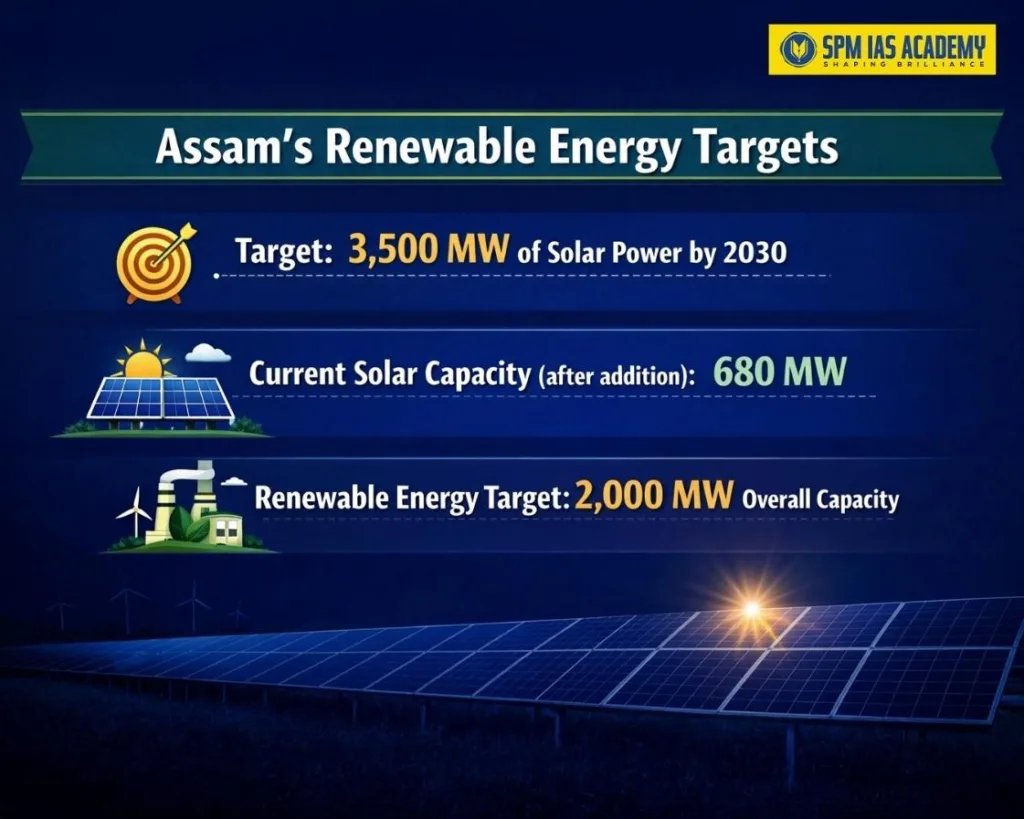
The Khudigaon project accelerates progress toward these targets.
Why the 70 MW Khudigaon Solar Plant Matters:
1. Renewable Energy Expansion in Assam:
With this project, Assam’s solar capacity increases significantly. The state reduces its dependence on thermal and fossil-fuel-based power.
Moreover, solar power improves energy self-reliance. It reduces dependence on imported fuels.
2. Environmental Impact and Climate Benefits:
Solar energy produces electricity without burning coal or oil. Therefore, it reduces greenhouse gas emissions.
The project avoids nearly 1.15 lakh tonnes of CO₂ annually. This reduction is equivalent to planting millions of trees and reducing thousands of tonnes of coal usage. Thus, the project supports India’s climate action goals.
3. Economic and Energy Security Benefits:
Solar power strengthens Assam’s energy infrastructure.
- It improves electricity availability during peak demand.
- It supports rural electrification.
- It reduces transmission losses by generating power closer to consumers.
- It attracts green investment into the state.
Furthermore, renewable energy projects create employment during construction and maintenance.
A strong understanding of renewable energy topics is essential for aspirants preparing through UPSC coaching in Assam.
Strategic Importance for Assam:
The Khudigaon plant helps Assam move toward sustainable development. It supports industrial growth and reliable electricity supply.
Additionally, renewable energy enhances long-term energy security. Assam can balance traditional hydrocarbon resources with green energy expansion.
This transition aligns with India’s broader vision of a gas-based and renewable-driven economy.
Link with National and Global Climate Commitments:
India has committed to reducing carbon intensity and expanding renewable capacity under the Paris Agreement.
Projects like Khudigaon help India achieve:
- Net-zero targets
- Clean energy transition
- Reduced fossil fuel dependence
Assam plays a crucial role in supporting these national goals.
Such region-specific developments are extensively covered in UPSC coaching in north east India to strengthen GS Paper-III preparation.
Conclusion:
In conclusion, the 70 MW Khudigaon Solar Power Plant at Bilasipara marks a decisive step in Assam’s clean energy journey. The project not only expands the state’s solar capacity but also reduces carbon emissions and strengthens long-term energy security. Moreover, it aligns perfectly with India’s ambitious goal of achieving 500 GW of non-fossil energy capacity by 2030 and Assam’s target of 3,500 MW solar power.
For UPSC and APSC aspirants, this development is more than just a news update. It connects directly with themes such as renewable energy targets 2030, climate change mitigation, energy security in Northeast India. Moreover, it promotes sustainable development policies. Therefore, understanding the importance of Khudigaon solar plant helps you link current affairs with core GS Paper 3 concepts in a practical and analytical manner.
Sources:
Frequently Asked Questions:
The 70 MW Khudigaon Solar Power Plant in Bilasipara, Assam, is a solar photovoltaic project with a capacity of 70 MW. It generates 141 million units of electricity annually. Moreover, it helps reduce 1.15 lakh tonnes of CO₂ emissions each year, supporting Assam’s renewable energy expansion.
The Khudigaon solar power project contributes to India’s goal of achieving 500 GW non-fossil fuel capacity by 2030. By adding clean solar energy to the grid, it strengthens India’s climate commitments and clean energy transition.
Assam aims to achieve 3,500 MW of solar power capacity by 2030. Currently, the state has around 680 MW solar capacity and targets 2,000 MW overall renewable energy capacity to improve energy security and reduce fossil fuel dependence.
The 70 MW Khudigaon Solar Power Plant is important for UPSC and APSC under Energy Security, Climate Change Mitigation, Sustainable Development, and Renewable Energy Policy. It helps aspirants link current affairs with GS Paper 3 topics on infrastructure and environment.