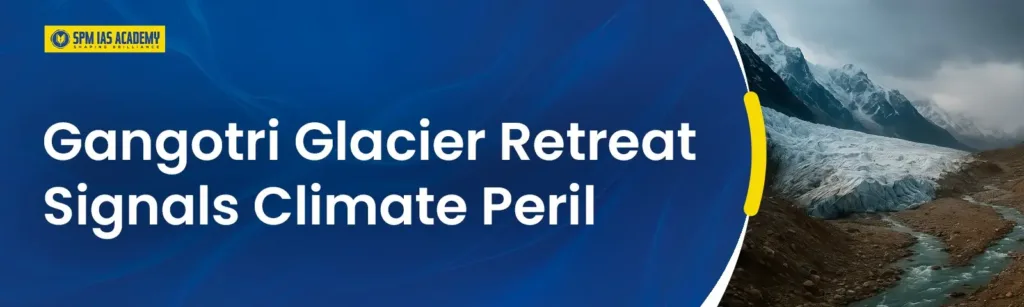


The Gangotri Glacier Decline has emerged as one of the most pressing indicators of climate change in the Indian Himalayas. Recent research has highlighted that the glacier, which feeds the Bhagirathi River and ultimately sustains the sacred Ganga, is shrinking at an alarming pace. As the glacier retreats, the risks of water scarcity, floods, and ecosystem imbalance are becoming increasingly evident.
Gangotri Glacier Decline: Key Findings
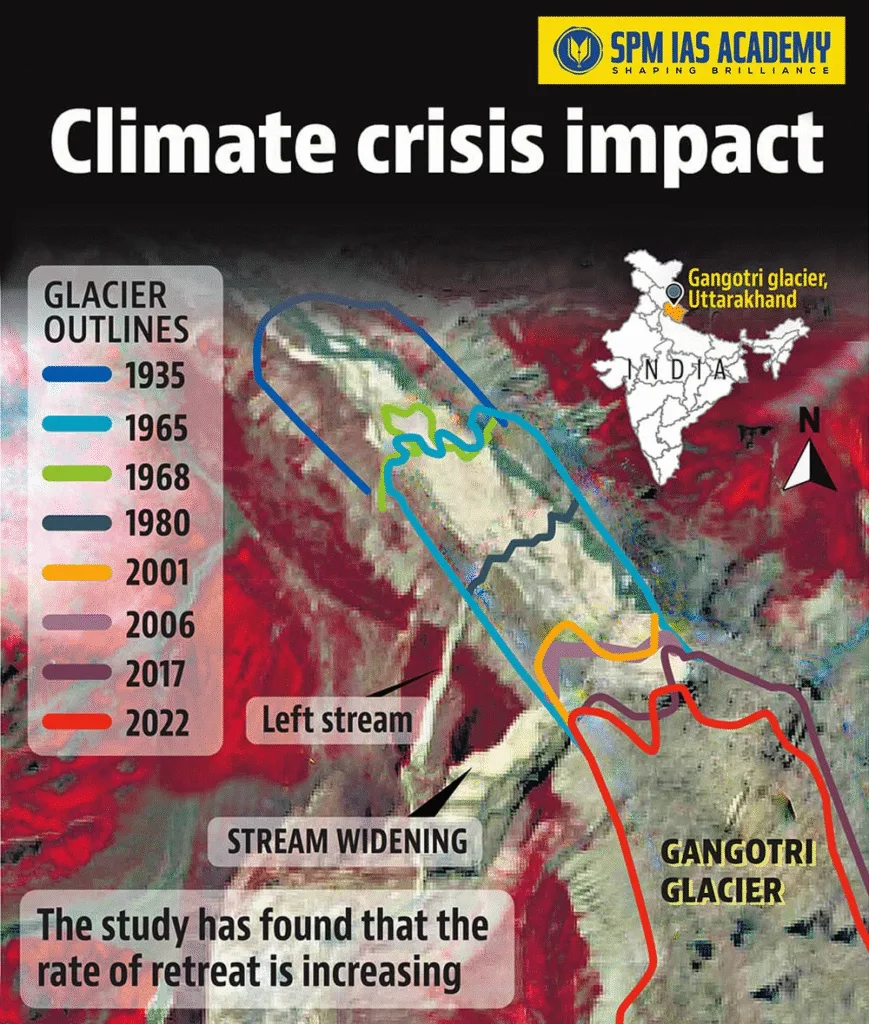
A study by IIT Indore and ICIMOD (Nepal) reveals that the Gangotri Glacier System (GGS) has lost nearly 10% of its snowmelt flow between 1980 and 2020. This decline has been driven by rising temperatures and climate change. Moreover, Himalayan glaciers are thinning at an average rate of 46 cm per year, and Gangotri’s snout continues to recede steadily.
At the same time, rainfall-runoff and baseflow in the glacier system have increased, signaling a significant climate-induced hydrological shift. The Central Water Commission reports that glacial lakes and other water bodies in the Himalayas grew by 10.81% in area from 2011 to 2024, a clear sign of warming-related transformations.
About Gangotri Glacier
The Gangotri Glacier Decline is particularly concerning because of its sacred and ecological significance.
- Location: It is situated in Uttarkashi, Uttarakhand, originating from the northern slopes of the Chaukhamba range.
- Type: It is a compound valley glacier fed by several tributary glaciers such as Raktvarn, Chaturangi, and Swachand.
- Peaks Feeding It: Shivling, Thalay Sagar, Meru, and Bhagirathi III.
- Terminus: It ends at Gaumukh, the source of the Bhagirathi River, which merges with the Alaknanda at Devprayag to form the Ganga.
Moreover, the Gangotri National Park, established in 1989, protects the glacier’s surroundings and is known for its rich biodiversity. The park is home to chirpine, deodar, spruce, oak, rhododendron, and rare species such as the Himalayan Tahr, Snow Leopard, Musk Deer, and Himalayan Monal.
What is the Gangotri Glacier System?
The Gangotri Glacier Decline is part of a larger Gangotri Glacier System (GGS), which plays a vital role in the hydrology of the Ganga basin.
- Composition: Gangotri, Chaturangi, Raktavaran, and Meru glaciers.
- Area: ~549 km² with ~48% glacierised region.
- Discharge Trends (1980–2020): 28 ± 1.9 m³/s average annual flow.
- Source Contributions:
- Snowmelt – 64%
- Glacier melt – 21%
- Rainfall-runoff – 11%
- Base flow – 4%
- Snowmelt – 64%
Interestingly, the peak discharge shifted from August (pre-1990) to July (post-1990). This shift reflects reduced winter snow and earlier summer melting.
Trends and Climate Signals
In essence, the Gangotri Glacier Decline has altered the balance of snowmelt, glacier melt, and rainfall contribution. With shrinking snow cover, snowmelt contribution is reducing, while rainfall-runoff and baseflow are steadily rising. Further, this shift mirrors warming-driven hydrological changes across the Himalayas.
- Earlier Peak Discharge: Creates water scarcity risks in late summer and autumn for millions downstream.
- Flood Vulnerability: Greater flood risk during July, especially with intense monsoon rains.
- Hydrological Instability: Long-term threat to agriculture, energy, and livelihoods dependent on the Ganga.
Implications of Gangotri Glacier Decline
The retreat of the glacier is not just an environmental issue; it also carries deep socio-economic and ethical consequences.
- Water Security: Firstly, reduced snowmelt threatens irrigation, drinking water supply, and hydropower generation.
- Disaster Risk: Secondly, its Glacial lake outburst floods (GLOFs) may become more frequent.
- Cultural Impact: Thirdly, the Ganga, revered as a lifeline, faces ecological stress.
- Ethical Concerns: Moreover, the Intergenerational equity is at stake as future generations may inherit depleted ecosystems.
Conclusion
The Gangotri Glacier Decline stands as a clear warning of how climate change is reshaping India’s lifeline rivers. The retreat is altering water flow patterns, increasing disaster risks, and threatening biodiversity. Protecting the glacier demands urgent global and national efforts ranging from emissions reduction to regional adaptation strategies. Hence , Safeguarding the Ganga’s source is not just an environmental responsibility but also a cultural and civilizational duty.
Sources
FAQs on Gangotri Glacier Decline
A: The primary cause is rising temperatures due to global climate change, leading to faster melting and reduced snowmelt.
A: Studies suggest Himalayan glaciers, including Gangotri, are thinning at about 46 cm per year, with the snout receding steadily.
A: It is the main source of the Bhagirathi River, which combines with the Alaknanda to form the Ganga, sustaining millions of people.
A: The key risks include water scarcity, floods, glacial lake outburst floods (GLOFs), and ecosystem stress.
A: It shifts peak discharge to earlier months, causing excess water in July but scarcity in late summer and autumn, directly impacting agriculture and water supply.