The UPSC Personality Test, also known as the UPSC Interview, is the final and most decisive stage of the Civil Services Examination. Conducted by the Union Public Service Commission (UPSC), this stage is not merely an evaluation of a candidate’s knowledge but a comprehensive assessment of personality, integrity, and suitability for public service.
At SPM IAS Academy, we understand the significance of this stage and have curated a detailed orientation programme to help aspirants prepare strategically and confidently.
Understanding the UPSC Personality Test:
The UPSC interview assesses qualities that define a true civil servant. Clarity of thought, integrity, confidence, communication skills, emotional intelligence, and the ability to handle pressure etc. are some of the important qualities a civil servant should possess. The board aims to evaluate whether the candidate has the temperament and maturity required for effective governance and leadership in public life.
Preparation Strategy for UPSC Interview 2025-26:
Step 1: Create a Realistic Preparation Plan:
Begin by assessing the total time available before your interview. Then, design a practical study plan and schedule mock interviews accordingly. Understand the purpose, structure, and expectations of the Personality Test to align your preparation with UPSC’s evaluation parameters.
Step 2: Master the Detailed Application Form (DAF):
Your DAF (Detailed Application Form) is the backbone of your UPSC interview. Every word in your DAF is a potential question. Conduct a thorough self-assessment and identify probable areas of questioning related to:
- Personal and educational background
- Work experience and service preferences
- Achievements, hobbies, and extracurricular activities
- Cadre choice and reasons for selecting particular services
Key focus areas also include grooming, entry and exit etiquette, dressing sense, and confident body language.
Step 3: Maintain Four Registers for Focused Preparation:
Organized preparation ensures efficient revision. Aspirants should maintain four separate registers:
- Register 1: DAF-based questions
- Register 2: Topics on Government Policies, Major Schemes, Economy, Science & Tech, Defence, and Current Affairs
- Register 3: Optional Subject-related questions
- Register 4: Opinion-based, abstract, and situational questions
This structured approach helps to build clarity and confidence during the interview.
Step 4: Avoid Common Mistakes:
Before the Interview:
Many aspirants fail to research their DAF entries properly or neglect their home state and optional subject. Unclear motivations and vague cadre preferences can also weaken their profile.
During the Interview:
Avoid overconfidence or extreme nervousness. Maintain composure, stay consistent in your answers, and avoid defensive behaviour towards criticism. Always listen attentively and respond with calm conviction.
Step 5: Handling Criticism, Anxiety, and Uncertainty:
The UPSC board often tests your emotional balance.
- Handle criticism gracefully by respecting diverse opinions.
- Manage anxiety through breathing control and positive self-talk.
- Address uncertainty by admitting limitations honestly and offering rational perspectives where possible.
These traits reflect maturity and self-awareness which are key components of a civil servant’s personality.
Step 6: Connecting Academics and Work Experience with Civil Services:
Your academic background can add tremendous value if linked to governance. For instance, engineers can relate concepts to infrastructure development, economists to fiscal policy, and humanities graduates to social welfare.
Similarly, your work experience showcases transferable skills such as teamwork, project execution, coordination, and decision-making – all essential in administrative roles.
Step 7: Final 2–3 Weeks Revision Strategy:
In the last few weeks before your interview, focus on:
- Reviewing your DAF line by line
- Revising core concepts from your optional subject
- Updating yourself on recent national and international developments
Prioritize current affairs from the last 3 – 6 months, government policies, and emerging socio-economic trends. Regular mock interviews during this period can polish articulation, body language, and confidence.
Step 8: Align Your Opinions, Hobbies, and Experiences to meet the expectations of UPSC:
UPSC seeks candidates with balanced opinions, analytical ability, emotional intelligence, and integrity. Your hobbies and extracurricular activities should reflect discipline, curiosity, and community involvement.
Engage in activities that demonstrate teamwork, leadership, and empathy – qualities essential for public administration.
Step 9: Home State, Cadre Preference, and Optional Subject Preparation:
Every aspirant must have in-depth knowledge of their home state’s demographics, governance, and socio-economic challenges. Be clear and rational while justifying your cadre preferences. Revise your optional subject’s conceptual base and highlight its relevance to real-world governance and policymaking.
Step 10: Strategy for Attending Mock Interviews:
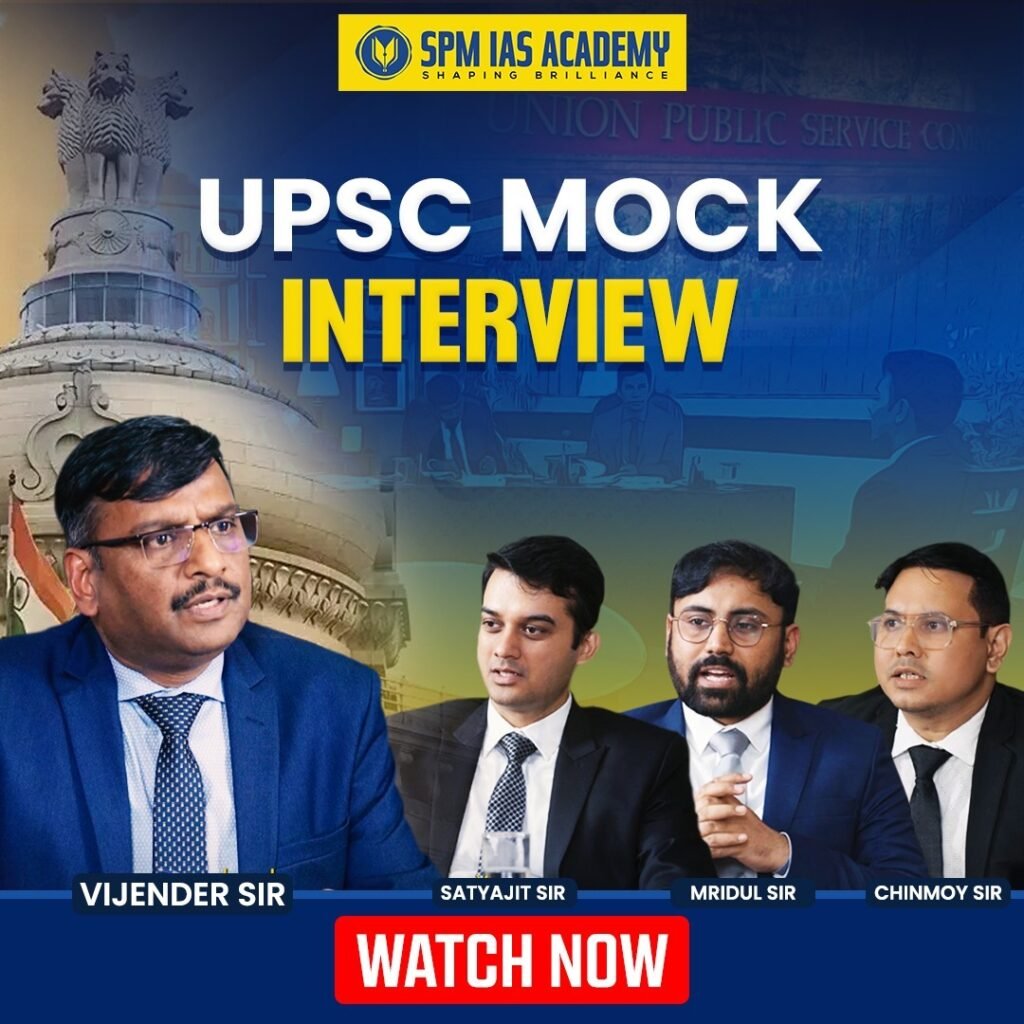
Mock interviews provide you the real UPSC Personality Test experience. Attend at least four to six sessions, document feedback after each session and work on constructive suggestions.
Avoid over-rehearsing; authenticity impresses the board more than memorized answers. Remember, the aim is to refine your personality.
For expert mentorship and structured guidance, explore UPSC coaching in Guwahati at SPM IAS Academy.
Key Probable and Important Questions for UPSC Personality Test:
Aspirants must prepare for diverse areas such as:
- Personal Profile:
- His/her name and its meaning and significance
- Place of birth and its significance
- Family background like parents’ residential address and occupation,
- Education qualifications & achievements,
- Hobbies and extracurricular activities etc.
- International Relations:
- India’s foreign policy and strategic positioning (2025),
- Multilateral forums, and great power dynamics
- Regional groupings & Summitry
- Peace, conflict resolution and humanitarian concerns
- Climate change and maritime governance
- Strategic operations, space policy and cyber security norms
- Economy & Business:
- Union Budget Planning & Fiscal Prudence
- Economic Growth Drivers: Infrastructure & Asset Optimization
- Inflation Control, Tax Policy & Compliance Mechanisms
- Enterprise Development, Credit Systems & Financial Regulation
- Sectoral Development Initiatives
- Evidence-Based Policy & Global Competitiveness
- International Trade & External Sector Dynamics
- Science & Technology:
- Semiconductors, Advanced Computing & Quantum Technologies
- Artificial Intelligence, Data Analytics & Digital India Initiatives
- Space Science, Exploration & Strategic Missions
- Biotechnology, Healthcare Innovation & Genomics
- Frontier Scientific Developments & Global Collaborative Initiatives
- Environment & Ecology:
- Energy Transition & Decarbonisation Strategies
- Biodiversity Conservation & Ecosystem Management
- Climate Policy Frameworks and Urban Environment
- International Cooperation and Environmental Trade-offs
- Polity & Governance:
- Constitutional Framework and Amendments
- Welfare Schemes, Service Delivery & Digital Governance
- Education Policy and Reforms
- Judicial System & Electoral Processes
- Urban Governance & Business Environment
- Social Issues: Welfare, Justice, Health, Gender and Education
- Direct Benefit Transfers & Social Protection Systems
- Healthcare Systems & Nutritional Security
- Social Equity, Inclusive Representation & Fundamental Rights
- Educational Access, Skill Enhancement & Bridging Digital Divide
- Accountability & Spatial Inequalities
- Reports, Indices & Ranking:
- Climate Change & Sustainability
- Innovation, ICT & Flows
- Human Development & Social Welfare
- Governance Frameworks & Rule of Law
- Security & Defence Capacity
- Defence & Security:
- Indigenisation and Defence Industrial Base
- Defence Exports, International Partnerships & Military Exercises
- Military Capabilities & Modernization Initiative
- Sports & Athletics:
- International Events and Soft Power Strategy
- Grassroots Development and Inclusive Participation
- Performance Excellence and Professional Leagues
- Sports Ecosystem and Athlete Recognition
- Art, Culture and Heritage:
- Festivals and Their Sociocultural Significance
- Cultural Platforms and National Representation
- Heritage Preservation and National Recognitions
- Awards & Honours:
- National Civilian Honours
- Literature and Cinema
- Global and Sports Honours
- Gallantry Awards
- Anticipated Questions on Current Affairs:
- Service Delivery and Administrative Reforms
- Flagship Schemes and Social Protection
- Fiscal Policy, Goods and Services Tax, and Micro, Small & Medium Enterprises
- Agriculture and Rural Credit
- Legal and Constitutional Amendments
- Domestic Security and Regional Concerns
- Self-Reliance and Industrial Policy
- Miscellaneous Topics (Current Affairs & Observances):
- National Observances & National Identity
- Institutions, Publications & Conferences
- Tourism & Personalities in the News
Why You Need To Attend SPM IAS Academy’s Orientation Session?
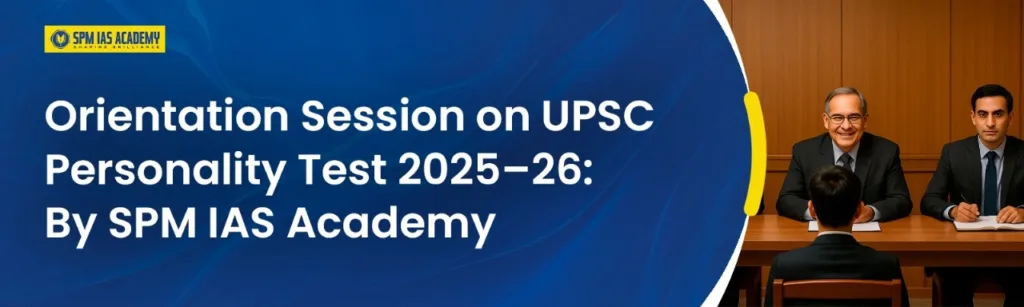
https://youtu.be/zNN-ugKrr8Y?si=Gn2leI0oLjhLDdGA: Orientation Session on UPSC Personality Test 2025–26: By SPM IAS AcademyAt SPM IAS Academy, the Orientation Session on UPSC Personality Test 2025–26 offers an exceptional opportunity to learn directly from Prof. Vinay Nangia, Former UPSC Interview Board Member and Former Head of the Department of Management Studies, IIT Roorkee.
Under his expert guidance, aspirants will gain invaluable insights into the expectations of the UPSC Interview Board. He will also provide advice on how to develop effective communication techniques and strategies to present their personality with confidence and authenticity.
Aspirants seeking quality UPSC coaching in north east India can benefit from SPM IAS Academy’s expert programs.
The UPSC Personality Test is not about showcasing perfection; it’s about demonstrating clarity, conviction, and character. With systematic preparation and guided mentorship from SPM IAS Academy, every aspirant can walk into the interview room with confidence and walk out leaving a lasting impression.
Sources:
- https://spmiasacademy.com/how-to-prepare-for-upsc-interview/
- https://assamtribune.com/article/spm-ias-academys-interview-guidance-programme-igp-your-edge-for-the-upsc-personality-test-2025-1597734
The UPSC Personality Test, or UPSC Interview, is the final stage of the Civil Services Examination. It evaluates a candidate’s personality, integrity, decision-making ability, and suitability for public service. All these make it the most crucial stage in the selection process.
SPM IAS Academy offers a comprehensive orientation session led by Prof. Vinay Nangia, Former UPSC Interview Board Member and Former HoD of Management Studies, IIT Roorkee. The session will provide valuable insights into how UPSC conducts the Personality Test and its expectations from the candidates.
The session will be conducted by Prof. Vinay Nangia, respected Former UPSC Interview Board Member and Former Head of the Department of Management Studies at IIT Roorkee.
The UPSC Interview Board assesses qualities like clarity of thought, integrity, confidence, balanced judgment, and emotional intelligence. SPM IAS Academy’s orientation program will help candidates to cultivate these attributes through expert mentorship and structured preparation.
Mock interviews replicate real UPSC Personality Test-like conditions. It will help candidates to practice stress management, structured answering, and clear expression. SPM IAS Academy conducts high-quality mock sessions with expert feedback to improve overall performance.

Behind every article at SPM IAS Academy is a team of skilled content writers and subject experts committed to making preparation easier for aspirants. From answering common doubts to breaking down complex issues and current affairs, we create content that is accurate, easy to understand, and directly useful for UPSC, APSC, and other competitive exams.