Source: Assam Tribune
Syllabus: Prelims, GS 1
Why in the News?
- A field documentation survey in Tawang, West Kameng, Shi-Yomi, Upper Siang, and Namsai uncovered rare manuscripts and traditional scripts, including texts containing episodes from the Ramayana and Mahabharata.
- A delegation from Arunachal Pradesh presented these significant findings at a special workshop on script and manuscript preservation in New Delhi.
- The workshop was organised by the Union Ministry of Culture during the 20th session of the Intergovernmental Committee for the Safeguarding of the Intangible Cultural Heritage (ICH 20COM).
Key Highlights of the Presentation:
- Manuscript Heritage of Arunachal Pradesh: The delegation showcased the State’s ancient and unique manuscript traditions, including:
- Lik-Thai manuscripts (Namsai):
- It refers to written forms of the Tai language (especially Shan or Tai Long) and traditional manuscripts themselves.
- Often called Lik Long (Great manuscript).
- Part of cultural and literary heritage of Tai speaking communities in Southeast Asia (Myanmar, Northern Thailand, Arunachal Pradesh).
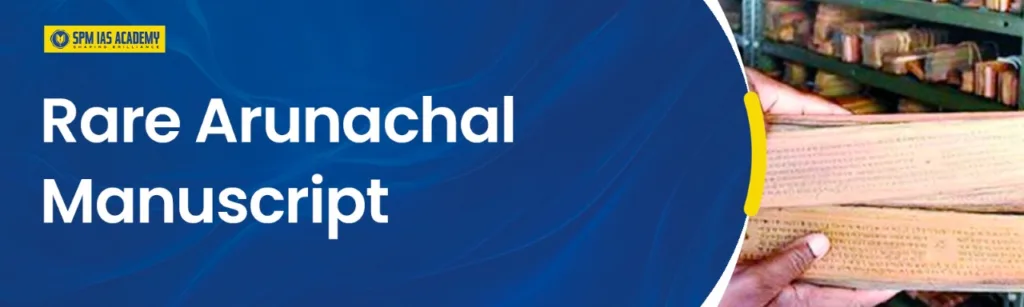
- Traditionally inscribed on dried palm leaves or a type of thick, accordion-folded paper called ‘phap sa’.
- Content – Buddhist text, Jataka stories and moral guides, secular subjects (law, history, traditional medicine, astrology and folk tales.
- Script – Tham (Dhamma) or Shan script, derived from ancient south Indian alphabets.
- Ancient Buddhist Kangyur scriptures:
- Kangyur means ‘Translated words’ of Buddha
- It contains Sutras (teachings of Buddha), Tantras (esoteric teachings), text on discipline and ethics, text for recitation and practice.
- Lik-Thai manuscripts (Namsai):
- Rare Buddhist and indigenous manuscripts containing mythological, historical, and religious narratives.
- Newly identified texts with episodes from the Ramayana and Mahabharata, indicating deep cultural and literary linkages across Himalayan and Northeast communities
Risks and Threats Identified:
The presentation highlighted multiple challenges:
- Ageing and fragility of manuscripts
- Climatic vulnerabilities in high-altitude and humid regions
- Lack of specialised archival facilities
- Insufficient conservation technology and skilled manpower
Roadmap for Preservation:
A structured plan was proposed for long-term safeguarding:
- Scientific documentation of all manuscripts
- Digitisation of Lik-Thai, Kangyur, and newly identified epic-based texts
- Climate-controlled archival infrastructure
- Capacity-building programmes for local scholars
- Systematic cataloguing, conservation training, and disaster-risk minimisation
- Ensuring cultural continuity through research, translations, and public dissemination
Government Support & Initiatives:
1. Gyan Bharatam Mission:
The Central Government reaffirmed support under the Gyan Bharatam Mission, aimed at:
- Providing scientific conservation assistance
- Supporting systematic documentation
- Establishing modern archival and digitisation infrastructure
- Strengthening cultural preservation efforts for inclusion in the national digital repository
- Earlier known as ‘National Mission for Manuscript’.
- Central sector scheme for the period of 2024-31.
- Key objectives:
2. Manuscript & Digitisation Support Cell:
- A dedicated Manuscript and Digitisation Support Cell for Arunachal Pradesh will be set up at the Ministry of Culture.
- The cell will ensure long-term coordination, resource support, and continuous monitoring of conservation work.
Significance of the Findings:
Cultural & Historical Significance:
- The discovery of manuscripts with Ramayana and Mahabharata episodes reveals long-standing literary exchanges between Arunachal communities and the broader Indian cultural sphere.
- Strengthens understanding of trans-Himalayan Buddhist, indigenous tribal, and Assamese cultural connections.
Aspirants seeking structured preparation can explore expert guidance through UPSC & APSC Coaching in Guwahati.
Academic & Research Value:
- Provides rich material for studies in linguistics, anthropology, religion, folklore, and art history.
- Enhances scope for epigraphic research on lesser-known Himalayan scripts and oral traditions.
Preservation Significance:
- Highlights urgent need for scientific conservation, especially in fragile ecological zones.
- Ensures that unique forms of Himalayan knowledge systems are preserved for future generations.
Topics like regional manuscripts are comprehensively covered under the Assam Specific Course for APSC for state-focused preparation.
Mains Practice Question:
“The discovery of rare manuscripts in Arunachal Pradesh underscores India’s rich cultural interconnectedness and the urgent need for safeguarding intangible heritage.” Examine this statement in the context of the significance, challenges, and preservation of manuscript traditions in the Himalayan-Northeast region.

Behind every article at SPM IAS Academy is a team of skilled content writers and subject experts committed to making preparation easier for aspirants. From answering common doubts to breaking down complex issues and current affairs, we create content that is accurate, easy to understand, and directly useful for UPSC, APSC, and other competitive exams.