
Why in the news?
The Governor of Arunachal Pradesh, K. T. Parnaik, has congratulated the State Election Commissioner of Arunachal Pradesh, Rinchin Tashi, and the entire election machinery. He congratulated the team for the smooth, transparent, and successful conduct of Panchayati Raj and Urban Local Body elections in Arunachal Pradesh.
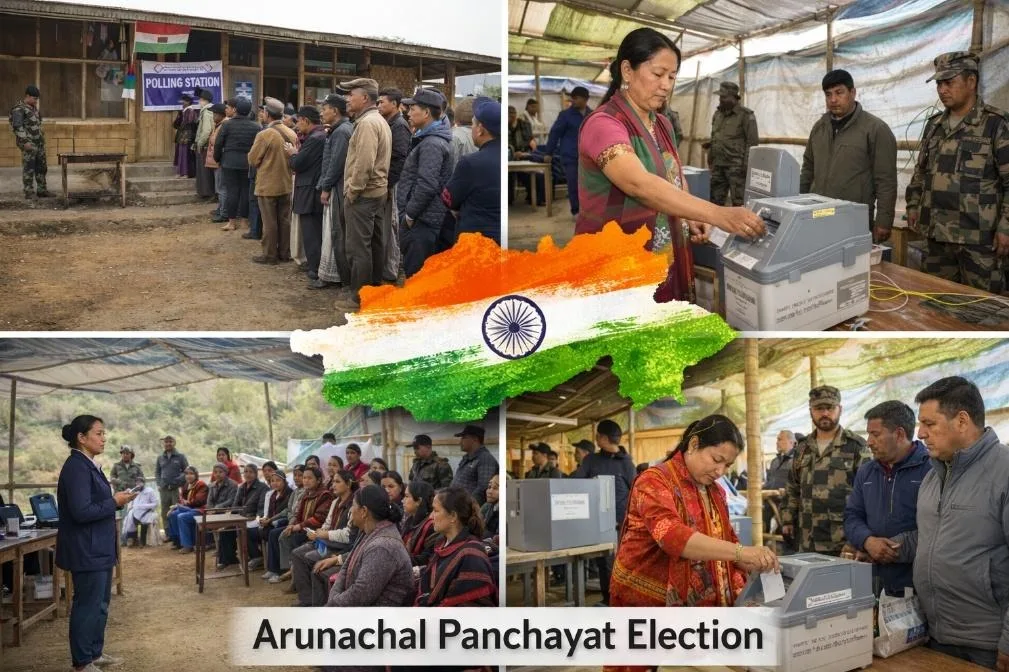
The State Election Commission (SEC) of Arunachal Pradesh played a pivotal role in ensuring the effective conduct of grassroots democratic elections, thereby strengthening local self-governance. By facilitating free and fair elections to Panchayati Raj Institutions and local bodies, the SEC has empowered citizens with a direct and meaningful participation in governance, reinforcing the principles of inclusive, participatory, and people-centric development.
State Election Commission of Arunachal Pradesh:
- In pursuance of constitutional provisions, particularly the 73rd Constitutional Amendment Act, 1992 and Article 243K of the Constitution of India, the Arunachal Pradesh State Election Commission was formally established.
- Accordingly, the State Election Commission was set up through a government notification dated 30 April 2001.
- Subsequently, the Commission became fully functional with the appointment of its first State Election Commissioner, Shri J. M. Tangu, IAS (Retd.), on 16 September 2002.
- Contextually, Arunachal Pradesh is a predominantly tribal state, where people traditionally manage their day-to-day affairs at the village and community levels through indigenous institutions.
- Importantly, these traditional village institutions function based on evolved customary laws and locally accepted codes, making grassroots governance an inherent feature of tribal society.
- Therefore, the concept of Panchayati Raj has historically been deep-rooted in the tribal communities of the state, even prior to formal legislation.
- To institutionalise this system, in early 1964, a four-member committee was constituted under the chairmanship of Late Daying Ering.
- The mandate of the committee was to examine the functioning of various tribal institutions in Arunachal Pradesh (then NEFA) and recommend a suitable framework for introducing Panchayati Raj through legislation.
- After detailed study, the committee recommended the establishment of a three-tier Panchayati Raj system, comprising:
- Gram Panchayat at Village Level
- Anchal Samity at Block or Circle Level
- Zilla Parishads at District level
- The Daying Ering Committee, 1965 also recommended for Agency Council at Agency or Territorial level.
- Following acceptance of these recommendations, the President of India promulgated the NEFA Panchayat Raj Regulation, 1967.
- As a result, provisions were made for the constitution of the three-tier Panchayati Raj Institutions, which came into force on 2 October 1968.
- Over the next three decades, Panchayati Raj Institutions functioned in the state, with regular elections conducted until 1992.
- However, Panchayati Raj Institutions established under the NEFA Panchayat Raj Regulation, 1967 were dissolved with effect from 14 September 1997.
- Consequent upon the 73rd Constitution (Amendment) Act, 1992, states were required to enact new laws and rules for conducting elections to Panchayati Raj Institutions (PRIs).
- However, in the case of Arunachal Pradesh, being a tribal-dominated state, the constitutional provision relating to reservation for Scheduled Castes (SCs) posed a legal and administrative challenge.
- As a result, the implementation of the 73rd Amendment in the state faced delays due to the reservation issue.
- This constitutional impediment was addressed through the Constitution (Eighty-Third Amendment) Act, 2000, which came into force on 8 September 2000.
- With the reservation issue resolved, Arunachal Pradesh proceeded to operationalise the Panchayati Raj framework by enforcing the following legal instruments:
- Arunachal Pradesh Panchayati Raj Act, 1997
- Arunachal Pradesh Panchayati Raj (Preparation of Electoral Roll) Rules, 2002
- Arunachal Pradesh Panchayati Raj (Delimitation of Constituencies and Reservation of Seats for Women) Rules, 2002
- Arunachal Pradesh Panchayati Raj (Conduct of Election) Rules, 2002
- Subsequently, the first General Election to Panchayati Raj Institutions under the new Act, in conformity with the 73rd Constitutional Amendment, was conducted in 2003.
Prelims Practice Question:
Q. With reference to the State Election Commission of Arunachal Pradesh, consider the following statements:
- The State Election Commission of Arunachal Pradesh was established in pursuance of the 73rd Constitutional Amendment Act, 1992 and Article 243K of the Constitution of India.
- The first State Election Commissioner of Arunachal Pradesh was Shri J. M. Tangu, IAS (Retd.), appointed in September 2002.
- The Daying Ering Committee recommended a two-tier Panchayati Raj system for Arunachal Pradesh.
- The implementation of the 73rd Constitutional Amendment in Arunachal Pradesh was delayed due to issues related to reservation for Scheduled Castes, which were resolved by the Constitution (Eighty-Third Amendment) Act, 2000.
Which of the statements given above are correct?
A) 1, 2 and 4 only
B) 1, 3 and 4 only
C) 2 and 3 only
D) 1, 2, 3 and 4
Correct Answer: A
Source:

SPM IAS Academy is a leading APSC & UPSC coaching institute based in Guwahati, Assam, dedicated to helping aspirants achieve success in civil services examinations. The academy provides expert mentorship, comprehensive study materials, current affairs guidance, test series, and personalized preparation strategies for APSC, UPSC, and other competitive exams. With a strong focus on quality education, discipline, and result-oriented learning, SPM IAS Academy has become a trusted name among civil service aspirants across Assam and Northeast India.