
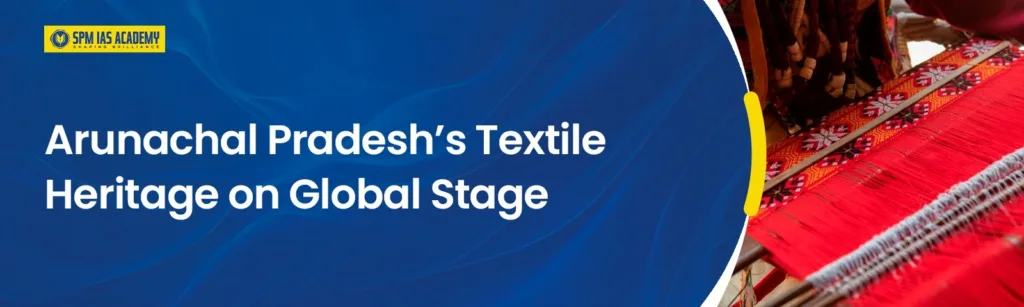
Why was Arunachal’s Textile Heritage in the News?
Recently, designer Yajir Mara from Upper Subansiri represented India at the 21st edition of the “Celebrating India” event held in Seoul, South Korea. In this context, she showcased the rich tribal textiles of Arunachal Pradesh on an international platform. Moreover, the event highlighted the state’s handwoven fabrics and traditional craftsmanship. As a result, it provided global exposure to local artisans, tribal crafts, and India’s diverse handloom traditions.
Cultural Significance:
To begin with, the event promoted indigenous craftsmanship by showcasing traditional weaving practices that have been passed down through generations. Moreover, it reflected the cultural identity of multiple tribes of Arunachal Pradesh and highlighted weaving traditions largely sustained by women weavers.
In addition, the international platform contributed to the preservation of intangible cultural heritage. Since traditional weaving lies at the core of tribal identity, such global events help safeguard tribal symbols, traditional motifs, and ancient knowledge systems. Finally, they also encourage youth participation in textile arts, ensuring continuity of these traditions into the future.
India – South Korea Cultural Exchange:
To begin with, such cultural exchanges strengthen India’s soft power in East Asia through effective cultural diplomacy. Moreover, they enhance people-to-people ties by using fashion and handloom as bridges between societies. At the same time, these initiatives support and deepen the India-Republic of Korea (ROK) Strategic Partnership.
In addition, the event enables global representation of India’s cultural diversity. It brings greater visibility to Northeast India in international fashion and cultural platforms. Finally, it opens new avenues for collaboration between Korean fashion institutions and Indian weaver clusters, encouraging cross-cultural learning and sustainable partnerships.
Economic & Development Significance:
To begin with, the international exposure provided a major boost to Arunachal Pradesh’s handloom sector. By showcasing tribal weaves globally, it helps increase demand for indigenous textiles. Moreover, it attracts investors and designers to local weaving clusters and enables artisans to access international markets.
In addition, the initiative significantly supports women’s empowerment. Since weaving is largely a women-led activity, rising demand directly improves household incomes. As a result, it strengthens local economies, especially in rural and tribal districts of the state.
Know about Arunachali Traditional Textiles:
To begin with, Arunachal Pradesh is home to more than 25 major tribes, each possessing a distinct textile identity. Tribes such as Adi, Apatani, Nyishi, Tagin, Galo, Wancho, Sherdukpen, Mishmi, and others use textiles as a powerful medium to express social status and clan identity. It also signifies ritual importance, and festive traditions. As a result, weaving is deeply embedded in everyday and ceremonial life.
Moreover, the weaving techniques and materials used are entirely traditional and sustainable. Most textiles are produced using the backstrap loom (loin loom), a method practiced predominantly by tribal women. In addition, artisans use cotton, wool, and other natural fibres, along with dyes extracted from plants, roots, bark, and flowers, reflecting a strong harmony with nature.
In terms of design, Arunachali textiles are easily recognisable for their bold and symbolic motifs. These include geometric patterns, zig-zags, and diamond shapes. These are often inspired by animals, natural elements, and tribal myths. For instance, Apatani shawls feature clean geometric designs, Adi gale is known for striking red and black colour combinations, Nyishi jackets display bold motifs, while Mishmi shawls are admired for their intricate embroidery.
Furthermore, these textiles carry deep cultural and ritual significance. They are traditionally worn during festivals such as Solung, Mopin, and Nyokum Yullo, as well as during marriages and clan rituals. Notably, certain designs and motifs are clan-specific or reserved for elders. They also symbolise prosperity, honour, and social rank within the community.
Finally, Arunachali textiles are gaining increasing national recognition. Several tribal textiles are being considered for Geographical Indication (GI) status. Importantly, GI tags have already been granted to Apatani, Monpa, Nyishi, Adi, Galo, and Tai Khamti textiles. It will help to protect traditional knowledge, promote artisan livelihoods, and enhance the global visibility of Arunachal Pradesh’s rich handloom heritage.
Additional Facts on the Handloom Sector of Arunachal Pradesh:
To begin with, according to the All India Handloom Census, 2019-20, Arunachal Pradesh has a significant handloom workforce. In total, the state has around 94,616 handloom workers. Out of these, approximately 77,600 are handloom weavers, while the remaining 17,016 are allied workers engaged in activities supporting the handloom sector.
Conclusion:
In conclusion, Arunachal Pradesh’s growing presence on global platforms highlights the deep cultural value and economic potential of its traditional textiles. International exposure helps preserve indigenous knowledge and tribal identity. It also strengthens cultural diplomacy and creates sustainable livelihood opportunities, especially for women artisans. Therefore, by combining heritage preservation with global outreach, Arunachal’s handloom sector can emerge as a strong driver of cultural pride, inclusive development, and long-term economic growth.
FAQ:
Arunachal Pradesh’s traditional textiles are gaining global recognition due to their unique tribal designs. It involves sustainable weaving techniques, and strong cultural significance. International events help showcase these handwoven fabrics, promote indigenous craftsmanship, and create global demand for tribal weaves.
International exposure helps handloom weavers by increasing market access, attracting designers and investors. It helps to boost demand for indigenous textiles. Since weaving is largely women-led, it also supports women’s empowerment, improves household incomes, and strengthens rural and tribal economies.
Source: Arunachal Times
Also, visit our APSC page for more updates and resources.

SPM IAS Academy is a leading APSC & UPSC coaching institute based in Guwahati, Assam, dedicated to helping aspirants achieve success in civil services examinations. The academy provides expert mentorship, comprehensive study materials, current affairs guidance, test series, and personalized preparation strategies for APSC, UPSC, and other competitive exams. With a strong focus on quality education, discipline, and result-oriented learning, SPM IAS Academy has become a trusted name among civil service aspirants across Assam and Northeast India.