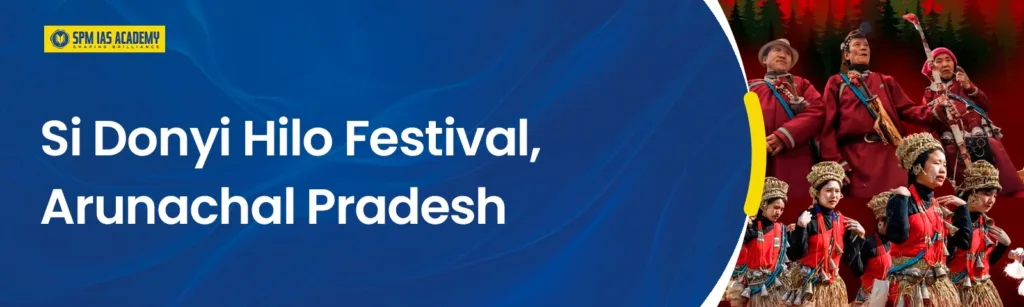
Why was the Si Donyi Hilo Festival in the News?
The annual celebration of Si Donyi Hilo has commenced in Upper Subansiri district and other parts of Arunachal Pradesh. Notably, the festival highlights the rich spiritual traditions and cultural heritage of the Tagin community, one of the prominent tribes of the state.
What is Si Donyi Hilo?
- To begin with, Si Donyi Hilo is one of the most significant festivals of the Tagin tribe, deeply rooted in their indigenous belief system.
- Conceptually, the festival centres on the veneration of nature, where ‘Si’ represents the Earth and ‘Donyi’ represents the Sun and ‘Hilo’ means power of the ritual chanting.
- Symbolically, the festival reflects harmony between human life and natural forces, a key feature of tribal cosmology in Arunachal Pradesh.
- Moreover, the Tagin tribe celebrates this festival as Tagin New Year from 4th January to 7th January. The second day is ‘Somin Nyormin’ day.
- Furthermore, the Nyibu (local priest) provide the ritual leadership. While he performs sacred rites, he also chants Uuyu Benam (celestial chantings).
- On the concluding day, there is a practice of ritual sacrifice of Mithun (Gayal). It symbolises Collective peace, Prosperity and Well-being of the entire community.
What are the Cultural and Spiritual Significances of Si Donyi Hilo?
- First, the festival features a vibrant display of Tagin art, dance, music, and traditional attire.
- Secondly, people from all walks of life gather to offer prayers to the supreme divine forces ‘Atu Sii’ (Earth deity) and ‘Ayu Donyi’ (Sun deity).
- Thirdly, the festival seeks universal peace, harmony, prosperity, and human welfare, extending beyond the community to humanity as a whole.
Historical Background of Si Donyi Hilo Festival:
To begin with, in 1975, Late Tatar Uli conceptualised Si Donyi Hilo Festival. Notably, he played a pioneering role in institutionalising the Si-Donyi belief system among the Tagin community. Moreover, through his efforts he tarnsformed traditional spiritual practices into a more organised cultural and religious celebration. As a result, the festival emerged as a platform to preserve indigenous beliefs while strengthening collective identity and social cohesion within the community.
Know About the Tagin Tribe:
The Tagin tribe is one of the major indigenous communities of Arunachal Pradesh. Culturally, they belong to the larger group of Tani tribes. Notably, they are traditionally believed to be descendants of Abu Tani, who is their mythical ancestral figure. Moreover, geographically, the Tagins are primarily concentrated in the Upper Subansiri district. At the same time, a significant number of populations are also there in theWest Siang and Papum Pare districts. Socially and culturally, the tribe is known for its strong sense of community life, deep reverence for nature, and a rich tradition of oral history and folklore.
What are the significances of the celebration of Si Donyi Hilo?
- Cultural Dimension:
- Firstly, the festival reflects indigenous ecological ethics and nature worship.
- Secondly, it strengthens tribal identity and cultural continuity.
- Social Dimension:
- Moreover, it promotes community cohesion and collective participation.
- Furthermore, it reinforces traditional institutions like ‘Nyibu’.
- Governance & Heritage:
- Notably, it highlights the need for preservation of intangible cultural heritage.
- Moreover, it is relevant in the context of tribal rights, cultural protection, and inclusive development.
Conclusion:
In conclusion, Si Donyi Hilo is not merely a festival but a living expression of the spiritual philosophy. Similarly, it highlights the ecological wisdom, and collective identity of the Tagin tribe. At the same time, by emphasising harmony between humans and nature, the festival reinforces indigenous belief systems. In addition, it strengthens community bonds, and preserves intangible cultural heritage. Its continued celebration highlights the importance of safeguarding tribal traditions within the broader framework of inclusive governance, cultural protection, and sustainable development in Arunachal Pradesh.
Prelims Practice MCQ:
Q. With reference to the Si Donyi Hilo festival, consider the following statements:
- It is celebrated by the Tagin tribe of Arunachal Pradesh as their New Year festival.
- The festival involves veneration of natural elements, particularly the Earth and the Sun.
- The rituals are presided over by a local priest known as the Nyibu, accompanied by celestial chantings called Uuyu Benam.
- The festival was institutionalised in the early 1990s as part of a state-sponsored cultural programme.
Which of the statements given above are correct?
A. 1, 2 and 3 only
B. 1 and 4 only
C. 2 and 3 only
D. 1, 2, 3 and 4
Correct Answer: A. 1, 2 and 3 only
Mains Practice Question:
Q. Examine the role of traditional festivals like Si Donyi Hilo in strengthening community identity and safeguarding the intangible cultural heritage of tribal societies in Northeast India.
Source: Arunachal Times
FAQ:
Si Donyi Hilo is the New Year festival of the Tagin community. Moreover, it symbolises harmony between humans, nature, and divine forces. At the same time, it also promotes peace, prosperity, and cultural continuity through rituals, chants, and community participation.
Si Donyi Hilo is the New Year festival of the Tagin tribe of Arunachal Pradesh. It is rooted in nature worship, where ‘Si’ signifies Earth, ‘Donyi’ represents the Sun, and ‘Hilo’ denotes the sacred power of ritual chanting. The festival emphasises harmony between humans and nature through prayers, chants, and community rituals.

SPM IAS Academy is a leading APSC & UPSC coaching institute based in Guwahati, Assam, dedicated to helping aspirants achieve success in civil services examinations. The academy provides expert mentorship, comprehensive study materials, current affairs guidance, test series, and personalized preparation strategies for APSC, UPSC, and other competitive exams. With a strong focus on quality education, discipline, and result-oriented learning, SPM IAS Academy has become a trusted name among civil service aspirants across Assam and Northeast India.