
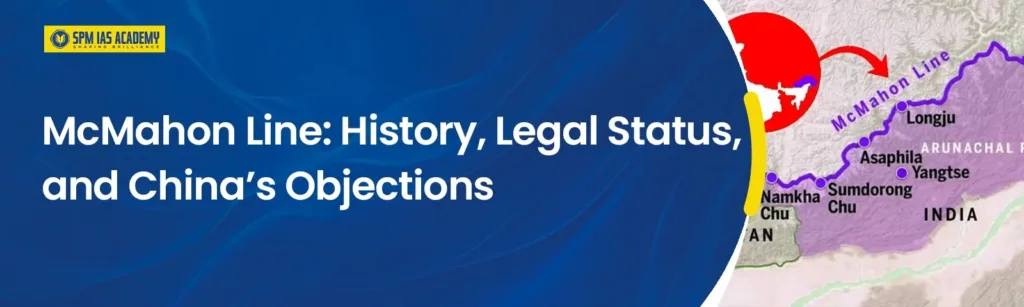
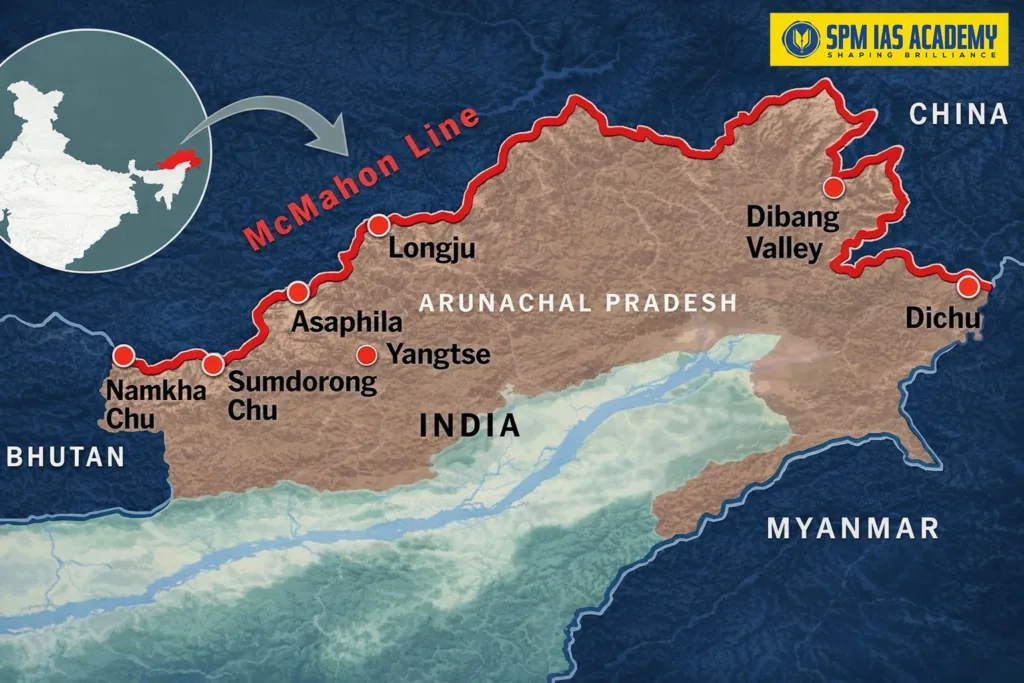
The McMahon Line is a boundary line between India and China in the eastern Himalayas. It mainly separates Arunachal Pradesh from Tibet. This line remains one of Asia’s most disputed international boundaries.
In simple words, the McMahon Line defines where India believes its border lies in the east. China, however, rejects this boundary and considers it illegal. Because of this disagreement, the line is often in the news.
The issue affects diplomacy, border security, and regional peace. It is also very important for UPSC civil services examination, APPSC and other state PCS examinations. Questions appear in Prelims, Mains, and interviews regularly.
This article explains the McMahon Line with its history, legal status, and China’s objections. It also explains why the issue matters today.
What is the Historical Background of the McMahon Line?
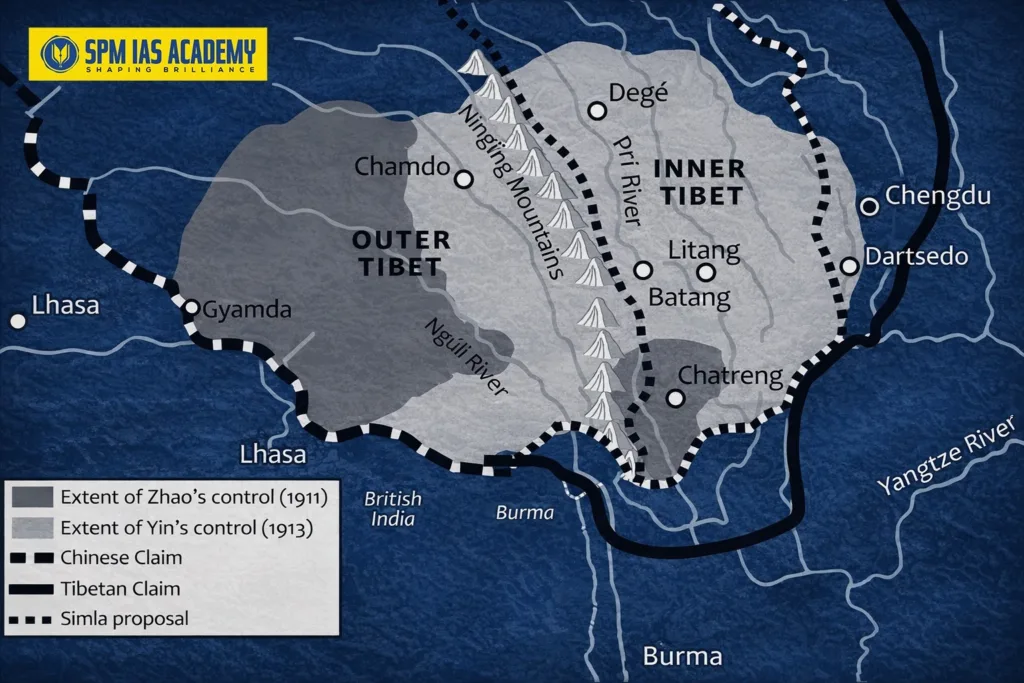
The McMahon Line originated during British rule in India. It was drawn during the Simla Convention in 1914. The Simla Convention, 1914 involved British India, Tibet, and China. Sir Henry McMahon represented British India. That’s why the line was named after him later.
The purpose was to settle the India-Tibet boundary peacefully. British officials wanted a clear and stable frontier. Tibet accepted the proposed boundary at the conference.
China, however, rejected the agreement later. Chinese representatives refused to sign the final convention. Despite this, British India considered the line valid. After India’s independence in 1947, India adopted this boundary. India treated this line as its official eastern border.
What is the Legal Status of the McMahon Line?
From India’s perspective, the McMahon Line is a legal boundary. India argues it was negotiated and accepted by Tibet. At that time, Tibet functioned with significant autonomy.
India also follows the principle of historical continuity. Independent India inherited boundaries from British India. This practice is common in international law.
India administers areas south of the line effectively. These areas include the entire Arunachal Pradesh region. Civil administration and elections operate normally there.
China holds a different legal view. China argues Tibet had no authority to sign treaties. Therefore, China considers the line invalid. This difference in legal interpretation causes ongoing disputes.
China’s Objections to the McMahon Line:
China objects to this line for several reasons.
First, China calls Arunachal Pradesh “South Tibet.” It claims historical and cultural links to the region.
Second, China rejects the Simla Convention entirely. It argues the agreement was imposed unfairly. China says it never accepted the boundary legally.
Third, strategic concerns influence China’s position. The Tawang region holds religious and military importance. It is also close to sensitive border areas.
China often expresses objections through diplomatic statements. It also protests Indian infrastructure development in the region. Sometimes, China renames places in Arunachal Pradesh symbolically.
What is the Strategic Importance of the McMahon Line?
The line has high strategic value for India. It protects India’s northeastern frontier. The terrain is mountainous and difficult to access. Control over this region ensures national security.
It also helps monitor movements near the border. Roads and airfields improve connectivity and defence readiness. For China, the region has symbolic and strategic meaning. This makes the dispute more complex.
What is the Current Relevance of the McMahon Line?
The line remains relevant in current affairs. Border talks between India and China continue regularly. Tensions sometimes rise due to patrol encounters.
Infrastructure development has increased on both sides. This has brought renewed attention to boundary issues. Diplomatic dialogue aims to prevent conflict escalation.
For exam aspirants, the topic is very important. It links history, geography, polity, and international relations.
Conclusion:
In conclusion, the McMahon Line remains a lasting legacy of colonial history. As a result, it continues to shape India-China relations even today. India firmly considers it a valid and legal boundary. On the other hand, China rejects it due to historical and political reasons. Consequently, this disagreement remains unresolved. Therefore, peaceful dialogue and diplomatic engagement remain the only sustainable way forward. Ultimately, understanding this line helps in better grasping regional geopolitics and border dynamics.
Source:
https://csdronline.com/decoding-the-eastern-sector-india-china-and-the-mcmahon-line/
You can also visit our APPSC page for the latest updates, syllabus, and exam-related current affairs.
FAQ:
This line is the eastern boundary claimed by India between Arunachal Pradesh and Tibet. It is important because it affects India-China relations, border security, and regional stability.
The line was drawn in 1914 during the Simla Convention held between British India, Tibet, and China. It was proposed by Sir Henry McMahon to define a clear boundary in the eastern Himalayas.
China rejects the McMahon Line because it argues that Tibet had no legal authority to sign international agreements. China also considers the Simla Convention invalid and claims Arunachal Pradesh as part of “South Tibet.”
India considers the McMahon Line a legal and valid boundary. It argues that Tibet accepted the boundary in 1914 and that independent India inherited this border under international law. India also exercises full administrative control south of the line.
The McMahon Line plays a central role in ongoing India-China border talks, especially in the eastern sector. India uses the line as the basis for maintaining the Line of Actual Control (LAC), while China continues to dispute it. This difference affects confidence-building measures, troop disengagement, and long-term boundary settlement efforts.

SPM IAS Academy is a leading APSC & UPSC coaching institute based in Guwahati, Assam, dedicated to helping aspirants achieve success in civil services examinations. The academy provides expert mentorship, comprehensive study materials, current affairs guidance, test series, and personalized preparation strategies for APSC, UPSC, and other competitive exams. With a strong focus on quality education, discipline, and result-oriented learning, SPM IAS Academy has become a trusted name among civil service aspirants across Assam and Northeast India.