
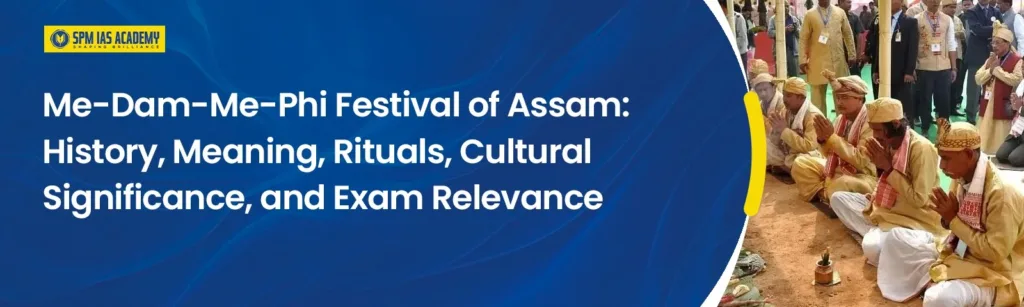
Me-Dam-Me-Phi is a traditional and spiritually significant festival of Assam, observed by the Tai Ahom community. The festival represents a deep-rooted belief in ancestor worship, collective memory, and continuity of lineage.
Unlike many festivals that focus on celebration and entertainment, Me-Dam-Me-Phi is solemn in nature. It emphasises respect for forefathers, gratitude for their guidance, and prayers for peace and prosperity. Therefore, for APSC and UPSC aspirants, this festival is an important example of intangible cultural heritage and indigenous belief systems of Northeast India. It is highly relevant for APSC and UPSC Prelims, UPSC and APSC Mains GS 1 (Art & Culture), APSC Mains GS 5.
What Is Me-Dam-Me-Phi?
Me-Dam-Me-Phi is an ancestral worship festival in which the Tai Ahom community pays homage to their departed ancestors. The festival is based on the belief that ancestors continue to influence the lives of the living and protect the community from misfortune.
In essence, Me-Dam-Me-Phi reflects the idea that:
- The past and present are closely connected.
- Ancestors play a guiding spiritual role.
- Rituals and remembrance preserve cultural identity.
Thus, the festival strengthens both spiritual faith and community unity.
Meaning and Symbolism of Me-Dam-Me-Phi:
The Meaning and Symbolism of Me-Dam-Me-Phi lie at the heart of this traditional Assamese festival of the Tai Ahom community. The term Me-Dam-Me-Phi comes from the Tai Ahom language. It clearly explains the spiritual purpose of the festival, which is centred on ancestor worship and remembrance.
- Me refers to offerings or ritual sacrifices made during the ceremony.
- Dam signifies ancestors or forefathers who shaped the community’s history and values.
- Phi denotes spirits or souls, especially those of the departed ancestors.
Together, Me-Dam-Me-Phi literally means ritual offerings made to ancestral spirits.
Symbolically, the festival represents the belief that ancestors continue to guide and protect the living. It highlights the deep connection between past and present, reinforcing ideas of lineage, cultural continuity, and collective memory. Therefore, the symbolism of Me-Dam-Me-Phi reflects respect for ancestral wisdom, spiritual harmony, and the preservation of Ahom cultural identity.
Origin of Me-Dam-Me-Phi (Mae Dam Mae Phi):
- Firstly, the Ahoms have their own religious beliefs and faith system, in which ancestor worship plays a very important role.
- Secondly, the practice of ancestor worship among the Ahoms links to an ancient tradition that also existed among the Tai and Chinese communities.
- Moreover, this tradition traces its origin to the teachings of Chinese philosopher Confucius. On respecting ancestors, many Tai societies still follow his ideas.
- According to the Ahom Chronicle Pyen Kaka, an important historical account explains the origin of Me-Da-Me-Phi.
- At that time, Lengdon, the king of Mong Phi (the heavenly kingdom), sent his two grandsons Khunlung and Khunlai to Mong Ri, which is present-day Xishuangbanna in China.
- During this journey, Ye-Cheng-Pha, the ancestral scholar and keeper of knowledge, advised them to perform several rituals throughout the year.
- These rituals included Umpha, Phuralong, Mae Dam Mae Phi, and Rik-Khwan worship. All these are different occasions on different months.
- The main purpose of these rituals was to pay respect to the Phi-Dam (ancestral spirits) and the Khwan elements of life.
- Since then, the Tai Ahom community has been continuously observing the rituals of Me Dam Me Phi. It remains an important cultural and spiritual tradition even today.
When Is Me-Dam-Me-Phi Celebrated?
The festival of Me-Dam-Me-Phi is in the month of January, soon after the harvest season. This year, Me-Dam-Me-Phi 2026 is on 31st January.
The festival has close relation with agricultural prosperity, seasonal transition and gratitude for food security and survival. Therefore, it reflects the agrarian roots of Assamese society and the Tai Ahom community’s close relationship with nature.
What are the Rituals and Practices of Me-Dam-Me-Phi?
The rituals of Me-Dam-Me-Phi are traditional, symbolic, and community-oriented. They are usually performed under the guidance of elders or traditional priests.
Key Ritual Practices Include:
- Invocation of ancestral spirits through prayers.
- Offerings of food items, such as rice and traditional drinks.
- Collective participation by families and clans.
- Observance of discipline and purity during rituals.
Importantly, the rituals are performed with humility and devotion rather than celebration or festivity.
In Me-Dam-Me-Phi, the Tai Ahom community worships a group of ten divine ancestral spirits known as Phi. These Phi represent different ancestral and spiritual forces that protect and guide the community. The ten Phi worshipped during the festival include Khao-Kham, Aai Laeng-Din, Ya-Sing-Pha, Jan-Chai-Hang, Laengdon, Chit-Lam-Cham, and Mut-Kam Tai-Kum. In addition, Dam Chau Phi or Chau Phi Dam, which refers to the ancestral spirits of grandparents up to thirteen generations ago, holds special importance. Moreover, Ra-Khin and Ba-Khin are also protective ancestral spirits. Together, these ten Phi symbolise the deep-rooted belief of the Tai Ahoms in ancestral guidance, spiritual balance, and the continuity of lineage.
Deodhai and Bailung, the traditional Ahom priests, perform the rituals during Me-Dam Me-Phi. They chant mantras in the Ahom language. They strictly follow ritual codes preserved in ancient manuscripts such as Phralung and Banfi.
In Ahom belief, Dam Chang Phi represents ancestor gods from the sixth to the fourteenth generation of a family. While Grihadam refers to ancestors up to the fourth generation.
However, on the day of Me-Dam Me-Phi, the community worships Chaufi and Dam Chaufi. They are heavenly gods. Moreover, Changphi and Grihadam are not worshipped on this day, as they are regarded as earthly ancestral deities.
Community Participation and Social Importance of Me-Dam-Me-Phi:
One of the defining features of Me-Dam-Me-Phi is its collective nature. The festival is not limited to individual households. Instead, entire communities gather at a common place. Moreover, the elders pass down oral traditions and younger generations learn about their roots.
As a result, the festival plays a vital role in preserving cultural memory and reinforcing social bonds.
Cultural Significance of Me-Dam-Me-Phi:
Me-Dam-Me-Phi holds deep cultural importance for the Tai Ahom community and for Assam as a whole.
Its significance lies in the following aspects:
- Preservation of Ahom identity and heritage.
- Respect for ancestors as moral and spiritual guides.
- Transmission of indigenous beliefs across generations.
- Balance between humans, nature, and the spiritual world.
Thus, the festival serves as a living reminder of Assam’s historical and cultural continuity.
Me-Dam-Me-Phi in the Context of Assam’s Cultural Diversity:
Assam is home to numerous festivals such as Bihu, Ali-Aye-Ligang, Baishagu, and Me-Dam-Me-Phi. Each festival reflects the customs of different ethnic groups.
In this diverse cultural landscape, Me-Dam-Me-Phi stands out because:
- It focuses on ancestral worship rather than seasonal celebration.
- It reflects Tai Ahom spiritual philosophy.
- It highlights indigenous governance and social structure.
Therefore, it adds depth to Assam’s multicultural identity.
What are the Significances of the Me-Dam-Me-Phi Festival?
The Me-Dam-Me-Phi festival holds deep cultural, social, and spiritual importance in Assam, especially for the Tai Ahom community. We can understand Its significance through the following points:
- First, it honours ancestors and forefathers, showing gratitude for their guidance, sacrifices, and protection.
- Secondly, it strengthens the belief that ancestors continue to influence the well-being and prosperity of the living community.
- Moreover, the festival helps preserve Tai Ahom culture, traditions, and identity, passing them on to future generations.
- In addition, it promotes social unity, as families and clans come together to perform rituals collectively.
- Furthermore, Me-Dam-Me-Phi reinforces respect for tradition, history, and collective memory within the community.
- Also, the festival reflects the close relationship between humans, nature, and the spiritual world, especially in an agrarian society.
Conclusion:
Me-Dam-Me-Phi is not merely a festival; it is a cultural institution that reflects the values, beliefs, and historical consciousness of the Tai Ahom community. By honouring ancestors, the festival strengthens identity, unity, and continuity.
For APSC and UPSC aspirants, understanding Me-Dam-Me-Phi helps in appreciating Assam’s cultural richness and writing well-rounded answers on Indian society and traditions.
Source:
https://en.wikipedia.org/wiki/Me-Dam-Me-Phi
Me-Dam-Me-Phi is a traditional ancestral worship festival of Assam. The Tai Ahom community celebrates this to honour forefathers and ancestral spirits.
The celebration of Me-Dam-Me-Phi aims to show respect and gratitude to ancestors, seek their blessings, and ensure peace, prosperity, and continuity of lineage.
Me-Dam-Me-Phi is usually observed in January after the harvest season. In 2026, the festival falls on 31st January.
The term means ritual offerings made to ancestral spirits, where Me refers to offerings, Dam to ancestors, and Phi to spirits or souls.
Me-Dam-Me-Phi is important for APSC and UPSC as it represents Assam’s cultural heritage, ancestor worship traditions, and indigenous belief systems, relevant for Prelims, GS-I (Art & Culture) and APSC Mains GS-V.

Behind every article at SPM IAS Academy is a team of skilled content writers and subject experts committed to making preparation easier for aspirants. From answering common doubts to breaking down complex issues and current affairs, we create content that is accurate, easy to understand, and directly useful for UPSC, APSC, and other competitive exams.