Choosing an optional subject for the UPSC Civil Services Mains is one of the most important decisions an aspirant makes, and for candidates who have a strong connection with Assamese literature, this choice becomes deeply meaningful. The UPSC Assamese optional syllabus covers Assamese literature as one of the 23 literature optional subjects offered by UPSC, and it carries both cultural richness and significant academic value. Since the optional subject contributes 500 marks out of the total 1,750 marks in the Mains examination, understanding the UPSC Assamese optional syllabus in full detail is essential before finalizing the choice and starting preparation.
For structured guidance, choose UPSC coaching in Assam to strengthen your preparation strategy.
Why Should Aspirants Understand the UPSC Assamese Optional Syllabus Before Choosing It?
The Assamese optional syllabus is not just a list of topics, it is a roadmap that defines how the two Mains papers are structured, what texts must be studied, and how deeply candidates need to engage with the literary and linguistic traditions of Assam. Candidates who understand this roadmap before starting preparation make better use of their time, avoid unnecessary topics, and build a coherent argument-based study approach from the very beginning. Since this optional contributes a substantial portion of the final merit marks, clarity on the syllabus directly affects the quality of preparation.
UPSC Assamese Optional Syllabus Overview
The Assamese optional syllabus consists of two papers, which is Paper I and Paper II, each carrying 250 marks. Both papers run for 3 hours each and appear in the mains examination as Paper VI and Paper VII in the optional section. Together, they contribute a total of 500 marks to the Mains.
| Mains Paper | Subject | Marks | Duration |
| Paper VI | Assamese Literature Optional Paper 1 | 250 | 3 hours |
| Paper VII | Assamese Literature Optional Paper 2 | 250 | 3 hours |
| Total | 500 |
Since the main examination total is 1,750 marks, the optional subject alone accounts for approximately 28.6% of the total merit score. This makes the choice of optional and the quality of preparation for it decisive factors in the final rank.
What Does Paper I of the UPSC Assamese Optional Syllabus Cover?
The paper I of the Assamese optional syllabus focuses on the Assamese language itself and on literary criticism and literary history. It is divided into two sections, Section A on Language and Section B on Literary Criticism and Literary History.
Section A — Language
Section A traces the development of the Assamese language from its origins to the present. The topics covered are:
| Topics |
| History of the origin and development of the Assamese language—its position among the Indo-Aryan languages—periods in its history.Development of Assamese prose.Vowels and consonants of the Assamese language—Rules of phonetic changes with stress on Assamese coming down from Old Indo-Aryan.Assamese vocabulary and its sources.Morphology of the language—conjugation, enclitic definitives, and pleonastic suffixes.Dialectical divergences—the standard colloquial and the Kamrupi dialect in particular.Assamese script—its evolution through the ages till the 19th century A.D. |
Section B — Literary Criticism and Literary History
Section B deals with literary theory and the historical development of Assamese literature. The topics covered are:
| Topics |
| Principles of literary criticism up to New Criticism.Different literary genres.Development of literary forms in Assamese.Development of literary criticism in Assamese.Periods of the literary history of Assam from the earliest beginnings, i.e., from the period of the Charyyageeta with their socio-cultural background: the proto-Assamese Pre-Sankaradeva—Sankaradeva—Post-Sankaradeva—Modern period (from the coming of the British)—Post-Independence period. Special emphasis is to be given to the Vaisnavite period, the Gauna, and the post-independence periods |
Hence, the paper I of the Assamese optional syllabus requires both deep linguistic knowledge and a thorough understanding of how Assamese literature evolved over several centuries across very different social and historical contexts.
What Does Paper II of the UPSC Assamese Optional Syllabus Cover?
The Paper II of the Assamese optional syllabus focuses on the first-hand reading of prescribed texts. It tests the candidate’s ability to understand, interpret, and analyze specific literary works from different periods of Assamese literature. Paper II is also divided into two sections, Section A and Section B.
| Section A — Classical and Medieval Texts |
| Ramayana (Ayodhya Kanda by Madhava Kandali only)Parijat-Harana by SankaradevaRasakrida by Sankaradeva (From Kirtana Ghosa)Bargeet Assamese by MadhavadevaRajasuya Assamese by MadhavadevaKatha-Bhagavata(Books I and II) by Baikurthanath BhattacharyyaGurucarit-Katha (Sankaradeva’s Part only), ed. by Maheswar Neog. |
| Section B — Modern Assamese Literary Works |
| Mor Jeevan Sonwaran—by Lakshminath Bezbaroa.Kripâbar Borbaruâr Kakatar Topola – by Lakshminath Bezbaroa.Pratimā – by Chandra Kumar Agarwalla.Gâonburhâ – by Padmanath Gohain Barua.Manomatî—by Rajanikanta Bordoloi.Purani Asamîyâ Sâhitya—by Banikanta Kakati.Kârengar Ligirî – by Jyotiprasad AgarwallaJeevanar Bâtat-by Bina Barva (Birinchi Kumar Barua)Mrityunjoy – by Birendrakumar BhattacharyyaSamrât—by Navakanta Barua |
Since the paper II tests text-specific knowledge and analysis, candidates must read each of these works thoroughly and develop the ability to write critical and interpretative answers about their themes, characters, narrative techniques, and socio-cultural significance.
What Are the Pros and Cons of Choosing the UPSC Assamese Optional Syllabus?
Understanding both the advantages and the challenges of the UPSC Assamese optional syllabus helps candidates make a well-informed decision.
Rich Cultural Heritage: The Assamese optional syllabus takes candidates through Assam’s cultural history across classical, medieval, and modern literary periods. This cultural depth not only enriches the academic experience but also helps candidates write thoughtful and original answers grounded in historical and social context.
Unique Perspective: Assamese literature reflects regional movements, freedom struggles, and societal transformation through a lens that most other optional subjects do not offer. Candidates who engage deeply with these themes develop a broader analytical perspective, which adds quality and distinctiveness to their Mains answers.
Lower Competition: Compared to popular optional subjects like history, geography, or public administration, fewer candidates opt for Assamese literature. Since competition within the optional group is lower, well-prepared candidates can stand out more clearly and improve their scoring potential relative to other aspirants in this category.
Cons of UPSC Assamese Literature Optional Subject
Despite its strengths, Assamese literature also comes with certain challenges that candidates must consider carefully.
Limited Study Resources: One of the real difficulties with the UPSC Assamese optional syllabus is the limited availability of quality study material in English. Candidates who are not fully fluent in Assamese may struggle to find comprehensive notes or reference books and may have to rely primarily on original regional texts and academic sources.
Language Barrier: Since the optional paper demands critical analysis, interpretative writing, and cultural understanding, candidates without genuine fluency in Assamese face a significant disadvantage. Weak language skills can limit the depth and authenticity of answers, which directly impacts scores in a literature option.
How Should You Prepare for the UPSC Assamese Optional in 2026?
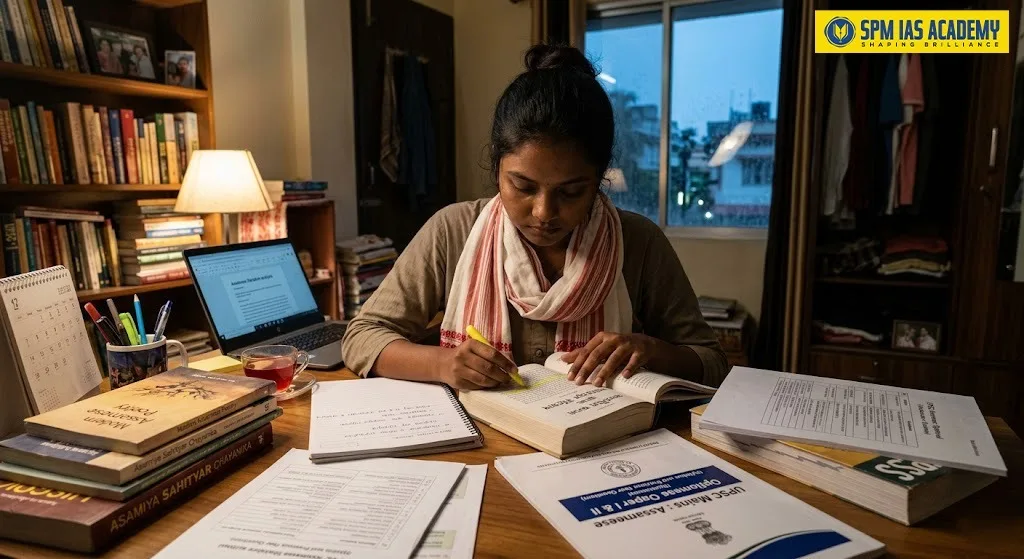
The UPSC Assamese optional rewards candidates who combine broad literary knowledge with strong analytical and writing skills. Here is a structured approach to preparation.
- Familiarize yourself with the complete syllabus first: Go through both Paper I and Paper II in detail before picking up any book. Mapping every topic and prescribed text to a study schedule ensures focused and complete coverage without wasting time on out-of-syllabus material.
- Read widely across all literary periods: Cover classical, medieval, colonial-era, and modern Assamese works. Wide reading builds an understanding of how Assamese literature evolved across time and helps candidates draw connections between periods, movements, and authors in their answers.
- Develop analytical and interpretative skills: Reading alone is not enough. Practice analyzing prescribed texts by focusing on themes, character development, narrative techniques, symbolism, and the socio-cultural background of each work. This analytical depth is what UPSC Mains answers actually need.
- Revise regularly and practice answer writing consistently: The volume of content across two papers is large. Regular revision prevents forgetting, and consistent writing practice builds the structure, precision, and time management needed for 3-hour descriptive papers.
- Read original Assamese texts wherever possible: Original texts expose aspirants to authentic language, stylistic features, and cultural expressions of specific authors. Using original textual references in answers adds credibility and analytical depth that translated versions alone cannot provide.
- Answer exactly what the question asks: UPSC Mains rewards precision. Every answer should address the specific aspect of Assamese literature that the question targets, whether it is thematic analysis, literary criticism, or a historical contribution, without adding unnecessary background.
- Seek academic guidance where possible: Discussion with subject experts, experienced mentors, or fellow aspirants helps in gaining new perspectives, identifying weak areas, and improving answer structure. Academic exchange is particularly valuable for a literature optional where individual interpretation plays a large role.
UPSC Assamese Syllabus 2025 PDF Download
What Are the Best Books for UPSC Assamese Literature Optional?
Having the right reference books is one of the most practical decisions in preparing for the UPSC Assamese optional. Since quality study material for this optional is limited compared to mainstream subjects, identifying and sticking to reliable books gives candidates a real structural advantage. Here are the key books recommended for both papers.
Books for Paper I — Language and Literary History
“Assamese Literature: Its History and Development” by Maheswar Neog is one of the most authoritative texts available for the Assamese optional. It provides a comprehensive account of the growth, major periods, and high points in Assamese literature, which directly supports the literary history section of Paper I.
“A History of Assamese Literature” by Birinchi Kumar Barua offers a chronological account of Assamese literary works along with an analysis of their cultural importance. Since Paper I demands an understanding of literary periods from Charyyageeta to the post-independence era, this book is a solid foundational reference.
“A Critical History of Assamese Literature” by Birendranath Dutta focuses on critical approaches and academic literary criticism, which supports the literary criticism section of Section B in Paper I.
“The Heritage of Assam” by Padmeshwar Gogoi discusses the cultural and literary heritage of Assam in a broader context. Since the Assamese optional syllabus requires socio-cultural understanding alongside pure textual knowledge, this book adds important contextual depth.
“Modern Assamese Literature” by Sisir Kumar Das covers contemporary developments and recent literary trends in Assamese writing. This is particularly useful for the modern and post-independence period coverage required in Paper I.
Books for Paper II — Prescribed Texts and Modern Literature
“Padum Kunwari Aru Anyanya Galpa” by Lakshminath Bezbaroa is a short story collection that explores Assamese society and culture across various dimensions, providing a well-rounded view of Bezbaroa’s narrative style.
“Bakor Putek” by Navakanta Barua is a significant work that unfolds the complexities of Assamese life and folk traditions, directly relevant to Section B of the prescribed texts in the UPSC Assamese optional syllabus.
“Chameli Memsaab” by Raseswar Saikia is a widely acknowledged novella that reflects the socio-cultural backdrop of Assam and is valuable for understanding modern Assamese literary themes.
“Karengar Ligiri” by Phanindranath Sharma is an important play depicting the nuances of Assamese social structure and traditions. Since Karengar Ligiri by Jyotiprasad Agarwalla is also a prescribed text in Paper II, reading associated critical works like this one deepens textual understanding.
“Katha Sankalan” (Collection of Assamese Short Stories), edited by Prafulladutta Goswami, brings together short stories from multiple Assamese authors and provides strong insight into the narrative art and stylistic diversity of Assamese prose fiction.
These books collectively cover the breadth of the Assamese optional syllabus across both papers and should be supplemented with the original prescribed texts, which remain the most important study material of all.
Personalized UPSC Mains Mentorship helps aspirants refine answer writing, strategy, and performance for higher scores.
UPSC Assamese Syllabus 2025 PDF Download
Conclusion
The UPSC Assamese optional syllabus 2026 offers a genuine opportunity for candidates who bring strong Assamese language skills and a deep interest in literary study to the Mains examination. Spanning linguistic history, literary criticism, classical texts like the works of Sankaradeva and Madhavadeva, and modern works like those of Lakshminath Bezbaroa, Birendrakumar Bhattacharyya, and Navakanta Barua, the syllabus is rich and academically demanding. While the challenge of limited study resources is real, disciplined preparation, regular reading of original texts, and consistent answer writing practice can overcome these barriers effectively. Candidates who align their strengths with the Assamese optional syllabus and approach it with consistent effort stand a strong chance of scoring well in the optional papers and improving their overall position on the final merit list.
FAQ:
Fluency in Assamese is highly important for candidates opting for Assamese Literature in the UPSC Mains examination. A strong command over the language helps in accurately understanding literary texts, themes, and critical viewpoints. Moreover, fluency improves answer writing by allowing candidates to express ideas clearly, use appropriate literary terms, and maintain the originality and elegance of language expected in literature papers.
Yes, candidates are allowed to write the Assamese Literature optional papers entirely in Assamese. UPSC permits answers in the chosen optional language, and writing in Assamese often gives candidates an advantage as it helps preserve the original tone, expressions, and cultural nuances of the texts. This also enables better interpretation and more authentic literary analysis.
English translations of some important Assamese literary works are available in the market and through academic publications. These translations can be helpful for basic understanding, especially for beginners. However, relying solely on translations is not advisable, as certain linguistic richness, cultural context, and stylistic elements may be lost. Therefore, original Assamese texts should be read as much as possible for better conceptual clarity and answer quality.
Several authors hold consistent importance in the UPSC Assamese Literature syllabus. Works of Shankardeva and Madhavdeva are crucial for understanding the Vaishnavite literary tradition. Lakshminath Bezbaroa plays a key role in modern Assamese literature, while Jyotiprasad Agarwalla’s writings reflect cultural and social transformation. Birendra Kumar Bhattacharyya’s works are also significant for their realistic portrayal of society and historical context. A thorough study of these authors strengthens preparation and enhances scoring potential.

Behind every article at SPM IAS Academy is a team of skilled content writers and subject experts committed to making preparation easier for aspirants. From answering common doubts to breaking down complex issues and current affairs, we create content that is accurate, easy to understand, and directly useful for UPSC, APSC, and other competitive exams.