
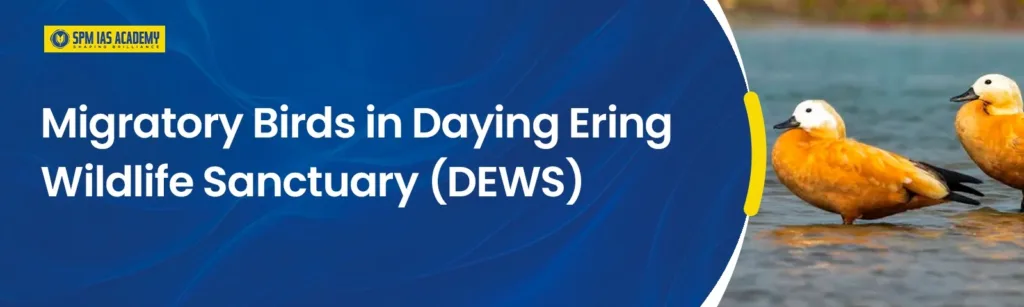
Recently, winter migratory birds have started arriving at the water bodies of Daying Ering Wildlife Sanctuary in East Siang district. Simultaneously, several migratory species have been observed in the wetlands bordering Jonai in Assam. It indicates cross-regional ecological connectivity. Notably, bird sightings include Ruddy Shelduck (Tadorna ferruginea), Great Cormorant (Phalacrocorax carbo), Black-bellied Tern (Sterna acuticauda) and Other smaller migratory waterfowl. These developments confirm the onset of the winter migration season in the Siang River basin.
Migratory Pattern & Seasonal Significance:
- Winter migratory birds regularly visit the water bodies of DEWS during colder months.
- Additionally, they depend on the river basins of the Siang and Lali rivers for feeding, resting, and roosting.
- Consequently, DEWS functions as a critical wintering and stopover site along migratory flyways in Northeast India.
About Daying Ering Wildlife Sanctuary (DEWS):
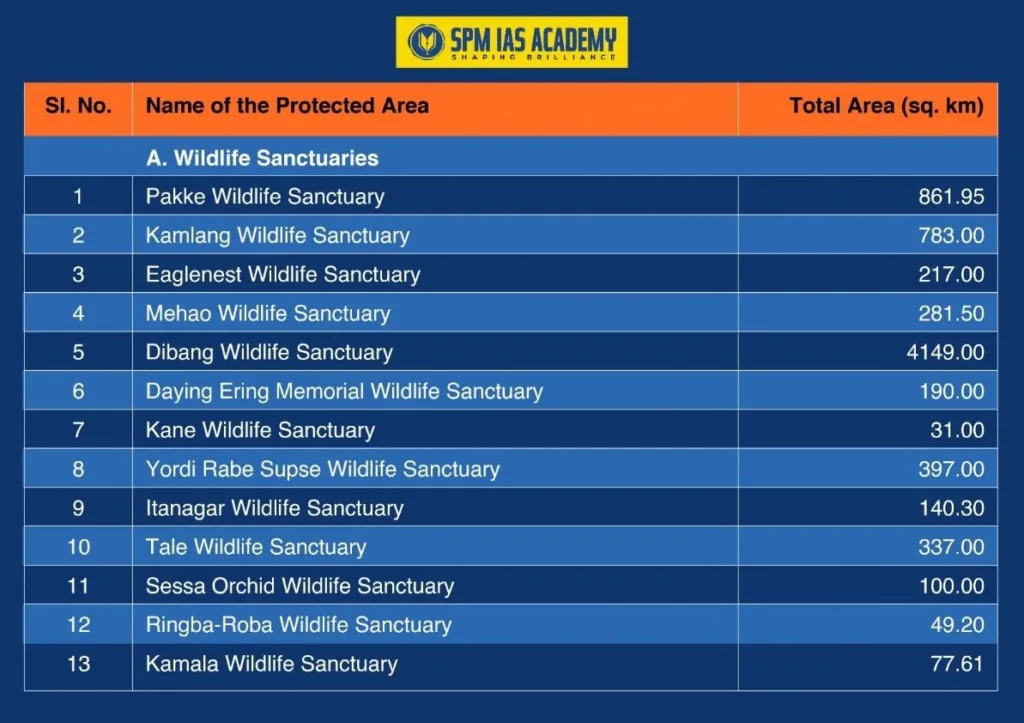
- The D’Ering Wildlife Sanctuary was established in 1978 covering an area of 190 sq. km.
- About 80% of its area is grassland and the remaining is riverine forest mixed with bamboo and secondary forests.
Location & Geographic Setting of Daying Ering Wildlife Sanctuary (DEWS):
- Daying Ering Wildlife Sanctuary also known as D’Ering Wildlife Sanctuary is located about 8 km from Pasighat town, near the Lower Mebo area of East Siang district.
- Geographically, the sanctuary is sandwiched between the Siang River and the Sibya River.
- This unique riverine setting creates ideal wetland ecosystems, including floodplains, sandbars and shallow water bodies.
What are the Ecological Importances of Daying Ering Wildlife Sanctuary (DEWS)?
- The sanctuary is endowed with pristine wetlands and sandbars, which support high avian diversity.
- Moreover, these habitats provide abundant food resources, safe resting grounds and suitable breeding and wintering conditions.
- As a result, DEWS plays a vital role in maintaining the ecological balance of the Siang Valley.
- Importantly, the sanctuary strengthens riverine biodiversity conservation in Arunachal Pradesh.
Avifaunal Significance of Daying Ering Wildlife Sanctuary:
- D’Ering Wildlife Sanctuary hosts several globally threatened bird species, making it an important conservation area.
- Key threatened species found here include Endangered vultures, Bengal Florican – one of the rarest grassland birds in the world.
- Moreover, the sanctuary supports both resident and migratory bird populations, enhancing its biodiversity value.
What is a Wildlife Sanctuary?
Wildlife Sanctuaries are protected areas notified by the State to conserve wild animals, birds, plants, and their habitats. In Arunachal Pradesh, at present there are 13 Wildlife Sanctuaries. Unlike national parks, wildlife sanctuaries allow limited human activities, provided they do not harm wildlife. Thus, they strike a balance between conservation and sustainable use.
Legal Framework of Wildlife Sanctuary:
- Wildlife Sanctuaries are notified under the Wild Life (Protection) Act, 1972.
- The State Government has the authority to declare an area as a wildlife sanctuary.
- Importantly, boundaries of a sanctuary can be altered by the State Government, unlike national parks which require legislative approval.
What are the Objectives of Wildlife Sanctuaries?
- The first and foremost objective of a wildlife sanctuary is to protect wildlife species from hunting, poaching, and habitat destruction.
- Secondly, it aims to preserve ecological balance and maintain food chains.
- Another important objective is to conserve biodiversity, especially endangered and threatened species.
- To promote scientific research, education, and awareness, under regulated conditions is also one of the most important objectives of wildlife sanctuary.
What are the important prohibited activities within a wildlife sanctuary?
Within a wildlife sanctuary, certain activities are strictly prohibited to ensure the protection of biodiversity. First and foremost, hunting, capturing, or killing of wild animals is completely banned. This restriction is essential to safeguard endangered species and maintain natural population balance. By preventing human interference in wildlife survival, sanctuaries help preserve ecological stability.
In addition, any form of destruction or diversion of wildlife habitat is not permitted. Activities such as land conversion, construction, or alteration of natural water sources can severely disrupt ecosystems. Therefore, these actions are restricted to ensure that animals continue to thrive in their natural surroundings without disturbance.
Moreover, illegal logging, mining, and encroachment are strictly forbidden within sanctuary boundaries. Such activities lead to deforestation, soil erosion, and loss of habitat. As a result, wildlife sanctuaries function as strong legal safeguards, protecting ecosystems from ecological degradation and ensuring long-term environmental conservation.
Conclusion:
In conclusion, the arrival of winter migratory birds in Daying Ering Wildlife Sanctuary highlights the ecological importance of riverine wetlands in Northeast India. Moreover, it reflects the strong ecological connectivity between Arunachal Pradesh and Assam through shared river basins. At the same time, the sanctuary’s rich avifaunal diversity underscores its role as a critical wintering and stopover site along major migratory flyways. Therefore, effective protection under the Wildlife (Protection) Act, 1972 becomes essential to safeguard these fragile ecosystems. Ultimately, sustained conservation efforts and responsible management of wildlife sanctuaries are vital for maintaining biodiversity, ecological balance, and long-term environmental stability.
Source: Arunachal Times
📘 You can also visit our APPSC Page for the latest updates, syllabus, and exam-related current affairs.
FAQ:
Daying Ering Wildlife Sanctuary is a crucial wintering and stopover site for migratory birds in the Siang River basin. Located between the Siang and Sibya rivers, its wetlands, floodplains, and sandbars provide ideal conditions for feeding, resting, and roosting. Species such as Ruddy Shelduck, Great Cormorant, and Black-bellied Tern regularly visit the sanctuary, highlighting its role in riverine and wetland biodiversity conservation in Arunachal Pradesh.
D’Ering Wildlife Sanctuary supports high avian diversity, including globally threatened species like endangered vultures and the Bengal Florican. It is one of the rarest grassland birds in the world. With nearly 80% grassland and riverine forest ecosystems, the sanctuary plays a vital role in maintaining ecological balance in the Siang Valley, while also strengthening India’s efforts toward wildlife protection and sustainable habitat management under the Wild Life (Protection) Act, 1972.

SPM IAS Academy is a leading APSC & UPSC coaching institute based in Guwahati, Assam, dedicated to helping aspirants achieve success in civil services examinations. The academy provides expert mentorship, comprehensive study materials, current affairs guidance, test series, and personalized preparation strategies for APSC, UPSC, and other competitive exams. With a strong focus on quality education, discipline, and result-oriented learning, SPM IAS Academy has become a trusted name among civil service aspirants across Assam and Northeast India.