
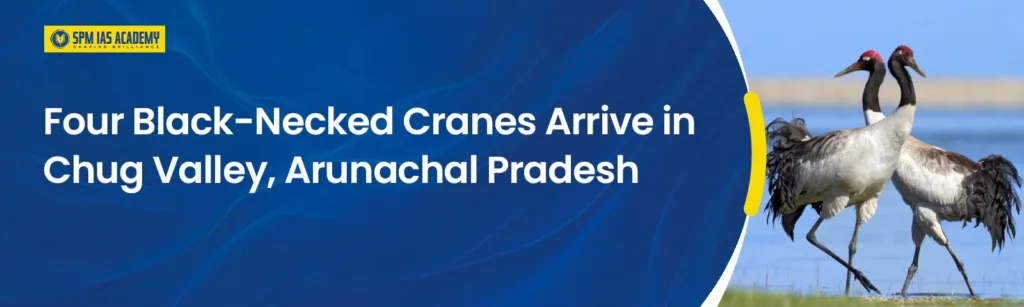
In an important biodiversity development, four Black-necked Cranes have arrived in the Chug Valley of West Kameng district, Arunachal Pradesh. Notably, observers recorded four cranes together in the valley for the first time. Consequently, this sighting highlights Arunachal Pradesh’s ecological importance as a key wintering and transit habitat for rare migratory birds. This makes it highly relevant for environment and biodiversity conservation topics in APPSC, UPSC, and other competitive examinations.
Details of the Sighting Black Necked Crane:
According to reports from Dirang, the four Black-necked cranes were spotted in the Chug Valley on 19 January 2026.
Key Observations:
- This is the first recorded instance of four black-necked cranes together in Chug Valley.
- Earlier sightings usually involved a pair or sometimes three cranes.
- The group includes three adult cranes and one juvenile. Biologists confirmed that the juvenile likely belongs to a pair that was separated last season.
This makes the sighting ecologically rare and scientifically valuable.
Why Do Black-Necked Cranes Visit Arunachal Pradesh?
Habitat Preference: Black-necked cranes prefer high-altitude valleys, marshlands and riverine grasslands. It also prefers areas with minimal human disturbance. The valleys of West Kameng district provide ideal wintering conditions, including food availability and relative safety.
Know about Black-Necked Crane:
- The Black-Necked Crane (Grus nigricollis) is a medium-sized species belonging to the crane family.
- Primarily, the species breeds in high-altitude wetlands of the Tibetan Plateau. These wetlands, with small mounds, provide ideal conditions for nesting and breeding.
- Geographically, we can find Black-Necked Crane in India, China, and Bhutan. Moreover, its breeding ground is at an elevation ranging from 2,950 to 4,900 metres above mean sea level.
- However, the species faces growing threats. It ranges from habitat loss to degradation caused by increasing climate change, shifting agricultural practices, pollution, and environmental contamination.
Conservation Status of the Black-Necked Crane:
- Black-necked crane IUCN Status: Near Threatened
- Legal Protection in India: Schedule I of the Wildlife (Protection) Act, 1972
- On the other hand, the CITES kept Black-necked cranes in Appendix I.
What are the Cultural and Ecological Importance of the black-necked crane:
Cultural Significance:
In the Himalayan regions, the Black-necked crane is considered a sacred bird. It symbolises peace and longevity, especially in Buddhist communities.
Ecological Importance:
Black-necked cranes act as indicators of healthy wetland ecosystems. At the same time, it plays an important role in maintaining ecological balance. Moreover, it reflects the success of habitat protection measures.
What are the Threats Faced by Black-Necked Cranes?
Despite protection, the Black-necked crane faces several threats such as:
- Firstly, habitat loss caused by infrastructure development has reduced safe breeding and wintering areas.
- Secondly, attacks by stray and feral dogs pose a serious risk, particularly in open wetlands and valleys.
- Moreover, increasing human disturbance in wintering grounds disrupts feeding and resting behaviour.
- Finally, climate change is altering migration routes and seasonal patterns, further stressing the species.
- Notably, the recent injury incident in the Chug Valley underscores the rising threat posed by feral animals to wildlife conservation.
How to protect black-necked cranes?
To protect the Black-necked crane effectively,
- Firstly, there must be stronger monitoring of breeding and wintering habitats.
- Secondly, controlling feral dog populations near wetlands and wildlife zones is essential to reduce direct threats.
- Moreover, community awareness and local participation should be enhanced to support conservation efforts.
- Finally, promoting eco-sensitive and responsible tourism practices can help minimise human disturbance.
- Overall, these measures are crucial for the long-term conservation of the species.
Conclusion:
The arrival of four Black-necked Cranes in Chug Valley is a positive sign for wildlife conservation in Arunachal Pradesh. At the same time, it underscores the need for stronger habitat protection and human–wildlife conflict management.
For UPSC and APPSC aspirants, this development is a high-value current affairs topic. It links to biodiversity, conservation policy, and regional ecology, and is especially useful for mains answers and interviews.
Source:
https://www.youtube.com/channel/UC8XTwBsJM-fRQmcGivtcYgA
The sighting of four Black-Necked Cranes in Chug Valley is significant. Because it is the first verified instance of four cranes together. It highlights Arunachal Pradesh as an important wintering and transit habitat for rare migratory birds.
In India, the Black-Necked Crane is mainly found in high-altitude valleys of Arunachal Pradesh and Ladakh, using these regions as wintering grounds during migration from the Tibetan Plateau.
The Black-Necked Crane is listed as Near Threatened on the IUCN Red List, protected under Schedule I of the Wildlife (Protection) Act, 1972, and included in CITES Appendix I.
Major threats to the Black-Necked Crane include habitat loss, climate change, human disturbance, and attacks by feral dogs, which affect its migration, feeding, and breeding behaviour.

Behind every article at SPM IAS Academy is a team of skilled content writers and subject experts committed to making preparation easier for aspirants. From answering common doubts to breaking down complex issues and current affairs, we create content that is accurate, easy to understand, and directly useful for UPSC, APSC, and other competitive exams.