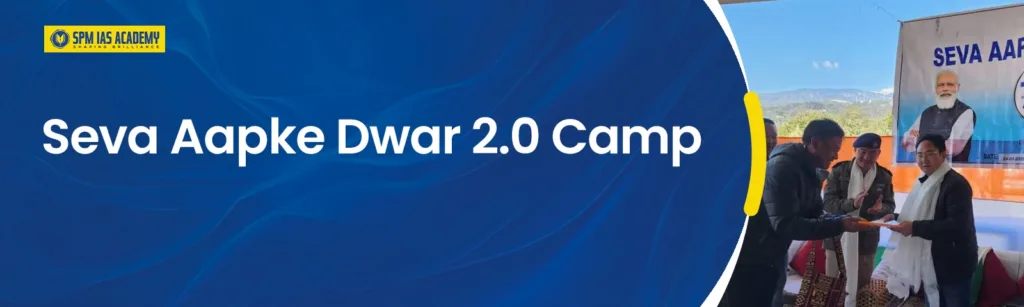
Why was Seva Aapke Dwar 2.0 Camp in the News?
The Seva Aapke Dwar 2.0 Camp was organised at a Government Higher Secondary School in Lower Subansiri district of Arunachal Pradesh. The camp was jointly conducted by the Tourism, Forest, and Rural Development Departments as part of the Good Governance Week celebrations .Moreover, the initiative brought essential government services directly to citizens, benefiting hundreds of villagers in a single window.
What is Seva Aapke Dwar 2.0?
Seva Aapke Dwar 2.0 is a people-centric governance initiative aimed at improving last-mile service delivery. To begin with, it follows an integrated service delivery model. Under this, multiple government departments provide services under one roof, thereby reducing the administrative burden on citizens.
Moreover, the initiative focuses on grassroots outreach, especially targeting rural and remote areas where access to government offices is limited. As a result, services are delivered at the doorstep. It enhances citizen convenience by saving time, cost, and effort, while strengthening transparent and inclusive governance.
Major Services Provided under the Seva Aapke Dwar 2.0:
To begin with, the initiative offers MGNREGA-related services, including registration for new job cards and replacement of old or damaged job cards.
Additionally, it provides support for housing welfare, particularly through the registration of eligible beneficiaries under Pradhan Mantri Awaas Yojana – Gramin (PMAY-G).
Moreover, the programme focuses on facilitation and awareness by offering guidance on eligibility criteria, required documentation, and grievance redressal mechanisms. It will ensure smoother access to government services.
Governance Significance:
To begin with, the initiative reflects the core principle of people-centric and responsive governance.
Moreover, it strengthens the last-mile delivery of welfare schemes, ensuring that benefits reach intended beneficiaries effectively.
At the same time, it enhances administrative efficiency and transparency through direct interaction between officials and citizens.
Finally, it reinforces the objectives of Good Governance Week (Sushasan Saptah) by promoting accountability, accessibility, and inclusive service delivery.
Administrative and Policy:
To begin with, it promotes convergence of multiple departments at the field level, enabling coordinated service delivery.
Moreover, they support the effective implementation of flagship schemes such as MGNREGA and PMAY-G, ensuring better outreach and beneficiary coverage.
At the same time, the initiative aligns with broader governance reforms by strengthening accessibility, accountability, and inclusion in public service delivery.
Conclusion:
Overall, the camp in Arunachal Pradesh clearly demonstrates how people-centric governance and last-mile service delivery can improve citizens’ everyday lives. By bringing essential government services under one roof, the initiative reduces administrative hurdles and ensures faster access to welfare schemes such as MGNREGA and PMAY-G. Moreover, its alignment with Good Governance Week (Sushasan Saptah) highlights the state’s focus on transparent, inclusive, and accountable administration. For APPSC GS Paper II and Arunachal Pradesh current affairs, Seva Aapke Dwar 2.0 serves as a practical example of effective governance reforms, departmental convergence, and citizen-friendly service delivery.
Mains Practice Question:
“Doorstep delivery of public services is central to achieving people-centric and responsive governance.” In this context, examine the objectives and significance of the Seva Aapke Dwar 2.0 initiative in Arunachal Pradesh. Discuss how such integrated service delivery models strengthen last-mile governance, improve administrative efficiency, and support the effective implementation of welfare schemes like MGNREGA and PMAY-G.
Source: Arunachal Times
Also read: ITANAGAR DEO RECEIVES RAKSHA MANTRI AWARD, 2025
It is a people-centric governance initiative that delivers government services at the doorstep, especially in rural and remote areas. It aims to ensure doorstep government services by bringing multiple departments under one platform. Therefore, it will improve last-mile service delivery and transparency.
The initiative improves welfare delivery by enabling on-the-spot registration, awareness, and grievance redressal for schemes like MGNREGA and PMAY-G. It will ensure faster outreach and better beneficiary coverage through departmental convergence.

Behind every article at SPM IAS Academy is a team of skilled content writers and subject experts committed to making preparation easier for aspirants. From answering common doubts to breaking down complex issues and current affairs, we create content that is accurate, easy to understand, and directly useful for UPSC, APSC, and other competitive exams.