
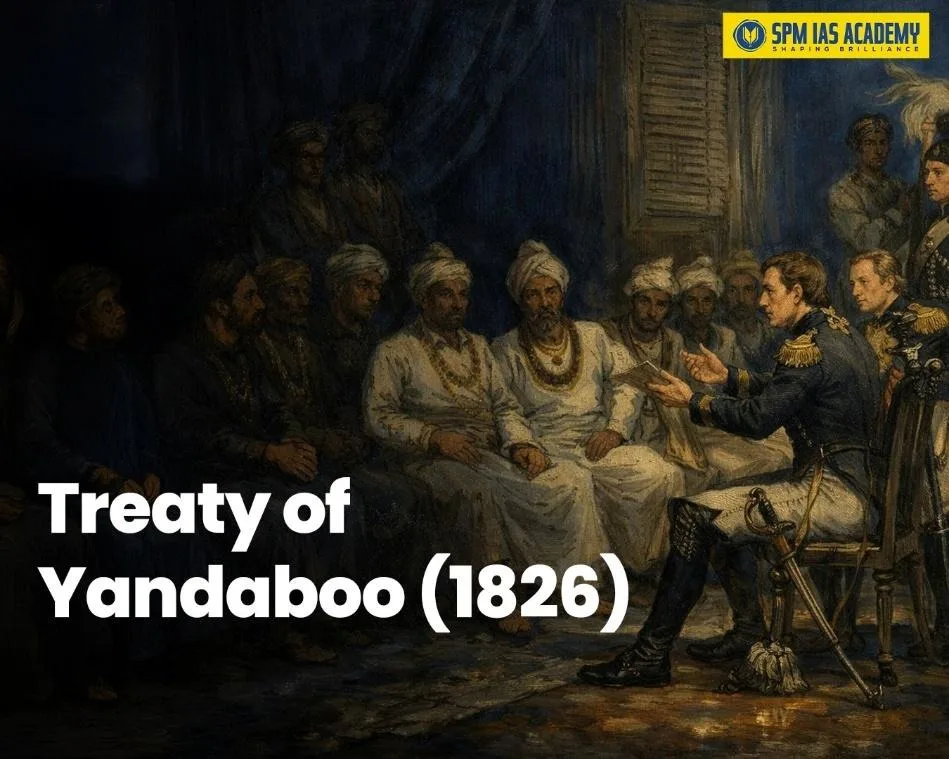
The Treaty of Yandaboo, signed on 24 February 1826, formally ended the First Anglo-Burmese War and led to the annexation of Assam into the British Empire. As the treaty completes 200 years in 2026, it remains one of the most important turning points in the history of Northeast India. The agreement not only dismantled the Ahom monarchy but also transformed Assam’s political, economic, and social structure under colonial rule.
Therefore, understanding the Treaty of Yandaboo is essential for comprehending Assam’s colonial history, British expansionism, and the socio-economic transformation of the region.
Background – Events Leading to the Treaty of Yandaboo:
The roots of the Treaty of Yandaboo lie in the growing tension between the Burmese Empire and the East India Company.
- Firstly, from 1784–85 onwards, Burmese forces expanded westward and reached the Bengal frontier. This expansion alarmed the British authorities.
- The Burmese sent threatening letters to the East India Company. They warned that if the Company sheltered the fugitive Ahom king Chandrakanta Singha, they would invade Company territory with an army of 18,000 soldiers.
- Consequently, the British strengthened their military presence under David Scott.
- In 1823, Scott informed the Company Council that the Burmese must evacuate Assam even if negotiations succeeded.
- On 4 March 1824, the First Anglo-Burmese War began. Within three weeks, British forces occupied Assam up to Kaliabar.
- The British quickly introduced dual administration — military under Colonel Richards and civil administration under David Scott.
- Moreover, earlier developments such as Captain Welsh’s expedition (1792), the discovery of indigenous tea in 1823, and trade concerns with China had already increased British interest in Assam.
Therefore, the ground for annexation had been prepared much earlier.
Terms and Conditions of the Treaty of Yandaboo:
The Treaty of Yandaboo contained 11 Articles. These articles mainly established British authority over Burma and its dependent territories.
Key provisions included:
- Firstly, Article 1 declared perpetual peace and friendship between the British and the Burmese.
- Secondly, Article 2 sealed the fate of Assam, Cachar, and Jaintia by removing Burmese claims.
- Moreover, Article 5 required the Burmese king to pay a war indemnity of ₹1 crore to the British. The payment was structured in stages:
- 25% payment would ensure British withdrawal up to Rangoon.
- Another 25% would lead to full evacuation within 100 days.
- The remaining 50% would be paid in two annual instalments.
This heavy indemnity deeply weakened the Burmese economy.
Impact on the Ahom Kingdom and Political Structure:
In 1826, the Burmese ceded Assam to the East India Company. However, Article 2 vaguely mentioned Assam, leaving scope for British interpretation.
Importantly, the Company had already signed treaties with the rulers of Cachar and Jaintia in 1824. No such treaty was signed with Assam.
As a result, Assam remained politically vulnerable. The British gradually established themselves as the de facto authority.
In 1825, David Scott recommended annexing Lower Assam permanently while restoring a native ruler in Upper Assam. However, citing the “oppressive character” of King Purandar Singha, the British annexed Upper Assam as well.
Thus, the Ahom monarchy effectively came to an end.
Socio-Economic Condition of Assam Before British Rule:
Before British occupation, Assam had suffered immense devastation under Burmese rule.
The Burmese invasion led to:
- Widespread killings of men, women, and children.
- Enslavement of nearly 30,000 Assamese people during the retreat.
- Excessive revenue extraction of ₹4,47,940 in 1822 compared to the Ahom assessment of ₹1,90,953.
These horrific days are remembered as “Maanor Din” in Assamese memory.
Although revenue collection remained above ₹2 lakh in some regions, the physical and human suffering was far greater than economic exploitation.
Moreover, limited money circulation and poor communication systems slowed commerce and industry.
Economic Transformation After the Treaty of Yandaboo:
The Treaty of Yandaboo opened Assam to modern economic forces under colonial rule.
- Firstly, the British introduced large-scale tea plantations. This drastically changed the demography of the region as labourers were brought from other parts of India.
- Capital investment rose significantly from £1 million in 1872 to £14 million in 1890
- In addition, further developments included:
- Formation of the Assam Railways and Trading Company in 1881.
- Coal production reached 293,000 tonnes by 1903 (5% of India’s total output).
However, as historian Dr. Amalendu Guha observed, the colonial objective was to convert Assam into an agricultural estate for British tea consumption.
Cultural and Intellectual Impact:
The Treaty also influenced Assamese society and literature.
American Baptist missionaries, including Nathan Brown, Oliver Thomas Cutter, and Miles Bronson, arrived in Assam.
Important developments included the publication of the Orunodoi in 1846. Moreover, Anandaram Dhekial Phukan published Asamiya Lorar Mitra(1849), which reflected a new intellectual awakening.
Thus, Assam entered a phase of cultural revival alongside colonial economic transformation.
Political Impacts of the Treaty and Colonial Reordering:
The Treaty of Yandaboo transformed the region into a British colony. It initiated a deep restructuring of land, governance, and identity that continues to shape political conflicts and aspirations in Northeast India.
- Before colonial rule, the region functioned through diverse polities governed by customary law and flexible territorial arrangements. However, the British imposed centralized administration based on maps, surveys, and revenue systems.
- The colonial redrawing of boundaries redefined authority, as legitimacy increasingly depended on state recognition rather than customary institutions.
- Moreover, the division of hills and plains for administrative convenience created artificial categories that ignored local socio-political realities.
- In addition, colonial land settlements converted collective and oral land rights into documented titles. It weakened indigenous governance systems and strengthened bureaucratic control.
- As a result, land and territory-related conflicts intensified, particularly where customary ownership survived in practice but lacked statutory recognition.
- Furthermore, independent India inherited an uneven legal framework. Although constitutional safeguards like the Sixth Schedule and special provisions for certain states aimed to protect indigenous systems, customary dispute resolution remains weakly integrated into formal law.
- Therefore, land disputes in regions such as Bodoland and Manipur remain persistent and emotionally charged due to the gap between legal provisions and lived realities.
- At the same time, colonial policies actively encouraged migration for plantation and industrial labour. It significantly altered the demographic composition of the region.
- After Independence, these demographic shifts hardened into political fault lines, intensifying debates over indigeneity, autonomy, and territorial rights.
- Consequently, migration is now often framed as a security issue, deepening mistrust between communities and the state.
Thus, historical memories of dispossession and disrupted sovereignty continue to fuel demands for autonomy, special status, and political recognition.
Impact on Environment and Ecology:
- Firstly, colonial forest laws and land classifications brought forests and natural resources under state control. Consequently, it displaced indigenous systems of ecological conservation.
- Moreover, shared forests and shifting cultivation areas were reclassified as “reserved forests” or “wastelands.” It undermined traditional livelihood systems and collective resource management.
- Furthermore, revenue-driven land settlements in the plains transformed flexible land use into taxable private holdings. It prioritised extraction over sustainability.
- Even today, development projects such as highways, oil drilling, and hydroelectric dams often bypass customary institutions. They compel communities to struggle for recognition of ancestral land rights.
- Consequently, environmental disputes frequently escalate into ethnic or political conflicts, particularly where customary rights lack formal legal backing.
Why the Treaty of Yandaboo Remains Important Today:
The Treaty of Yandaboo remains significant because:
- Firstly, the Treaty of Yandaboo formally ended the First Anglo-Burmese War (1824–1826), bringing a decisive shift in regional power dynamics.
- Moreover, it marked the beginning of British colonial rule in Assam, thereby altering the political structure of the region.
- Consequently, the treaty led to the dismantling of the Ahom monarchy and the decline of indigenous sovereignty.
- In addition, it transformed Assam’s economy through the introduction of tea plantations, railway networks, and coal industries under British administration.
- Ultimately, it integrated Assam with the emerging global economy and connected the region to international trade and commerce.
Conclusion: Treaty of Yandaboo – A Turning Point in Assam’s History
The Treaty of Yandaboo (1826) represents a historic milestone that reshaped Assam’s political, economic and social landscape. By annexing Assam to the British Empire, it ended centuries of Ahom rule and initiated colonial transformation.
The treaty led to British expansion in Northeast India, the introduction of tea plantations, railway development, coal mining, and missionary activities. At the same time, it caused political displacement and long-term socio-economic changes.
Source:
https://www.britannica.com/event/Treaty-of-Yandabo
The Treaty of Yandaboo (24 February 1826) was an agreement between the British East India Company and the Burmese Empire that ended the First Anglo-Burmese War and led to the annexation of Assam into the British Empire.
The Treaty of Yandaboo was signed to end the First Anglo-Burmese War (1824–1826). It formalized peace between the British and the Burmese and transferred control of Assam, Cachar, and Jaintia to the East India Company.
The main provisions of the Treaty of Yandaboo 1826 included perpetual peace, cession of Assam to the British, and payment of a war indemnity of ₹1 crore by the Burmese king to the East India Company.
The Treaty of Yandaboo led to the collapse of the Ahom monarchy. The British gradually annexed Assam and dismantled indigenous political authority, bringing the region under colonial rule.
The Treaty of Yandaboo marked the beginning of British colonial rule in Assam, transformed its economy through tea plantations and railways, and integrated the region into the global colonial economy.

Behind every article at SPM IAS Academy is a team of skilled content writers and subject experts committed to making preparation easier for aspirants. From answering common doubts to breaking down complex issues and current affairs, we create content that is accurate, easy to understand, and directly useful for UPSC, APSC, and other competitive exams.