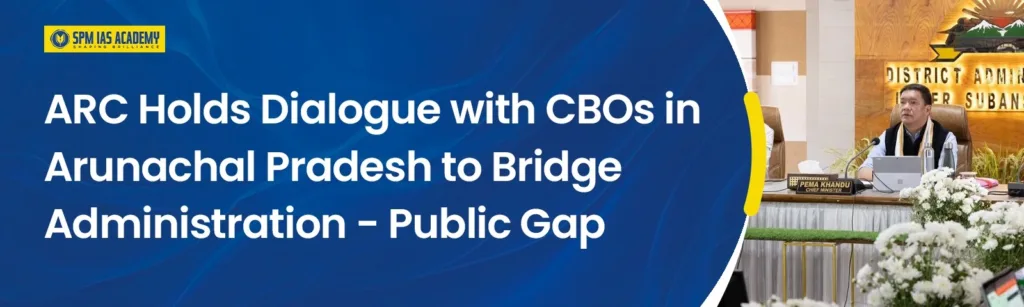
The Arunachal Pradesh Administrative Reforms Commission (ARC) has initiated a high-level dialogue with community organisations. It aims to bridge the gap between the state administration and the public. The interaction was held at Naharlagun on 20 January. Leaders of the Arunachal Indigenous Tribes Forum (AITF) and various Community-Based Organisations (CBOs) participated.
The core aim was to build social trust, improve transparency, and reposition the ARC as a responsive ‘limb of governance’. It is an issue directly relevant to UPSC and APPSC Mains under governance, ethics, and inclusive administration.
What are the Key Takeaways from the ARC Dialogue with CBO?
1. Bridging the Administration-Public Gap:
Firstly, the dialogue acknowledged a persistent trust deficit between citizens and the state. By engaging CBOs, the ARC seeks two-way communication, grievance redressal, and policy co-creation.
2. Building Social Trust:
Secondly, discussions centred on social trust which is the foundation of effective governance. Trust depends on predictable procedures, transparent decisions, and respectful engagement, especially in culturally diverse regions.
3. ARC as an Enabler of Governance:
Moreover, the ARC articulated its role as an institutional enabler and not merely a reviewer.
4. Indigenous Empowerment:
Importantly, the engagement prioritised indigenous voices, recognising customary institutions, local knowledge systems, and community leadership as assets for policy implementation.
What are the Best Practices Highlighted in the ARC Dialogue with CBO?
- Firstly, the dialogue highlighted the importance of holding regular and structured interactions with Community-Based Organisations so that communication between the administration and citizens remains continuous and meaningful.
- Secondly, it emphasised the inclusion of indigenous representatives in the design of administrative reforms, ensuring that policies are rooted in local realities and customary practices.
- Moreover, the need for feedback-driven administrative reforms was underlined, where public inputs and community experiences are used to improve governance outcomes.
- Finally, the dialogue stressed cultural sensitivity in service delivery, recognising that respect for social and cultural diversity is essential for building trust and effective governance.
Way Forward – Policy Suggestions:
- Firstly, consultations should be institutionalised by conducting periodic ARC–CBO forums to ensure sustained dialogue and participatory decision-making.
- Secondly, grievance redressal mechanisms should be digitised and supported by local facilitation centres to improve accessibility and timely resolution.
- Moreover, capacity-building programmes must be introduced for officials to enhance cultural competence and sensitivity in administration.
- In addition, outcome tracking should be strengthened through public dashboards to promote transparency, accountability, and performance monitoring.
- Finally, where feasible, consultative mechanisms should be given legal recognition to formalise community participation in governance processes.
Arunachal Pradesh Administrative Reforms Commission (APARC):
- Firstly, the Arunachal Pradesh Administrative Reforms Commission (APARC) is a state-level body set up to improve the efficiency, transparency, and responsiveness of governance in Arunachal Pradesh.
- Secondly, the Commission studies the working of the state administration and suggests reforms to make public service delivery citizen-centric and effective.
- Moreover, APARC focuses on simplifying rules, procedures, and processes. So that people can access government services easily and without unnecessary delays.
- In addition, it examines issues related to institutional capacity, accountability, and use of technology in administration.
- Importantly, the Commission engages with stakeholders such as government departments, community-based organisations, and civil society to understand ground-level challenges.
- Furthermore, APARC places special emphasis on local conditions of Arunachal Pradesh, including difficult terrain, cultural diversity, and remote habitations.
- As a result, its recommendations aim to promote inclusive governance, strengthen public trust, and ensure better coordination between the government and citizens.
Conclusion:
The ARC Dialogue with CBO in Arunachal Pradesh represents a significant step toward participatory governance. It also promotes inclusive administration, and citizen-centric reforms. By directly engaging with Community-Based Organisations (CBOs) and indigenous apex bodies, the Arunachal Pradesh Administrative Reforms Commission (APARC) is actively working to bridge the administration-public gap and rebuild social trust in governance. This initiative strengthens transparency, accountability, and cultural sensitivity in public administration, which are essential for effective service delivery in a diverse and remote region like Arunachal Pradesh. Overall, the dialogue highlights a governance model rooted in collaboration, trust-based policymaking, and inclusive development. It makes this topic highly relevant for UPSC and APPSC examinations for GS 2 and GS 4, especially under governance, ethics, and administrative reforms.
Source: Arunachal Times
📘 You can also visit our APPSC Page for the latest updates, syllabus, and exam-related current affairs.
FAQ:
The ARC dialogue is an initiative by the Arunachal Pradesh Administrative Reforms Commission to engage Community-Based Organisations. It aims to bridge the gap between the administration and the public.
It strengthens social trust, promotes transparency, and enables participatory governance by involving indigenous and community voices in policy discussions.