

Assam ranked 24th among 36 States and UTs in NITI Aayog’s Export Preparedness Index (EPI) 2024. The state exported around ₹3,700 crore in FY 2024. Tea remains Assam’s largest export and contributes more than 50% of merchandise exports. However, infrastructure gaps and limited diversification restrict export growth. This topic is highly important for UPSC and APSC under Economy, Governance, and Regional Development.
What is the Export Preparedness Index (EPI) 2024?
NITI Aayog released the fourth edition of the Export Preparedness Index, 2024. The first edition came in August 2020.
The index measures export readiness and growth potential of States and UTs. It supports India’s goal of achieving USD 1 trillion merchandise exports by 2030. It also aligns with the vision of Viksit Bharat @2047.
Key Features of EPI 2024:
- Structured around 4 pillars.
- Divided into 13 sub-pillars.
- Based on 70 indicators.
- Uses official data from Central and State governments.
- Focuses on districts as export units.
The index categorises States into:
- Large States
- Small States
- North East States
- Union Territories
Within each category, States are grouped as Leaders, Challengers, and Aspirers.
Assam’s Rank in Export Preparedness Index 2024:
- Firstly, Assam ranked 24th out of 36 States and Union Territories in the Export Preparedness Index 2024.
- Moreover, the state ranked below its northeastern neighbours, including Nagaland and Tripura.
Key Findings for Assam:
- In FY 2024, Assam recorded exports of approximately ₹3,700 crore.
- However, its share in India’s total exports remained below 1%.
- Importantly, tea accounted for over 50% of Assam’s total merchandise exports.
- Therefore, the data clearly indicates that Assam relies heavily on a narrow export basket, making diversification essential for long-term resilience.
Major Export Items of Assam:
Assam exports both primary and value-added goods; however, tea continues to dominate the state’s export profile.
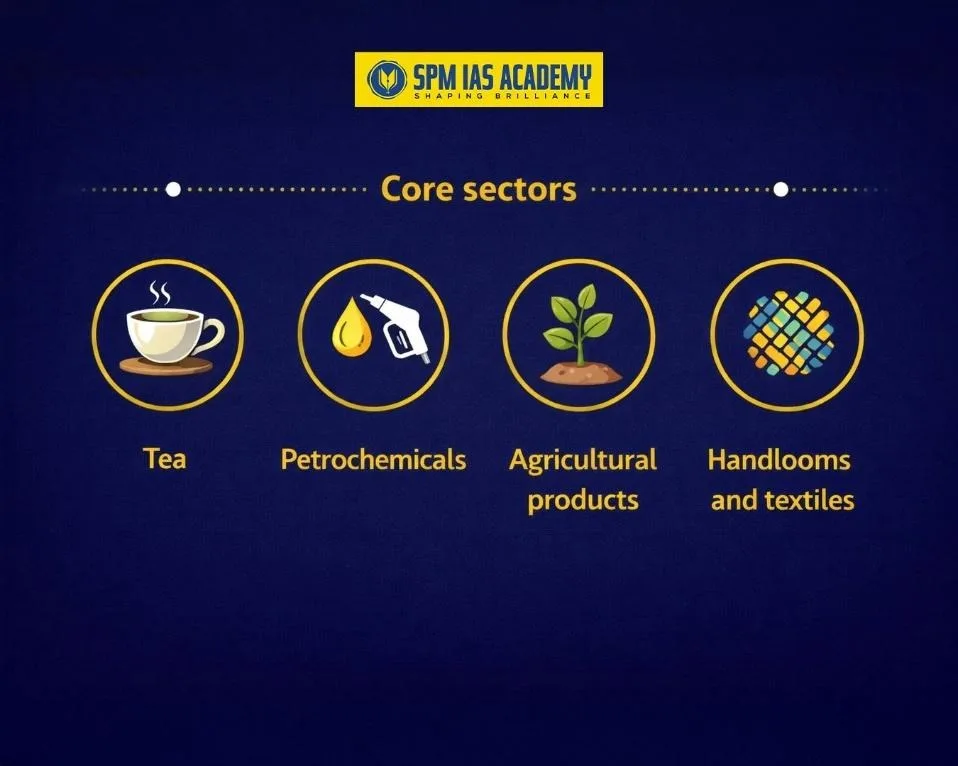
Firstly, Assam is globally recognised for its premium tea, and importantly, Assam tea holds a Geographical Indication (GI) tag. Notably, tea contributes more than 50% of the state’s total merchandise exports, making it the backbone of Assam’s export economy.
Secondly, rice also plays a significant role in the export basket. This includes Joha rice, which is a GI product. Moreover, it is witnessing growing demand in niche and specialty markets.
Thirdly, petroleum products form an important component of exports. These mainly consist of refined petroleum products and are directly linked to Assam’s oil fields and refineries. In addition, coal, coke, and semi-coke contribute to industrial and energy-related exports.
Furthermore, Assam exports high-quality silk varieties such as Muga silk, Eri silk, and Pat silk. These products highlight the state’s rich handloom tradition and cultural heritage.
Lastly, pharmaceutical products have shown gradual growth in recent years. Therefore, the pharma sector represents an emerging area of diversification in Assam’s export basket.
Key Export Markets of Assam:
Assam primarily exports its products to neighbouring countries as well as selected global markets.
Firstly, among neighbouring countries, Bhutan, Bangladesh, and Nepal serve as important trade partners due to geographical proximity and strong regional connectivity. These markets provide steady demand for Assam’s agricultural and industrial products.
Moreover, at the global level, Assam’s exports reach Europe, the Middle East, and Southeast Asia. These regions offer high-value markets, especially for premium and specialty products.
Notably, tea, silk, and agarwood dominate Assam’s exports to these destinations, highlighting the state’s strength in traditional and value-added products.
Top Exporting States of India (Comparative View):
| State | Export Value (Approx.) | Share in India’s Exports | Major Export Items |
| Gujarat | ₹9–10 lakh crore | ~25–30% | Petroleum products, chemicals, gems & jewellery |
| Maharashtra | ₹5.5–6 lakh crore | ~16–17% | Engineering goods, chemicals, pharmaceuticals |
| Tamil Nadu | ₹4–4.5 lakh crore | ~13–14% | Automobiles, electronics, textiles |
| Assam | ₹3,500–4,000 crore | <1% | Tea, petroleum, coal, silk |
This comparison highlights Assam’s limited export scale.
Strengths of Assam’s Export Ecosystem:
Assam possesses several structural advantages that support its export ecosystem.
- Firstly, improving road and rail connectivity has enhanced trade logistics and market access. As a result, transportation costs and delivery timelines are gradually improving.
- Secondly, the growth of the pharmaceutical sector has added momentum to export diversification. At the same time, coal-based industrial expansion continues to strengthen the state’s industrial base.
- Moreover, Assam’s strategic location near Southeast Asia provides a natural gateway for cross-border trade. Importantly, the Act East Policy further expands these opportunities by promoting regional connectivity, trade integration, and investment flows.
Major Constraints Affecting Assam’s Exports:
- Despite existing strengths, several structural challenges continue to limit Assam’s export growth.
- Firstly, Lack of Testing Infrastructure:
- Assam faces a shortage of NABL-accredited laboratories.
- It also lacks sufficient EIC-approved testing centres.
- As a result, exporters depend heavily on laboratories in Kolkata and Hyderabad, which increases time and cost.
- Secondly, Inadequate Cold-Chain Infrastructure:
- Perishable goods suffer from storage and transportation losses.
- Consequently, export quality and competitiveness decline.
- Thirdly, Limited Cargo and Air Freight Services:
- Air connectivity for exports remains weak.
- Therefore, timely delivery to global markets becomes difficult.
- Moreover, Export Concentration Risk:
- Tea and Bhutan together account for nearly 23% of total exports.
- This creates vulnerability to geopolitical or market disruptions.
- In addition, High Logistics Costs:
- Dependence on third-party hubs increases expenses and delays.
- As a result, exporters face reduced profit margins.
- Lastly, Informal Exports:
- A portion of trade remains unaccounted.
- Consequently, the state loses revenue and international credibility.
Topics like EPI 2024 are core current affairs themes emphasized in quality UPSC coaching in north east India.
Emerging Export Areas for Assam (Future Potential):
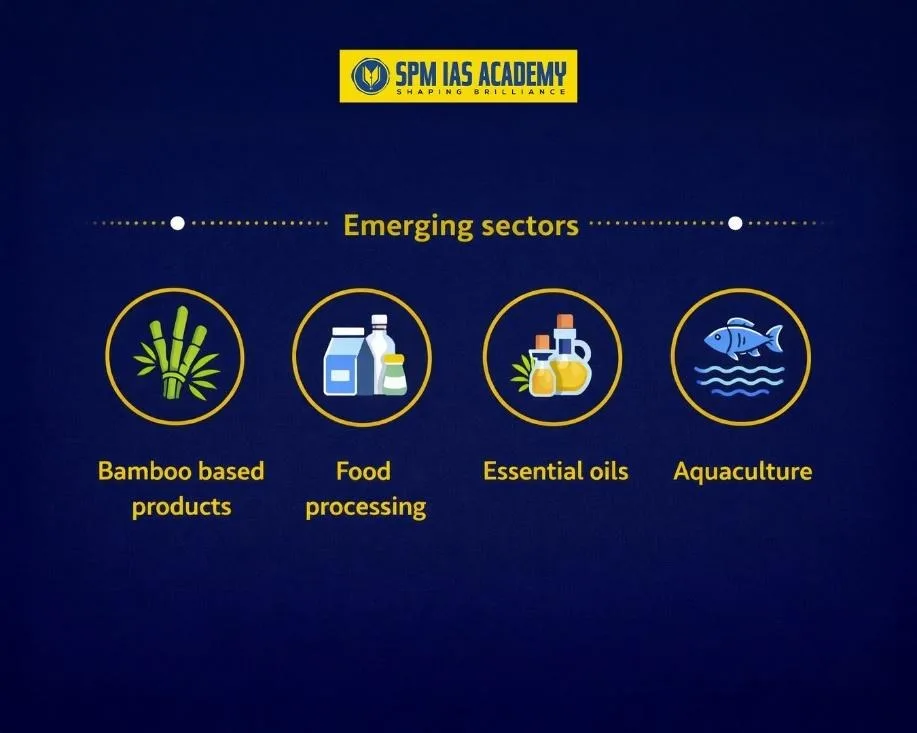
Assam has strong potential to diversify its export basket in several emerging sectors.
- Firstly, Agri and Food Processing:
- Organic tea
- Packaged rice
- Spices such as ginger and turmeric
- Processed fruits
- Moreover, value addition in agriculture can increase export earnings and farmer income.
- Secondly, Handloom and Handicrafts:
- Sustainable textiles
- Bamboo and cane products
- Importantly, these products reflect Assam’s traditional craftsmanship and eco-friendly production.
- Thirdly, Silk Value-Added Goods:
- Finished Muga silk garments
- Eri silk apparel
- As a result, moving from raw silk to finished goods can enhance export value.
- In addition, Forest-Based Products:
- Essential oils
- Aromatic plants
- Bamboo composites
- Therefore, sustainable forest management can support green exports.
- Furthermore, Petrochemicals and Plastics:
- Expansion of downstream industries can strengthen industrial exports.
- Moreover, IT and Knowledge Services:
- IT-enabled services
- Data processing
- Startups
- Consequently, service exports can reduce dependence on traditional goods.
- Lastly, Tourism Services:
- Eco-tourism
- Cultural tourism
- With proper policy support, service exports can expand rapidly and generate employment.
Top Performing States in EPI 2024:
| Category | Top Performing States/UTs in EPI 2024 |
| Large States | 1. Maharashtra 2. Tamil Nadu 3. Gujarat 4. Uttar Pradesh 5. Andhra Pradesh |
| Small States, North East States & UTs | 1. Uttarakhand 2. Jammu and Kashmir 3. Nagaland 4. Dadra and Nagar Haveli & Daman and Diu 5. Goa |
These states show strong export governance and infrastructure.
Way Forward for Assam:
- Firstly, Assam must establish more NABL-accredited laboratories to strengthen testing infrastructure and improve export compliance.
- Secondly, the state should enhance cold-chain networks to reduce losses in perishable goods and improve product quality.
- Thirdly, it is essential to expand cargo and air freight facilities, thereby improving connectivity with global markets.
- Moreover, Assam should actively promote value-added exports, as this will increase export earnings and competitiveness.
- In addition, the government must support MSMEs and startups through financial assistance, skill development, and market access initiatives.
- Furthermore, developing district-level export plans can help unlock local strengths and encourage balanced regional growth.
- Importantly, Assam must diversify beyond tea to reduce export concentration risk.
- Therefore, diversification will ensure long-term economic stability, resilience, and sustainable export growth.
Conclusion: Assam’s Export Preparedness
In conclusion, Assam’s ranking in the Export Preparedness Index (EPI) 2024 reflects both pressing challenges and promising opportunities. On the one hand, the state holds strong potential in sectors such as tea, silk, petroleum products, and agro-based exports. On the other hand, it must focus on export diversification, infrastructure improvement, and institutional strengthening to enhance long-term competitiveness.
For UPSC and APSC aspirants, this topic goes beyond simple statistics. It helps you understand Assam’s export performance, the role of the NITI Aayog’s EPI 2024 framework. Moreover, it also highlights the importance of district export hubs, and regional trade development. Therefore, studying Assam’s export preparedness allows you to connect current affairs with core themes in Economy, Governance, and Sustainable Development in a practical and analytical manner.
A strong understanding of Assam’s economy is vital for aspirants preparing through UPSC coaching in Assam.
Sources:
https://www.pib.gov.in/PressReleasePage.aspx?PRID=2214514®=3&lang=1
https://niti.gov.in/sites/default/files/2026-01/Export_Preparedness_Index_2024.pdf
Frequently Asked Questions:
Assam ranked 24th among 36 States and Union Territories in the Export Preparedness Index (EPI) 2024. NITI Aayog released this index. The ranking highlights Assam’s export challenges, including limited diversification and infrastructure gaps.
Tea is the largest export from Assam and contributes over 50% of the state’s total merchandise exports. Assam tea, which holds a Geographical Indication (GI) tag, plays a crucial role in shaping Assam’s export competitiveness under EPI 2024.
Key challenges affecting Assam’s export ecosystem include shortage of NABL-accredited labs, inadequate cold-chain infrastructure. Moreover, there are limited cargo connectivity, high logistics costs, and heavy dependence on tea exports. Therefore, all these increase export concentration risk.