
Arunachal Pradesh occupies a unique and highly significant place in India’s cultural and anthropological landscape. Located in the far northeastern frontier of the country, the state is a living museum of tribal cultures, where ancient traditions coexist with evolving modern influences. Owing to its strategic geography, ethnic diversity, and historical isolation, Arunachal Pradesh has preserved a rich mosaic of culture, tribes, traditions, belief systems, festivals, languages, and art forms.
Moreover, understanding Arunachal Pradesh’s cultural diversity is essential not only from an exam perspective but also from a governance and policy angle. Many developmental and administrative decisions in the state remain closely linked to tribal identity, customary laws, and traditional institutions. Therefore, this article presents a comprehensive, exam-oriented explanation of the culture, tribes, and traditions of Arunachal Pradesh, integrating static knowledge with analytical insights.
Overview of Arunachal Pradesh’s Cultural Landscape:
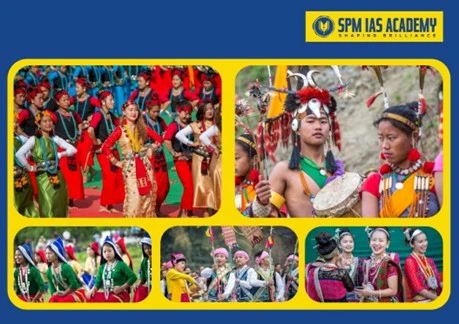
Arunachal Pradesh is home to 26 major tribes and more than 100 sub-tribes, each possessing distinct culture, traditions, languages, rituals, and social practices. Unlike many other regions of India, tribal life here continues to shape everyday governance, social relations, and economic activities.
Importantly, the state’s cultural diversity arises from:
- Geographical isolation caused by rugged mountains and dense forests.
- Multiple migration routes from Tibet, Southeast Asia, and the Indian plains.
- Limited historical penetration of large empires, which allowed indigenous systems to flourish.
As a result, Arunachal Pradesh exhibits one of the highest degrees of ethno-cultural diversity in India.
Major Tribal Groups of Arunachal Pradesh:
Classification of Tribes:
Anthropologists broadly classify tribes of Arunachal Pradesh into three cultural zones, based on geography and socio-religious practices:
- Tibetan Cultural Zone
- Central (Tani) Cultural Zone
- Eastern Cultural Zone
Tibetan Cultural Zone:
This zone covers Tawang and West Kameng districts and reflects strong Tibetan Buddhist influence. In this zone, major tribes are Monpa, Sherdukpen, Aka (Hrusso), Bugun.
- Cultural features:
- Practice Mahayana Buddhism.
- Strong influence of monasteries, especially Tawang Monastery.
- Rich traditions of thangka painting, wood carving, mask dances, and monastic festivals.
- They are the followers of the Lamaistic tradition of Mahayana Buddhism.
- Social life:
- Community life revolves around monasteries
- Agriculture and animal husbandry form the economic base
- Monastic institutions play an educational and spiritual role
Central (Tani) Cultural Zone:
This zone covers a large part of central Arunachal and represents the largest cultural group.Major tribes in this group areApatani, Nyishi, Galo, Adi and Tagin.
- Cultural features:
- Indigenous belief system centred on Donyi-Polo (Sun–Moon worship).
- Strong oral traditions and folklore.
- Highly developed community institutions
Eastern Cultural Zone:
This zone includes Changlang, Tirap, and Longding districts, and reflects Southeast Asian influences. Here, the major tribes are Nocte, Wancho, Octes and Tangsa.
- Cultural features:
- Transition from animistic traditions to Christianity in many areas.
- Strong warrior traditions in the past.
- Rich material culture including wood carvings and traditional weapons.
- They follow basic Vaishnavism and maintain a strict village society that is ruled by a hereditary chief.
- Social organisation:
- Village-based authority structures.
- Emphasis on clan identity and customary norms.
Religious Beliefs and Faith Systems:
Religion in Arunachal Pradesh remains deeply intertwined with nature and community life.
- Indigenous Belief Systems:
- Donyi-Poloism: Worship of Sun (Donyi) and Moon (Polo), symbolising truth and cosmic balance.
- Animism: Belief in spirits inhabiting forests, rivers, mountains, and animals.
- Buddhism:
- Practised mainly by Monpa and Sherdukpen tribes.
- Monasteries function as religious, cultural, and educational centres.
- Christianity:
- Spread mainly among eastern tribes.
- Influenced education, health services, and social reforms.
- Hindu Influence:
- Limited but present in certain areas due to migration and cultural interaction.
Festivals of Arunachal Pradesh:
Festivals form the backbone of tribal cultural expression. Most festivals revolve around agriculture, seasons, and spiritual harmony.
Major Festivals of Arunachal Pradesh:
- Losar – New Year festival of Monpa tribe.
- Nyokum – Agricultural festival of Nyishi tribe.
- Solung – Harvest festival of Adi tribe.
- Mopin – Prosperity festival of Galo tribe.
- Dree – Agricultural festival of Apatani tribe.
- Reh – Ritual festival of Idu Mishmi tribe.
These festivals reinforce community bonding. They transmit oral traditions and folklore. Further, they promote sustainable agricultural cycles.
Traditional Social and Political Institutions:
Despite modern administrative systems, traditional institutions continue to play a significant role.
Village Councils:
- They are known by different names across tribes. For example, Adi tribe follows the ‘Kebang’ system (a democratic village council), Nyishi and Galo tribes follow ‘Buliang’ (elder deliberate on social, economic and political issues).
- Moreover, these village councils resolve disputes through customary laws.
- Furthermore, they maintain social order and collective decision-making.
Traditional Dress, Art and Handicrafts:
Traditional Attire of Tribes of Arunachal Pradesh:
- Made from cotton, wool, and locally sourced fibres.
- Each tribe has distinct colours, patterns, and motifs.
- Ornaments made of beads, feathers, and metal hold cultural symbolism.
- Thuma, Mushaiks, Chupa etc. are some the popular tribal attire.
Arts and Crafts of Tribes of Arunachal Pradesh:
- To begin with, traditional weaving, bamboo craft, and wood carving constitute the backbone of tribal arts and crafts in Arunachal Pradesh, reflecting both utility and aesthetics.
- In addition, handloom weaving forms an integral part of daily life, with almost every tribal household engaged in producing textiles for personal, ritual, and commercial use.
- Moreover, masks and ritual objects play a significant role in tribal festivals and religious ceremonies, symbolising deities, spirits, and ancestral beliefs.
- Region-wise, districts such as Tirap, Upper Siang, West Siang, Lohit, and Tawang are popular for their rich tradition of artistic wood carving, often seen in houses, monasteries, and ceremonial objects.
- Similarly, painting traditions hold cultural importance in the state. A notable form is Thangka painting which is also known asTangka/Tanka (meaning recorded message). This form of painting is widely popular in Buddhist-dominated regions like Tawang, West Kameng, and Upper Siang.
- Notably, the themes of Thangka paintings has deep connections with religion, mythology, and traditional narratives. It depicts Buddhist deities, mandalas, and spiritual symbols.
- Along the same lines, carpet weaving is prevalent in the same regions where painting traditions flourish, especially in Buddhist areas.
- Importantly, the carpets produced in Arunachal Pradesh have earned national and international recognition for their quality, durability, and intricate designs.
- Furthermore, a unique craft item of the state is the Wangcho Bag, handcrafted by the women of the Wangcho tribe in Tirap district, showcasing indigenous skills and traditional patterns.
- Finally, these diverse craft traditions not only preserve tribal heritage but also support local livelihoods, contributing significantly to income generation and sustainable rural development.
Music, Dance and Oral Traditions of Arunachal Pradesh:
Music and dance function as tools of cultural transmission in Arunachal Pradesh. This section deals with the msuci, dance and oral traditions of tribes in Arunachal Pradesh.
Music of Arunachal Pradesh:
- The traditional songs sung by the locals are called fables.
- In essence, these folk songs bring to life the historic past of various tribes, preserving their collective memory.
- Notably, the themes of these songs are mainly mythological and are deeply connected with folk history, religious beliefs, and cultural traditions.
- Moreover, different folk songs are performed on specific social occasions and ceremonies.
- For instance, Ja-Jin-Ja is sung during marriage ceremonies, celebrating union and social harmony.
- Similarly, Baryi songs narrate history, mythology, and religious lore, serving an educative and cultural function.
- Likewise, Nyioga, which revolves around the theme of joy and celebration, is commonly sung during weddings and festive occasions.
- Finally, the musical traditions of Arunachal Pradesh play a vital role in preserving tribal heritage and transmitting cultural values across generations.
Dance Traditions of Arunachal Pradesh:
- To begin with, folk songs and dances of Arunachal Pradesh serve as a vital medium to narrate myths, migration histories, and heroic deeds of various tribes.
- In this context, dances are predominantly performed during festivals, religious rituals, and community celebrations, strengthening social cohesion.
- Importantly, in the absence of a strong written tradition, oral traditions through dance and music play a crucial role in preserving history and collective memory.
- Moreover, some of the popular folk dances of the state include Aji Lamu, Chalo, Hiirii Khaniing, Popir, Ponung, Pasi Kongki, Rekham Pada, Roppi, Lion Dance, and Peacock Dance.
- Notably, most dance forms are accompanied by chorus singing, where performers sing collectively while dancing.
- Community-wise, distinct tribes practice specific dance forms:
- Mishmi priests perform the Igo dance.
- Adi, Wancho, and Nocte tribes engage in war dances, and
- Buddhist communities perform ritualistic dances linked to religious ceremonies.
- Significantly, these dance traditions are predominantly male-oriented, and in many forms, women are not permitted to participate.
- Furthermore, rhythmic musical accompaniment is a defining feature, with songs sung in chorus setting the tempo of the dance.
- Alongside this, traditional instruments such as drums and cymbals are played in the background, enhancing the vibrancy and ceremonial appeal of the performances.
- Finally, together, dance and music in Arunachal Pradesh reflect the deep cultural roots, spiritual beliefs, and social traditions of its diverse tribal communities.
Food Habits and Traditional Livelihoods of Arunachal Pradesh:
Food Culture:
- Rice constitutes the staple diet of the people across most tribal communities of Arunachal Pradesh.
- In addition, the diet includes a significant consumption of meat, fish, bamboo shoots, and fermented food items, reflecting indigenous culinary practices.
- Moreover, locally grown herbs, forest produce, and wild edibles are extensively used, enhancing nutritional value and flavour.
- Overall, the food culture highlights a strong dependence on local ecological resources.
Livelihood Patterns:
- Primarily, agriculture serves as the main source of livelihood, practiced in the form of shifting cultivation (jhum) as well as settled farming in suitable areas.
- Alongside agriculture, hunting and fishing traditionally supplement food requirements and income, especially in forested and riverine regions.
- Furthermore, animal husbandry supports subsistence needs, while handicrafts provide additional sources of livelihood and cultural expression.
- Finally, these livelihood practices collectively demonstrate a well-adapted response to the mountainous terrain, forest ecosystem, and climatic conditions of Arunachal Pradesh.
Conclusion:
In conclusion, Arunachal Pradesh stands out as a land of ancient and vibrant cultural heritage, aptly known as the “Land of the Dawn-Lit Mountains.” Its significance in India’s civilizational history is well established, as reflected in classical scriptures such as the Kalika Purana and the Mahabharata, which make references to the region and underscore its antiquity and spiritual relevance.
Furthermore, the culture, tribes, and traditions of Arunachal Pradesh together represent one of the most diverse, dynamic, and resilient cultural systems in the country. Despite the growing influence of modernisation and developmental pressures, tribal communities have continued to preserve their unique identities, belief systems, and community-based institutions. At the same time, they are progressively adapting to change through education, policy interventions, and cultural revival initiatives. Consequently, for aspirants preparing for UPSC, APPSC, and other competitive examinations, a clear and analytical understanding of Arunachal Pradesh’s cultural landscape offers not only factual enrichment but also deeper insights into pluralism, indigenous governance, sustainability, and social ethics. Ultimately, mastering this topic enhances conceptual clarity and answer-writing quality, making it a highly valuable area in competitive exam preparation.
Sources:
- https://ignca.gov.in/divisionss/janapada-sampada/northeastern-regional-centre/miscellaneous-art-and-crafts-of-arunachal-pradesh/
- https://www.holidify.com/pages/arunachal-pradesh-culture-83.html
- https://www.incredible-northeastindia.com/arunachal-pradesh/music-dance.html
FAQ:
Arunachal Pradesh is home to 26 major tribes and over 100 sub-tribes, making it one of the most ethnically diverse states in India.
The tribes of Arunachal Pradesh are broadly classified into three cultural zones: the Tibetan Cultural Zone, Central (Tani) Cultural Zone, and Eastern Cultural Zone, based on geography and socio-religious practices.
The major religious belief systems include Donyi-Polo (indigenous faith), Buddhism (mainly among Monpa and Sherdukpen), Christianity (especially in eastern districts), and limited Hindu influences.
Customary laws govern marriage, inheritance, land ownership, and dispute resolution and are constitutionally protected, making them central to tribal governance and administration.
The major festivals of Arunachal Pradesh include Losar, Nyokum, Solung, Mopin, Dree, and Reh, most of which are linked to agriculture, harvest cycles, seasonal change, and spiritual harmony, reflecting the close relationship between tribal life and nature.