
The Indian Army has officially declared 2026 as the ‘Year of Networking and Data Centricity’, marking a decisive step in India’s ongoing military transformation. The announcement highlights the Army’s intent to strengthen connectivity, enable real-time decision-making, and enhance combat effectiveness through digital integration and indigenous technologies.
This move reflects the Army’s preparedness for future warfare, where information superiority, speed of decision-making, and seamless coordination across domains determine success on the battlefield.
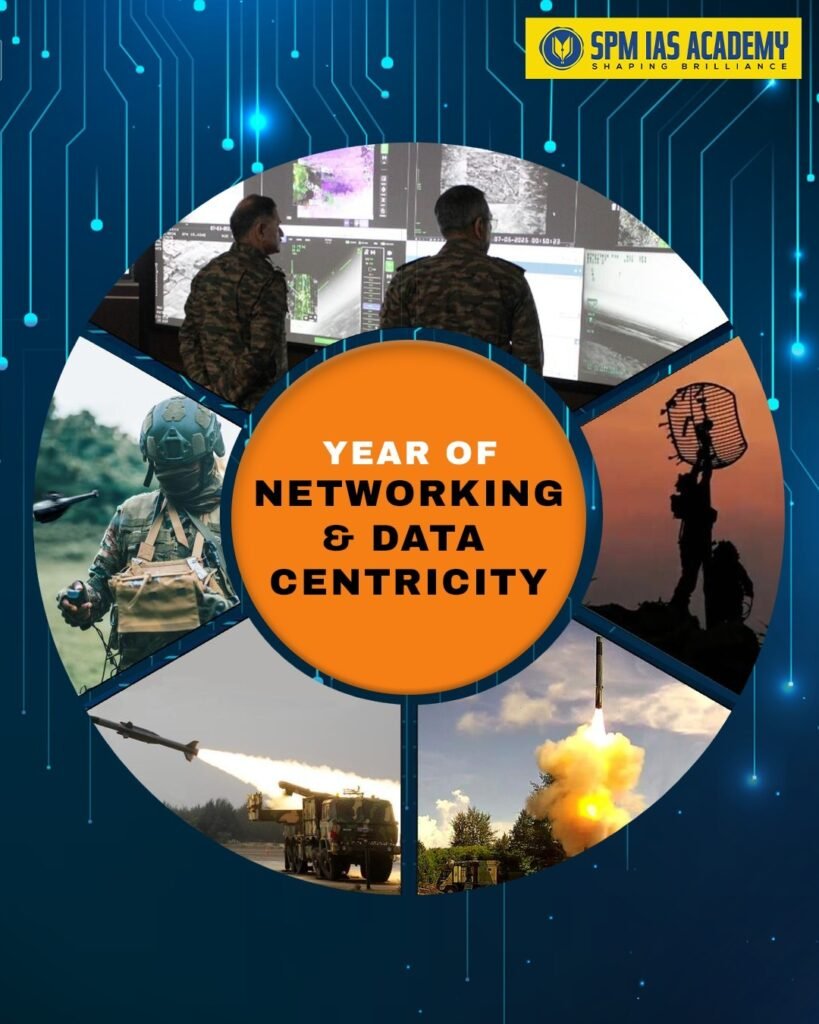
Why Is the Indian Army’s ‘Year of Networking and Data Centricity’ in the News?
The declaration was made as part of the New Year message by the Army Chief, Gen Upendra Dwivedi. He emphasised that the Indian Army is undergoing a decade-long transformation. According to him, jointness, self-reliance, and innovation form the core pillars of India’s military power.
He underlined that networking and data centricity are no longer optional. They are essential capabilities and these are the domains where India must “act faster” to remain combat-ready in future conflict scenarios.
What Does ‘Networking and Data Centricity’ Mean in Military Terms?
- Networking in the Indian Army: Networking refers to the seamless digital connectivity between Soldiers on the ground, Command and control centres, Surveillance systems, Weapon platforms and Intelligence and logistics units. A fully networked force allows information to flow instantly across all levels, reducing response time and improving operational coordination.
- Data Centricity in Modern Warfare: Data centricity means Collecting vast amounts of battlefield data, processing it in real time and Converting it into actionable intelligence. This enables commanders to make faster, more accurate decisions, especially in high-intensity or multi-domain operations.
Strategic Objectives of the ‘Year of Networking and Data Centricity’:
The Indian Army’s 2026 as Year of Networking and Data Centricity aims to achieve multiple long-term goals:
- Real-time situational awareness across all theatres
- Faster decision-making at tactical, operational, and strategic levels
- Enhanced combat effectiveness through data-driven operations
- Greater resilience and agility against cyber and electronic warfare threats
- Interoperability with the Navy and Air Force under joint command structures
Link with Indigenous Defence Modernisation:
A key aspect of this initiative is indigenisation. The Army plans to leverage:
- Indigenous communication systems
- Indian-developed battlefield management systems
- Secure defence networks
- Home-grown software and AI-enabled tools
This aligns with India’s broader push for self-reliance in defence manufacturing. It will ensure data security and reduce dependence on foreign technology.
Continuity with Previous Army Initiatives:
The 2026 declaration builds on earlier reform milestones:
- 2024-25 was designated as the ‘Year of Technology Absorption’, focusing on integrating new technologies already developed.
- 2026-27 will take this further by institutionalising networking and data-centric operations across formations.
Together, these initiatives signal a structured and phased transformation of the Indian Army.
Why Networking and Data Centricity Are Critical for Future Wars:
Modern conflicts are increasingly defined by Cyber warfare, electronic warfare, space-based surveillance, precision strikes and information dominance. Without robust networks and data-centric systems, even advanced weaponry loses effectiveness. Recognising this, the Indian Army has identified networking as a capability gap that must be urgently addressed.
Implications for India’s Defence Preparedness:
The ‘Year of Networking and Data Centricity’ will:
- Strengthen India’s deterrence posture
- Improve joint operations under integrated theatre commands
- Prepare the Army for hybrid and high-tech conflicts
- Enhance battlefield transparency and command efficiency
This initiative positions the Indian Army as a future-ready force, capable of operating in fast-evolving and data-intensive war environments.
Conclusion:
By declaring 2026 as the ‘Year of Networking and Data Centricity’, the Indian Army has sent a clear strategic signal. Future wars will be won by those who control information, connectivity, and decision speed. Anchored in indigenisation, digital integration and jointness, this initiative marks a crucial leap toward a technologically empowered and agile military force.
Sources:
Army declares 2026 as ‘Year of Networking & Data Centricity’, Gen Dwivedi says Op Sindoor still on
Working on designating 2026-27 as year of networking and data centricity: Army chief
The Indian Army declared 2026 as the Year of Networking and Data Centricity to strengthen digital connectivity, enable real-time decision-making, and enhance combat effectiveness in future warfare scenarios.
The announcement was made by the Army Chief, Gen Upendra Dwivedi, in his New Year message, highlighting the Army’s decade-long transformation agenda.
Networking refers to seamless digital connectivity among soldiers, command centres, sensors, and weapon systems, while data centricity focuses on collecting, processing, and using battlefield data for faster and more accurate military decisions.
The initiative will improve situational awareness, joint operations, cyber resilience, and interoperability across services, making the Indian Army more agile and future-ready.
The focus on networking and data centricity relies heavily on indigenous communication systems, secure defence networks, and Indian-developed digital platforms, supporting India’s goal of self-reliance in defence technology.