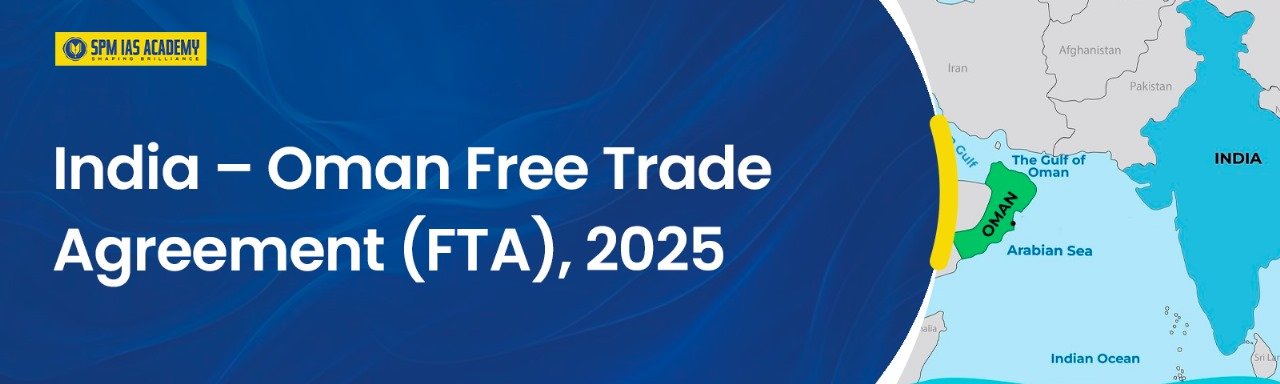
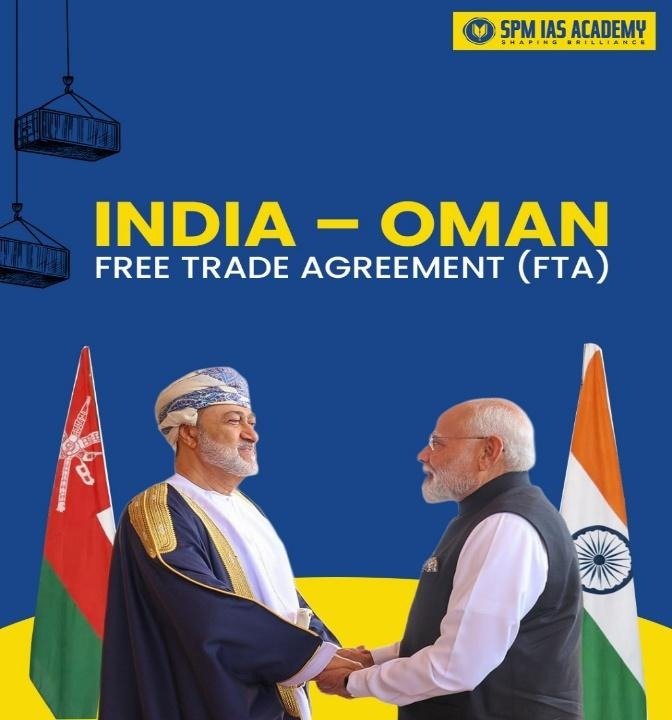
As part of a three nations tour, the Prime Minister of India visited Oman. This visit coincides with the 70th anniversary of India-Oman diplomatic relations established in 1955. Earlier he visited Ethiopia and Jordan. During his Oman visit, the Prime Minister of India has signed a Free Trade Agreement (FTA) with Sultan Haitham bin Tarik.
In the last few years, India has signed many Free Trade Agreements (FTAs) which are reaping rewards for farmers, traders, and exporters. Some of them include the UK (2025), EFTA (2024), Australia (2022), UAE (2022), Mauritius (2021). This expanding network of agreements highlights India’s foresighted trade strategy. This strategy focuses on diversification, resilience and mutually beneficial growth.
Stay updated with relevant current affairs crucial for UPSC, covering diplomacy, FTAs, and India’s foreign policy.
India – Oman Free Trade Agreement (FTA), 2025:
- The India-Oman Free Trade Agreement (FTA) aims to deepen the bilateral strategic partnership between India and Oman.
- Both leaders exchanged views on a wide range of topics, including:
- Defence and security
- Trade and investment
- Energy, agriculture, and technology
- Cultural exchanges and people-to-people contacts
- A milestone achievement in this partnership is the signing of the Comprehensive Economic Partnership Agreement (CEPA), which strengthens the India-Oman strategic ties.
- This agreement marks Oman’s second FTA with an individual country and the first in over 20 years.
- Oman has offered zero-duty access on 98% of its tariff lines, which is expected to generate $2 billion worth of exports in the near-term. Beneficiary sectors include:
- Gems and jewellery
- Textiles, leather, and footwear
- Sports goods, plastics, and furniture
- Agricultural and engineering products
- This is India’s second FTA with a Gulf Cooperation Council (GCC) country, after the UAE.
- India has liberalized tariffs on 77.79%of its tariff lines, with exceptions made for sensitive sectors such as:
- Agricultural products (dairy, tea, coffee, rubber, tobacco)
- Gold, silver, bullion, and jewellery
- The agreement includes provisions for the services sector:
- Oman’s increase in the quota for Intra-Corporate Transferees from 20% to 50%.
- Enhanced cooperation on energy transition, including green hydrogen, renewable energy, and infrastructure development.
- Oman has also extended the permitted stay duration for Contractual Services Suppliers, from 90 days to two years, with the possibility of a further two-year extension.
- The agreement allows for 100% Foreign Direct Investment (FDI) by Indian companies in major services sectors in Oman.
Significance of the Comprehensive Economic Partnership Agreement (CEPA):
- Strengthening Trade Cooperation: The CEPA aims to enhance and solidify trade relations between India and Oman, fostering growth across key sectors.
- Promoting Trade Diversification: It supports diversification in trade, while simultaneously improving the resilience of supply chains between the two countries.
- Expanding Market Access: The agreement opens up broader market access for Indian exporters, especially in the West Asian region, helping India expand its trade footprint.
- Injecting New Confidence: By infusing fresh energy and confidence into the India-Oman partnership, the CEPA is set to revitalize bilateral ties, particularly for the 21st century.
- Creating Momentum for Growth: The agreement will create new opportunities for trade, investment, and innovation, paving the way for increased growth and job creation, especially benefiting the youth.
- Facilitating Professional Engagement: The CEPA provides more liberal entry and stay conditions for skilled professionals in vital sectors such as accountancy, taxation, architecture, and medical services. This provision will promote deeper and seamless professional exchanges between the two countries.
- Encouraging Investment and Economic Diversification: The agreement is poised to stimulate investments and catalyze economic diversification, ultimately enhancing the economic growth of both India and Oman.
India – Oman Relations:
- Oman is the 3rd largest export destination for India among the Gulf Cooperation Council countries.
- India – Oman bilateral trade was about USD 10.5 billion (export USD 4 billion and imports USD 6.54 billion) in 2024-25.
- India’s key imports are petroleum products and urea. These account for over 70% of imports.
- Other key products are propylene and ethylene polymers, pet coke, gypsum, chemicals, iron and steel and unwrought aluminum.
Background of India – Oman Relation:
- India and Oman are linked by geography, history, and culture and enjoy warm and cordial relations.
- While people-to-people contact between India and Oman can be traced back 5000 years, diplomatic relations were established in 1955.
- Furthermore, their relationship became a Strategic Partnership in 2008.
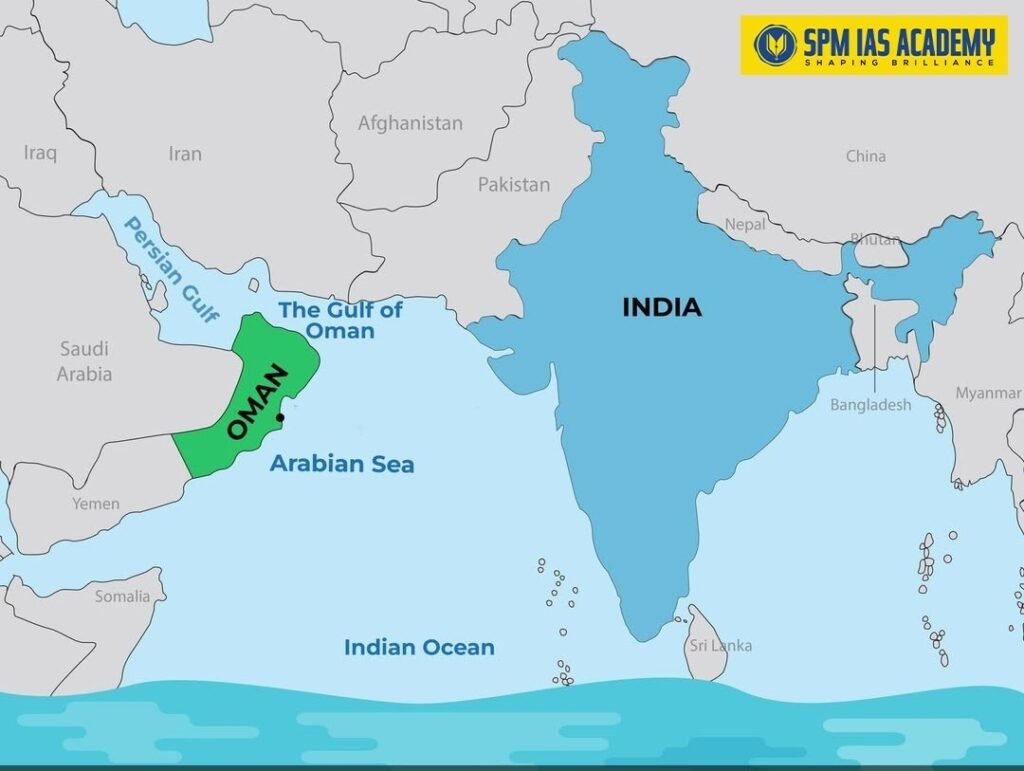
India – Oman Relations: Key Dimensions:
Political Relations:
- Oman is a crucial pillar of India’s West Asia Policy and its oldest regional strategic partner.
- The political engagement between the two countries has increasingly taken on a more strategic shape.
- The historical India-Oman bilateral ties were transformed into a strategic partnership in November 2008.
- India and Oman have maintained steady diplomatic contact through regular high-level engagements.
- As a mark of special friendship, India extended an invitation to the sultanate of Oman to participate in the G20 Summit and meetings as a guest country during India’s Presidency in 2023.
- Oman actively participated in more than 150 meetings of the Working Groups, and 9 Omani Ministers travelled to India to participate in G20 Ministerial Meetings.
Bilateral Agreements & Institutional Mechanisms:
- MoUs across digital payments, health, tourism, IT, agriculture, civil aviation, manpower, culture.
- Agreements on military cooperation, outer space, maritime transport, standards & measures.
- Legal frameworks: Extradition, Criminal & Civil Judicial Cooperation.
- DTAA amendment protocol signed (Jan 2025).
- Visa exemption for diplomatic and official passport holders.
- Cooperation between:
- Oman NDC & India’s IDSA
- FSI & Omani Diplomatic Institute
- CAG of India & State Audit Institution of Oman
- Cultural MoU – ICCR Chair of Hindi at Dhofar University.
- Agreement on employment of accompanying spouses of officials.
Defence & Security Cooperation:
- Oman is India’s closest defence partner in the Gulf.
- Only Gulf country with joint exercises of all three Indian armed forces.
- Strong cooperation in Indian Ocean maritime security.
- High-level defence visits are exchanged regularly.
- India–Oman Defence Industrial Seminar held (Sept 2023).
- Regular participation in AERO India exhibitions.
- 13th India-Oman Joint Military Cooperation Committee held in New Delhi (Nov 2025).
- 6th Coast Guard High-Level Meeting held in Muscat (Apr 2025).
Economic & Trade Relations:
- The value of India-Oman Bilateral trade:
- US$ 8.95 bn (FY 2023–24)
- US$ 10.61 bn (FY 2024–25)
- Oman:
- India’s 28th largest trading partner (2024-25).
- 29th export market, 25th import source (2024-25).
- India:
- 4th largest source of Oman’s non-oil imports (2024-25).
- 3rd largest market for Oman’s non-oil exports (2024-25).
- Over 6,000 India–Oman joint ventures in Oman.
- Cumulative FDI from Oman to India: US$ 605.57 million.
- India’s Exports to Oman:
- Petroleum products, aluminium oxide, rice.
- Machinery, boilers, electrical equipment.
- Aircraft, plastics, iron & steel, ceramics.
- Cosmetics and beauty products.
- India’s Imports from Oman:
- Crude oil and LNG (major share)
- Fertilizers (urea), ammonia, sulphur
- Organic chemicals, iron ore
- Stone, lime, plastics, aircraft
Cultural Cooperation:
- Relations rooted in centuries-old maritime & trade links.
- Gandhi Peace Prize 2019 awarded to late Sultan Qaboos.
- ‘Oman Collection’ digitization project (May 2024): Digitized 7,000+ archival records and documents from 1838 onwards.
- ‘Mandvi to Muscat’ lecture series focused on Indian diaspora history, participation of global scholars.
Indian Community in Oman:
- Indian population: ~6.77 lakh (2025).
- Work visa holders: ~5.2 lakh
- OCI card holders: 2,052
- Indian professionals across health, engineering, education, finance.
- 22 Indian schools serving ~48,000 students.
- Active Indian Social Clubs in Muscat, Salalah, Sohar, Sur.
- Religious facilities:
- Hindu temples, cremation grounds.
- Churches and Gurudwaras permitted.
- Notable contributions by Overseas Indians and NRIs for strengthening bilateral ties are recognised through Pravasi Bharatiya Samman Awards.
Conclusion:
In conclusion, the India-Oman Free Trade Agreement (FTA) marks a significant landmark in strengthening the bilateral strategic partnership between the two countries. With a focus on trade diversification, economic growth, and mutual cooperation in key sectors like defense, energy, and agriculture, the agreement opens up new opportunities for India and Oman. By fostering closer professional and cultural ties, the India – Oman FTA is poised to enhance economic resilience, create employment opportunities, and ensure sustainable development for both countries. This strategic partnership not only supports India’s growing influence in West Asia but also promotes long-term growth and prosperity for both nations.
Such international developments are comprehensively covered at the Best UPSC Coaching in Guwahati for aspirants.
Sources:
FAQ:
The India-Oman Free Trade Agreement (FTA), signed during India’s Prime Minister’s visit to Oman. It aims to enhance bilateral trade relations, improve market access, and boost investment between the two countries. It focuses on sectors like trade, defense, agriculture, and technology.
The agreement offers Indian exporters enhanced market access, including zero-duty access on 98% of Oman’s tariff lines. It is expected to generate significant export growth in sectors like gems, textiles, and agricultural products, boosting India’s trade with Oman.
The India-Oman FTA covers a wide range of sectors, including trade and investment, defense, agriculture, energy, technology, and cultural exchanges. It also emphasizes professional engagement, particularly in sectors like accountancy, taxation, and medical services.
The India-Oman FTA is designed to stimulate economic diversification and create new opportunities for trade, investment, and innovation. This, in turn, will contribute to growth, employment, and opportunities for youth in both countries.
The agreement facilitates liberal entry and stay conditions for skilled professionals in key sectors such as accountancy, architecture, and medical services. It includes provisions for 100% Foreign Direct Investment (FDI) in major services sectors, enhancing professional engagement between India and Oman.

Behind every article at SPM IAS Academy is a team of skilled content writers and subject experts committed to making preparation easier for aspirants. From answering common doubts to breaking down complex issues and current affairs, we create content that is accurate, easy to understand, and directly useful for UPSC, APSC, and other competitive exams.