
India has climbed five places to secure the 91st position on the Corruption Perceptions Index (CPI) 2025. It reflects a modest but noteworthy improvement in its global corruption ranking. The index is released annually by Transparency International, a leading global civil society organisation that works across more than 100 countries to fight corruption and promote integrity, accountability, and good governance.
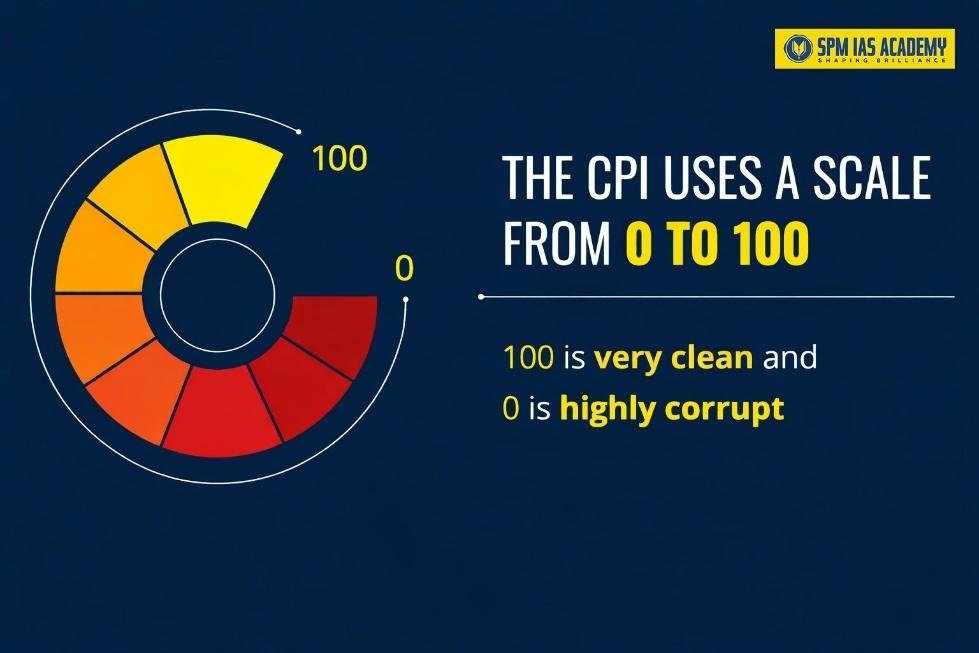
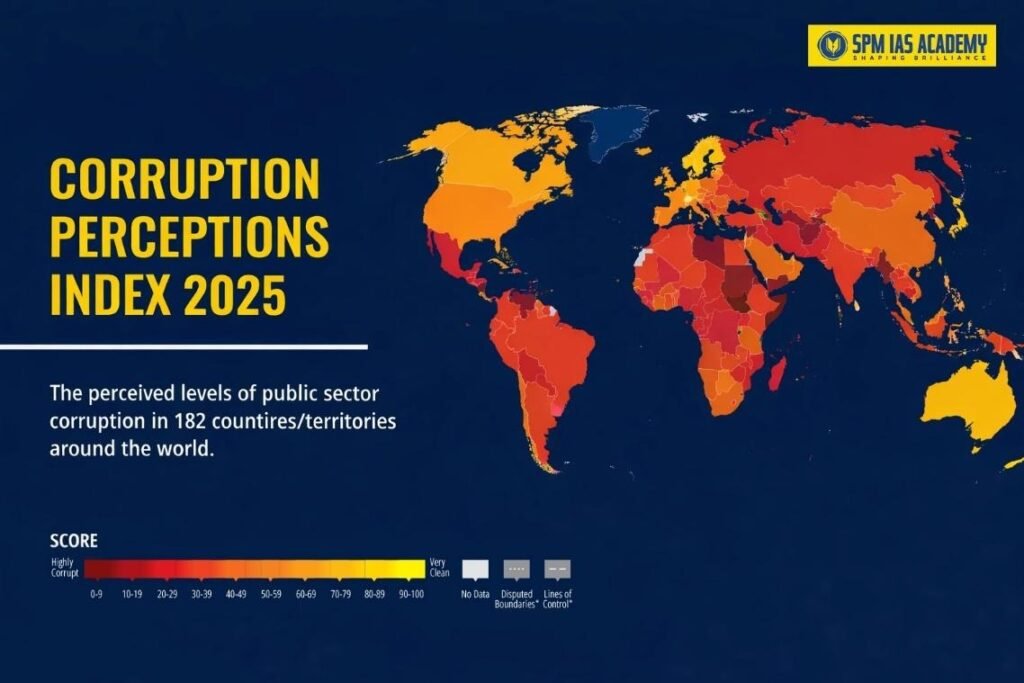
The CPI 2025 evaluates perceived levels of public sector corruption in 182 countries and territories, using a scale from 0 (highly corrupt) to 100 (very clean). Denmark has retained the top position with a score of 89, followed by Finland and Singapore. On the other hand, South Sudan and Somalia remain at the bottom of the corruption ranking.
For aspirants preparing for UPSC, APSC, APPSC, and other State PCS examinations, the Corruption Perceptions Index 2025 is highly relevant. It is relevant under themes such as Governance, Ethics, Integrity, Accountability, Corruption, International Conventions like UNCAC, and Good Governance frameworks.
Students seeking quality preparation can consider UPSC coaching in north east India for structured Civil Services training.
Understanding the Corruption Perceptions Index (CPI) 2025:
The Corruption Perceptions Index (CPI) is one of the most widely cited global indicators. It measures corruption in the public sector. Rather than measuring actual incidents of bribery or corruption cases, the CPI assesses expert opinions and surveys to evaluate how corruption is perceived in government institutions.
The CPI examines multiple dimensions, including:
- Abuse of power by public officials.
- Bribery and bribery-related practices.
- Political corruption and opaque political financing.
- Weak enforcement of anti-corruption laws.
- Lack of accountability in governance systems.
- Restricted access to information.
Each country receives a score between 0 and 100. A higher score indicates stronger integrity systems, transparent governance practices, and better accountability mechanisms. Conversely, a lower score reflects systemic corruption, weak rule of law, and institutional decay.
The CPI 2025 report shows that corruption continues to pose a serious threat globally. The global average score has fallen to 42, and more than two-thirds of countries score below 50. This data indicates that despite decades of international conventions and anti-corruption reforms, many governments are struggling to fight corruption effectively.
India’s Performance in the Corruption Perceptions Index 2025:
- Firstly, India improved its position from 96th to 91st in the Corruption Perceptions Index 2025. It indicates incremental progress in its anti-corruption efforts over the past year.
- Moreover, India’s score increased by one point compared to the previous year. It suggests that governance reforms and digital transparency initiatives may be contributing positively to improving its corruption ranking.
- However, despite this improvement, India continues to face significant challenges in strengthening its national integrity system. Moreover, it is also facing hurdles in ensuring stronger accountability mechanisms.
- In particular, concerns remain regarding political financing transparency, delays in judicial processes, bureaucratic inefficiencies, and persistent local-level bribery practices. All of these continue to affect the country’s overall corruption perception.
- Furthermore, the CPI 2025 report flagged India among countries that can be “dangerous for journalists reporting on corruption.” It raises serious concerns about media safety and freedom.
- Consequently, when journalists are attacked or silenced for investigating corruption, transparency weakens. Similarly, abuse of power becomes much harder to expose effectively.
- Importantly, global data shows that since 2012, hundreds of journalists have lost their lives while investigating corruption outside conflict zones. It underlines the risks associated with exposing wrongdoing.
- Therefore, protecting media freedom and ensuring the safety of investigative journalists must form a central part of India’s broader anti-corruption strategy and governance reforms.
Global Trends: What CPI 2025 Reveals
Top Performers: Strong Governance and Integrity
Denmark retained its first rank with 89 points. It has maintained its reputation for clean governance, strong public institutions, and transparent political systems. Finland and Singapore also ranked among the least corrupt countries.
These nations demonstrate:
- Strong rule of law
- Transparent political financing
- Effective anti-corruption enforcement
- High levels of public trust
- Robust access to information laws
Their performance shows that consistent commitment to integrity and accountability can significantly reduce corruption.
Countries with Weak Integrity Systems:
At the bottom of the index are South Sudan and Somalia, both scoring extremely low. These countries face political instability, weak institutional frameworks, limited access to information, and poor enforcement of anti-corruption mechanisms.
Established Democracies Also Face Decline:
Interestingly, even established democracies such as the United States and the United Kingdom have witnessed declining scores. This indicates a broader global leadership gap in addressing corruption. Moreover, weakening democratic checks and balances, political polarization, and reduced civic space contribute to this decline.
What Is Corruption? A Governance Perspective
Transparency International defines corruption as the abuse of entrusted power for private gain. Corruption can take many forms, including:
- Offering or accepting a bribe.
- Engaging in bribery in public procurement.
- Manipulating political financing systems.
- Misusing public office.
- Corporate fraud and money laundering.
Corruption erodes public trust, weakens democracy, hampers economic development, and deepens inequality. Furthermore, it also diverts funds away from essential services such as healthcare, education, and infrastructure. Under-funded hospitals, unbuilt flood defences, and stalled welfare programs often result from systemic corruption.
Therefore, fighting corruption is not merely a legal or administrative task. It is essential for achieving sustainable development and social justice.
The Role of Transparency International in the Fight Against Corruption:
Transparency International plays a critical role in the global anti-corruption movement. As an independent and non-governmental organisation, it focuses on exposing systems and networks that enable corruption to thrive.
Key Areas of Work:
- Advocacy for International Conventions:
Transparency International supports frameworks such as the United Nations Convention Against Corruption (UNCAC). It promotes global cooperation in anti-corruption enforcement. - Global Corruption Report:
The organisation publishes research reports and policy recommendations to guide reforms. - Strengthening Civil Society Organisation Networks:
By empowering civil society organisations, Transparency International enhances public participation in governance. - Promoting Integrity Pacts:
Integrity pacts are agreements between governments and bidders in public procurement to prevent bribery and corruption. - Monitoring Political Financing and Political Corruption:
Transparent political financing systems reduce the influence of money in politics. - Legal Advice Centres:
These centres provide guidance to whistleblowers and victims of corruption. - Encouraging Corporate Social Responsibility (CSR):
By promoting ethical business practices and CSR standards, the organisation strengthens corporate integrity.
Through these efforts, Transparency International seeks to strengthen the global national integrity system framework.
Anti-Corruption Leadership Gap: A Growing Concern
The CPI 2025 highlights a decline in anti-corruption leadership worldwide. Many governments have reduced democratic oversight, weakened checks and balances, and imposed restrictions on civic space.
When governments limit access to information, silence journalists, or weaken independent institutions, corruption flourishes. As a result, accountability diminishes, and abuse of power increases.
Therefore, governments must:
- Strengthen independent anti-corruption agencies.
- Protect journalists and whistleblowers.
- Enhance transparency in political financing.
- Implement robust access to information laws.
- Improve enforcement under UNCAC.
Without bold leadership and sustained reforms, corruption will continue to challenge democratic institutions.
How Can India Improve Its Corruption Ranking?
India can strengthen its corruption ranking by focusing on structural reforms and strengthening institutions.
- Firstly, it must improve transparency in political financing and electoral funding.
- Secondly, it should enhance enforcement of anti-corruption laws and fast-track judicial processes.
- Moreover, it must strengthen whistleblower protection mechanisms.
- In addition, digital governance reforms can reduce direct interaction between citizens and officials, thereby lowering bribery opportunities.
- Finally, strengthening the national integrity system and promoting corporate social responsibility (CSR) standards will improve governance outcomes.
These measures will not only improve India’s corruption ranking but also enhance public trust and economic growth.
Conclusion: Corruption Perceptions Index 2025 and the Road Ahead
The Corruption Perceptions Index 2025 clearly shows that corruption remains a global challenge despite limited signs of progress. India’s rise to the 91st position reflects moderate improvement, but sustained anti-corruption reforms are essential to achieve stronger integrity and accountability.
For UPSC, APSC, APPSC, and other State PCS aspirants, understanding key concepts such as anti-corruption reforms, abuse of power, bribery, national integrity system, corporate social responsibility (CSR), access to information is crucial.
For expert guidance, explore UPSC coaching in Guwahati at SPM IAS Academy.
Sources:
https://www.transparency.org/en/cpi/2025
https://files.transparencycdn.org/images/CPI-2025-Report-EN.pdf
FAQ:
The Corruption Perceptions Index 2025 is an annual global report. The Transparency International releases this index. It measures perceived levels of public sector corruption in 182 countries and territories. It ranks countries on a scale from 0 (highly corrupt) to 100 (very clean) based on expert assessments and surveys.
India ranks 91st in the Corruption Perceptions Index 2025, improving from 96th position in the previous year. This moderate rise in India’s corruption ranking reflects incremental progress in anti-corruption reforms and governance transparency.
The Corruption Perceptions Index 2025 is important for UPSC, APSC, APPSC, and other State PCS exams. It is relevant to topics such as governance, integrity, accountability, anti-corruption measures, UNCAC, political corruption, and good governance frameworks.
Transparency International fights corruption by promoting anti-corruption policies. Moreover, it supports international conventions like UNCAC, publishes the Global Corruption Report, strengthen civil society organisations. Furthermore, it encourages corporate social responsibility (CSR) and advocate for transparency in political financing and public procurement.
A country can improve its corruption ranking by strengthening its national integrity system, ensuring transparency in political financing. Moreover, countries can also enforce anti-corruption laws effectively, protecting whistleblowers and journalists. Similarly, they can improve access to information and promote accountability and good governance practices.

Behind every article at SPM IAS Academy is a team of skilled content writers and subject experts committed to making preparation easier for aspirants. From answering common doubts to breaking down complex issues and current affairs, we create content that is accurate, easy to understand, and directly useful for UPSC, APSC, and other competitive exams.