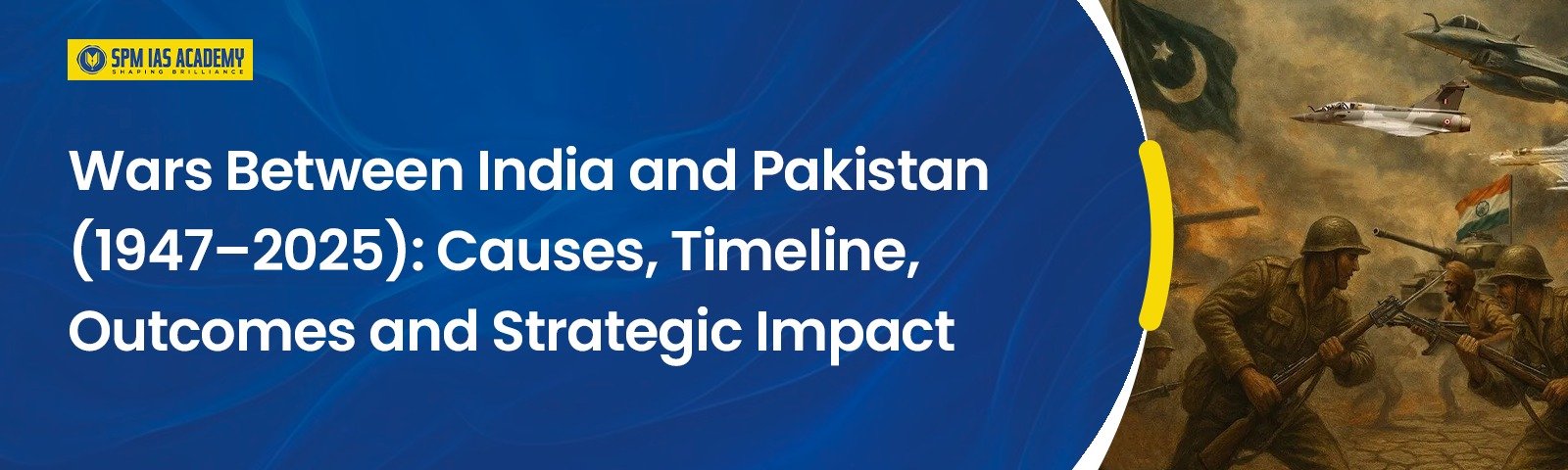
Wars Between India and Pakistan – 1947, 1965, 1971, Kargil 1999 and Developments up to 2025
The wars between India and Pakistan have deeply influenced South Asian geopolitics since 1947. India and Pakistan have fought four major wars — 1947–48, 1965, 1971, and 1999 (Kargil War). In addition, several military standoffs and cross-border escalations have occurred up to 2025.
Most of these conflicts revolve around the Kashmir dispute, cross-border terrorism, and strategic rivalry. For UPSC, APSC, and APPSC aspirants, the topic “wars between India and Pakistan” is important under International Relations, Security Studies, and Modern Indian History.
UPSC coaching in Assam provides expert mentorship and structured preparation for civil services aspirants aiming for success.
Background of India–Pakistan Wars:
India and Pakistan emerged as independent nations after Partition in 1947 based on ‘Two Nation Theory’. However, disputes started immediately over Jammu and Kashmir. The accession of Kashmir to India triggered the first armed conflict.
Therefore, Kashmir remains the central issue in most wars between India and Pakistan.
Major Wars Between India and Pakistan:
1. First India–Pakistan War (1947–48):
The First India-Pakistan War began in 1947 when Pakistan-backed tribal forces invaded the princely state of Jammu and Kashmir. In response to the invasion, Maharaja Hari Singh signed the Instrument of Accession to India, thereby legally acceding the state to the Indian Union. Consequently, India sent its troops to defend the region and protect the territory from further aggression. The conflict continued until 1948, when the United Nations intervened and facilitated a ceasefire. As a result, Kashmir was divided between India and Pakistan along a ceasefire line, which later came to be known as the Line of Control (LoC).
2. Second India–Pakistan War (1965):
The Second India–Pakistan War began in 1965 when Pakistan launched Operation Gibraltar. It aimed to infiltrate forces into Jammu and Kashmir and incite an uprising against the Indian administration. However, India responded firmly to the infiltration, and the conflict soon escalated into a full-scale war. Consequently, intense fighting spread beyond Kashmir to the international borders in Punjab and Rajasthan. After weeks of heavy military engagement, both countries agreed to cease hostilities. Eventually, the war ended with the signing of the Tashkent Agreement in 1966, which restored the status quo and required both sides to withdraw to pre-war positions.
3. Third India-Pakistan War (1971):
The Third India-Pakistan War broke out in 1971 due to a severe political crisis in East Pakistan. Following the electoral victory of the Awami League, tensions escalated when the West Pakistani leadership refused to transfer power. Consequently, large-scale military repression began in East Pakistan, which led to a massive influx of refugees into India. As a result, India extended support to the Mukti Bahini, the liberation forces of East Pakistan, thereby intensifying the conflict.
Eventually, the situation developed into a full-scale war between India and Pakistan. The conflict ended decisively with the creation of Bangladesh as an independent nation. Moreover, around 93,000 Pakistani soldiers surrendered, marking one of the largest military surrenders after World War II. Subsequently, both countries signed the Shimla Agreement in 1972, which aimed to resolve issues peacefully and convert the ceasefire line into the Line of Control (LoC).
Thus, the 1971 war remains the most decisive and transformative conflict in India–Pakistan relations.
4. Kargil War (1999):
The Kargil War of 1999 was a limited but intense conflict fought in the high-altitude region of Jammu and Kashmir.
- Firstly, the cause of the war was the infiltration of Pakistani soldiers and militants, who occupied strategic peaks in the Kargil sector along the Line of Control (LoC).
- Consequently, India responded by launching Operation Vijay, a large-scale military operation aimed at evicting the intruders and reclaiming occupied positions.
- Subsequently, the Indian Army, supported by the Indian Air Force, successfully regained control of the captured territories after heavy fighting in difficult terrain.
- Moreover, international pressure mounted on Pakistan, particularly from major global powers, which eventually compelled Pakistan to withdraw its forces.
- As a result, the Kargil War strengthened India’s diplomatic position globally, as the international community largely recognized India’s restraint and legitimate territorial claims.
List of Wars Between India and Pakistan (1947–2025):
This timeline highlights the major India-Pakistan conflicts and operations, outlining their causes, outcomes, and key diplomatic agreements over the decades.
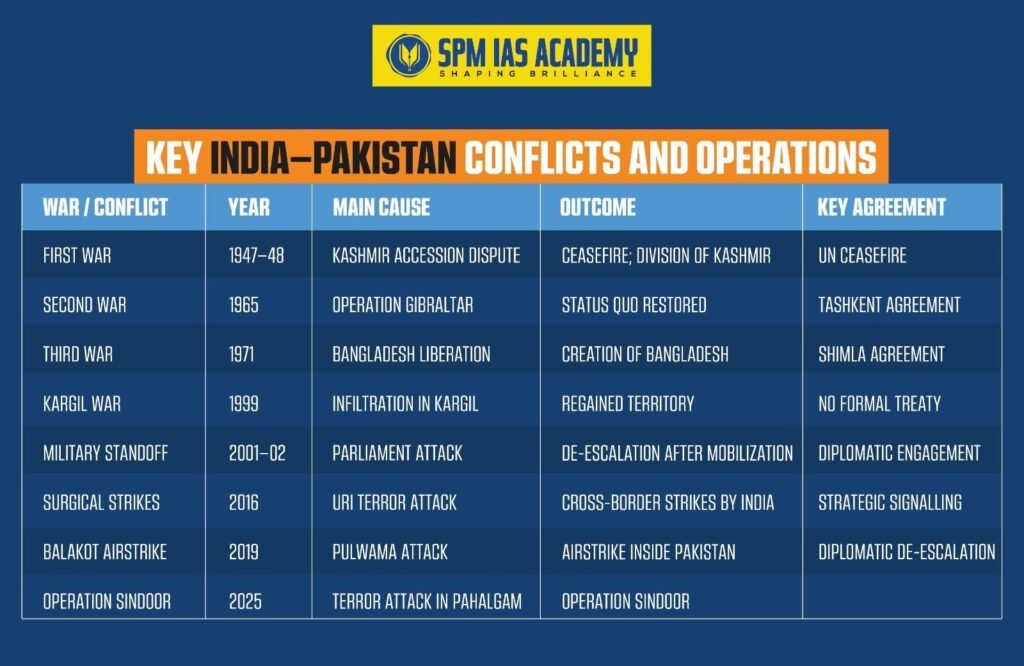
Together, these events reflect the evolving military, strategic, and diplomatic dimensions of India–Pakistan relations.
Developments Between 2000 and 2025:
Although no full-scale war occurred after 1999, tensions continued.
1. 2001–02 Military Standoff:
After the Parliament attack, India mobilized troops under Operation Parakram (2001-2002). However, war was avoided.
2. 2016 Surgical Strikes:
After the Uri attack, India conducted surgical strikes across the LoC.
3. 2019 Balakot Airstrike:
After the Pulwama terror attack, India carried out an airstrike in Balakot. Pakistan responded with aerial action.
4. Ceasefire Reaffirmation (2021):
Both countries reaffirmed the 2003 ceasefire agreement along the LoC.
5. 2025 Escalation – Operation Sindoor:
On 22nd April, 2025, tensions rose again due to a terror attack in Pahalgam, a tourist spot in Kashmir. India launched Operation SINDOOR, a calibrated military response aimed at neutralizing specific threats along the Line of Control. It aimed to destroy terror bases behind the attack. Along with military measures, India also adopted non-military measures like terminating the Indus Waters Treaty, 1960.
Although the operation remained limited in scope, it demonstrated India’s continued policy of strong retaliation against security challenges while avoiding full-scale war. Moreover, diplomatic engagement followed to prevent further escalation.
Major Causes of Wars Between India and Pakistan:
The wars and recurring tensions between India and Pakistan did not emerge suddenly. Instead, they evolved due to deep-rooted historical, political, and strategic issues. The following factors have played a central role in shaping conflicts between the two nations:
- Firstly, the Kashmir dispute remains the core issue. The conflict began immediately after Partition in 1947 when both India and Pakistan claimed the princely state of Jammu and Kashmir. Since then, the region has become the primary cause of wars in 1947-48, 1965, and the Kargil conflict of 1999. Moreover, the Line of Control (LoC) continues to witness ceasefire violations and military tensions. Therefore, the unresolved status of Kashmir remains the most significant trigger of hostility.
- Secondly, cross-border terrorism has intensified tensions. Over the years, India has accused Pakistan-based groups of supporting terrorist activities in Jammu and Kashmir and other parts of India. Major incidents such as the 2001 Parliament attack, 2016 Uri attack, 2019 Pulwama attack and 2025 Pahalgam Terror attack have led to military responses and diplomatic strain. As a result, terrorism has become a persistent cause of confrontation.
- Thirdly, territorial disagreements have contributed to repeated clashes. In addition to Kashmir, disputes over areas such as Sir Creek and Siachen Glacier have created friction. The Siachen conflict, for instance, involves control over strategically important high-altitude territory. Consequently, these territorial disagreements continue to affect bilateral relations.
- Furthermore, political instability and domestic pressures have influenced conflict dynamics. At times, internal political challenges in both countries have shaped foreign policy decisions. Political leadership, public opinion, and national security concerns often impact diplomatic engagement and military posture. Therefore, domestic factors also play an important role in escalating tensions.
- Finally, military rivalry and strategic competition have deepened mistrust. Both India and Pakistan maintain large armed forces and possess nuclear weapons. The arms race, missile development, and strategic doctrines have created a climate of deterrence mixed with suspicion. As a result, even minor incidents can escalate quickly due to high military preparedness on both sides.
Therefore, unresolved Kashmir issue combined with terrorism, territorial disagreements remain central to wars and tensions between India and Pakistan.
Impact of India-Pakistan Wars:
1. Militarization and Nuclearization:
- Firstly, the repeated conflicts led to rapid militarization in both countries, with increased defence spending and expansion of armed forces.
- Moreover, in 1998, both India and Pakistan conducted nuclear tests, thereby officially declaring themselves nuclear-armed states.
- As a result, South Asia emerged as a nuclear flashpoint, raising global concerns about strategic stability in the region.
2. Strategic Realignment:
- Secondly, India began strengthening strategic partnerships with major global powers to enhance its diplomatic and defence position.
- In particular, India expanded ties with countries like the United States and France, focusing on defence cooperation, technology transfer, and joint military exercises.
- Consequently, India’s global strategic profile improved significantly.
3. Defence Modernization:
- Furthermore, the wars highlighted operational gaps in military preparedness, especially after the Kargil War and later the Balakot airstrike.
- Therefore, India accelerated defence modernization, upgrading weapons systems, surveillance capabilities, and border infrastructure.
- As a result, the Indian armed forces enhanced their combat readiness and technological capabilities.
Conclusion:
In conclusion, the wars between India and Pakistan from 1947 to 2025 have deeply influenced regional geopolitics, defence strategy, and international diplomacy in the region of South Asia. The 1971 war fundamentally altered the political map of the subcontinent by the creation of Bangladesh. Subsequently, the Kargil War of 1999 highlighted the importance of intelligence coordination and high-altitude military preparedness. More recently, the Balakot airstrike in 2019 signalled a shift toward a more assertive cross-border response doctrine.
Therefore, a clear and analytical understanding of the wars between India and Pakistan strengthens conceptual clarity in International Relations, Security Studies, and Modern Indian History. Such knowledge enables aspirants to write structured, balanced, and well-informed answers in UPSC, APSC and APPSC Mains examination.
UPSC coaching in north east India offers comprehensive guidance tailored specifically for aspirants from the Northeast region.
Source:
https://www.pib.gov.in/Pressreleaseshare.aspx?PRID=2128748®=3&lang=2
https://www.cfr.org/global-conflict-tracker/conflict/conflict-between-india-and-pakistan
Frequently Asked Questions:
The major wars between India and Pakistan include the India-Pakistan War 1947-48, India-Pakistan War 1965, India-Pakistan War 1971, and the Kargil War 1999. In addition, major military confrontations such as the 2016 Surgical Strikes, 2019 Balakot airstrike, and developments up to 2025 have shaped bilateral relations.
The primary cause of the wars between India and Pakistan has been the Kashmir dispute. Moreover, cross-border terrorism, territorial disagreements (Siachen and Sir Creek), and strategic rivalry have repeatedly triggered conflicts and military escalations.
The India-Pakistan War 1971 was the most decisive conflict between the two countries. It led to the creation of Bangladesh, the surrender of around 93,000 Pakistani soldiers, and the signing of the Shimla Agreement (1972), which shaped future diplomatic relations.
The Kargil War 1999 occurred when Pakistani intruders occupied strategic peaks along the Line of Control (LoC). India launched Operation Vijay and successfully regained the territory. The war strengthened India’s global diplomatic position and highlighted the importance of high-altitude warfare and intelligence coordination.
Although no full-scale war occurred after 1999, tensions continued through events such as Operation Parakram (2001–02), Surgical Strikes (2016), Balakot airstrike (2019), Ceasefire Reaffirmation (2021), and Operation Sindoor (2025). These developments reflect a shift toward limited military responses and strategic deterrence rather than conventional warfare.

Behind every article at SPM IAS Academy is a team of skilled content writers and subject experts committed to making preparation easier for aspirants. From answering common doubts to breaking down complex issues and current affairs, we create content that is accurate, easy to understand, and directly useful for UPSC, APSC, and other competitive exams.