The Export Promotion Mission (EPM) is a flagship initiative to strengthen India’s export ecosystem. The Government approved it in November 2025 with an outlay of ₹25,060 crore. The Mission focuses on MSMEs, first-time exporters, and labour-intensive sectors. It provides financial and non-financial support under two sub-schemes, Niryat Protsahan and Niryat Disha.
For UPSC, APSC, APPSC and State PCS aspirants, this topic is important under GS Paper 3 (Indian Economy), MSME sector, export promotion, and inclusive growth.
Aspirants seeking expert guidance can explore UPSC coaching in Assam for structured preparation and current affairs analysis.
What is the Export Promotion Mission (EPM)?
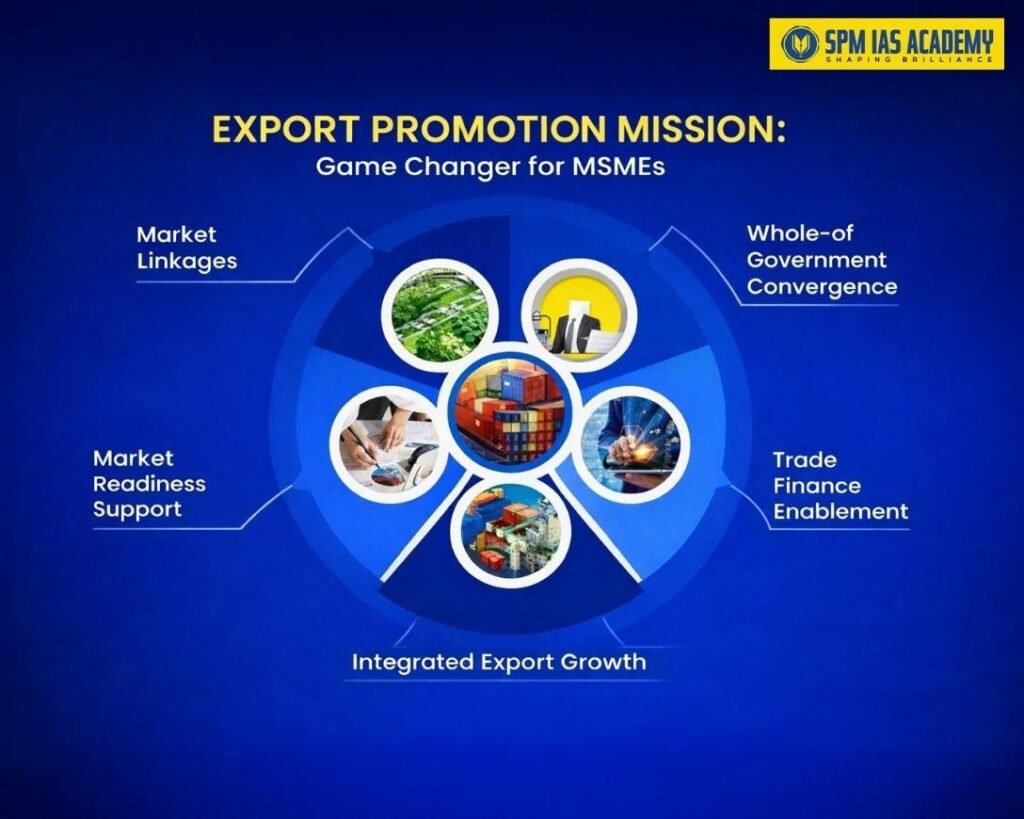
The Export Promotion Mission (EPM) is a coordinated, mission-mode export strategy. It integrates multiple export support measures into one unified framework.
The Mission aims to improve export competitiveness and expand India’s global trade footprint. It supports trade finance, compliance, logistics, and overseas market access.
The Mission works through two integrated sub-schemes:
- Niryat Protsahan – Financial enablers
- Niryat Disha – Non-financial and market access support
Thus, EPM adopts a whole-of-government approach to export growth.

What Are the Main Objectives of Export Promotion Mission?
- Firstly, the Mission seeks to improve access to affordable and diversified export finance, especially for MSMEs.
- Moreover, it supports compliance with international quality, technical, and sustainability standards to enhance global competitiveness.
- In addition, it aims to strengthen export branding, logistics infrastructure, and supply chain efficiency.
- Furthermore, the Mission promotes the expansion of overseas warehousing and fulfilment facilities to improve global reach.
- At the same time, it encourages the growth of cross-border e-commerce exports to integrate MSMEs into digital trade networks.
- Additionally, it enhances trade intelligence systems and expands market access opportunities for Indian exporters.
Therefore, the Export Promotion Mission reduces fragmentation in export support and enables integrated, inclusive export growth.
Niryat Protsahan – Financial Enablers for MSMEs:
Niryat Protsahan focuses on export finance and credit support. It reduces the cost of borrowing for MSMEs.
1. Support for Alternative Trade Instruments (Export Factoring):
- Firstly, this intervention promotes export factoring as an accessible trade finance option for MSMEs.
- Moreover, it provides an interest subvention of 2.75% on the factoring cost to reduce financing burden.
- In addition, support is available up to a maximum limit of ₹50 lakh per Importer Exporter Code (IEC).
- Furthermore, the scheme covers both recourse and non-recourse factoring arrangements.
- At the same time, factoring transactions can be undertaken in Indian Rupees as well as freely convertible foreign currencies.
Therefore, this intervention improves working capital liquidity and ensures smoother export business cycles for MSMEs.
2. Credit Assistance for E-Commerce Exporters:
- Firstly, this intervention supports MSME exporters engaged in cross-border e-commerce activities.
- Moreover, it provides up to 90% guarantee coverage under the Direct E-Commerce Credit Facility.
- In addition, the maximum guarantee coverage under this facility is capped at ₹50 lakh.
- Furthermore, the Overseas Inventory E-Commerce Credit Facility offers coverage up to ₹5 crore to support global fulfilment operations.
- At the same time, exporters receive an interest subvention of 2.75% on eligible financing.
Therefore, this scheme significantly strengthens cross-border e-commerce exports and improves working capital access for MSMEs.
3. Support for Emerging Export Opportunities:
- This intervention aims to reduce risk for MSMEs entering new or high-risk export markets.
- Moreover, it provides risk-sharing support ranging from 10% to 90% of the transaction value, based on the risk profile.
- In addition, a country-wise exposure cap of 15% is maintained to ensure balanced risk distribution.
- Furthermore, an exporter-wise exposure cap of 5% is prescribed to prevent excessive concentration.
Therefore, this component encourages MSMEs to confidently expand into emerging and higher-risk global markets.
Already Operational Financial Interventions:
4. Interest Subvention for Pre- and Post-Shipment Export Credit:
- Firstly, the scheme provides an interest subvention of 2.75% on pre- and post-shipment export credit.
- Moreover, the benefit is available up to a maximum limit of ₹50 lakh per exporter.
- In addition, arrears amounting to ₹850 crore under the earlier scheme have been cleared, ensuring smoother implementation.
5. Collateral Support for Export Credit:
- Firstly, the scheme provides 85% credit guarantee coverage for micro and small enterprises.
- Moreover, it offers 65% guarantee coverage for medium enterprises.
- In addition, eligible exporters can avail credit support up to a limit of ₹10 crore.
Therefore, these measures significantly improve access to formal and collateral-free export finance for MSMEs.
Niryat Disha: Non-Financial and Market Access Enablers:
Niryat Disha addresses non-financial export barriers. It improves compliance and market readiness.
1. Trade Regulations, Accreditation and Compliance Enablement (TRACE):
- Firstly, TRACE supports exporters in meeting international certification and compliance requirements.
- Moreover, it provides financial assistance of 60% of the actual cost under the notified Positive List.
- In addition, higher assistance of 75% is available for certifications under the Priority Positive List.
- Furthermore, the support is subject to an annual cap of ₹25 lakh per exporter.
Therefore, TRACE strengthens compliance readiness and improves alignment with global quality standards.
2. Logistics Interventions for Freight and Transport (LIFT):
- Firstly, LIFT addresses logistics disadvantages faced by exporters in hinterland and remote regions.
- Moreover, it provides financial support of up to 30% of the actual transport cost incurred.
- In addition, the assistance is capped at a maximum of ₹20 lakh per exporter per financial year.
Therefore, this intervention significantly lowers freight and inland transportation costs, enhancing export competitiveness.
3. Integrated Support for Trade Intelligence and Facilitation (INSIGHT):
- INSIGHT enhances exporter preparedness by strengthening institutional and information support systems.
- Moreover, it provides assistance for research, trade intelligence, and advanced trade analytics.
- In addition, the intervention supports training programmes and district-level facilitation initiatives.
- Furthermore, it offers financial assistance of up to 50% of the approved project cost for eligible activities.
Therefore, INSIGHT reduces information asymmetry and bridges critical gaps in the export ecosystem.
4. Facilitating Logistics, Overseas Warehousing and Fulfilment (FLOW):
- Firstly, FLOW strengthens overseas logistics and fulfilment infrastructure for Indian exporters.
- Moreover, it provides financial assistance of up to ₹10 crore for establishing overseas warehousing facilities.
- In addition, support of up to ₹5 crore is available for display and market access infrastructure.
- Furthermore, the assistance is provided for a maximum support period of three years.
Therefore, FLOW enhances global market integration and improves the international presence of Indian exporters.
Intervention Already Operational:
5. Market Access Support (MAS):
- Firstly, MAS promotes international trade participation by supporting market access activities.
- Moreover, it provides financial assistance of up to ₹5 crore per event for trade fairs, buyer–seller meets, and trade delegations.
- In addition, higher support of up to ₹10 crore is available for Reverse Buyer Seller Meets.
- Furthermore, airfare support is extended to MSMEs to encourage their participation in global events.
Therefore, MAS enhances the global visibility and market reach of Indian products and services.
Significance of Export Promotion Mission (EPM):
The Export Promotion Mission (EPM) is significant for economic growth, MSME development, trade diversification, and inclusive globalization. It reflects India’s shift toward a structured, mission-mode export strategy.
1. Strengthening MSME Competitiveness:
- Firstly, EPM directly addresses structural constraints faced by MSMEs. These include limited access to credit, compliance barriers, and logistics disadvantages.
- By integrating financial and non-financial support, the Mission enhances export readiness and global competitiveness of small businesses.
2. Promoting Export-Led Economic Growth:
- Secondly, EPM supports India’s goal of becoming a major global trading power.
- It reduces transaction costs and improves market access. As a result, it strengthens India’s merchandise and services exports.
- Export growth improves foreign exchange earnings and strengthens the current account balance.
3. Advancing Inclusive and Decentralised Growth:
- Moreover, the Mission promotes inclusive growth by supporting first-time exporters and labour-intensive sectors.
- Interventions like LIFT and TRACE help exporters from hinterland and rural districts.
- Thus, EPM supports balanced regional development and aligns with the objective of inclusive growth and social justice.
4. Enhancing Ease of Doing Business in Exports:
- Furthermore, EPM reduces fragmentation in export support schemes.
- It integrates trade finance, compliance, logistics, and trade intelligence into one framework.
- Therefore, this improves policy coherence and strengthens institutional coordination.
5. Supporting Digital Trade and E-Commerce:
- In addition, EPM promotes cross-border e-commerce exports.
- This aligns with India’s Digital Public Infrastructure and digital economy expansion.
- By supporting e-commerce credit and overseas fulfilment, the Mission integrates MSMEs into global digital supply chains.
- This connects with topics like digital economy, globalisation, and technological integration.
6. Strategic Trade Diversification:
- Finally, EPM encourages entry into emerging and high-risk markets through risk-sharing instruments.
- This reduces dependence on limited export destinations. It strengthens India’s resilience in global trade disruptions.
Conclusion: Export Promotion Mission and India’s Export-Led Growth Strategy
The Export Promotion Mission (EPM) creates an integrated export ecosystem for MSMEs. It combines trade finance, compliance support, logistics, and market access in one framework. By reducing export costs and improving global competitiveness, Export Promotion Mission strengthens India’s position in global trade. It promotes inclusive and decentralised export growth.
For UPSC, APSC, APPSC and State PCS examinations, themes like Export Promotion Mission remain highly important under GS Paper 3, Indian Economy and Current Affairs. Therefore, understanding EPM helps aspirants develop clarity on India’s evolving export strategy and economic governance framework.
Students preparing for civil services can join UPSC coaching in north east India for specialized GS and current affairs mentorship.
Mains Practice Question:
Q. The Export Promotion Mission (EPM) represents a shift toward an integrated, mission-mode export strategy in India. Discuss the objectives, key components, and significance of the Export Promotion Mission (EPM) in strengthening MSME competitiveness and promoting export-led growth.
Source:
https://www.pib.gov.in/PressNoteDetails.aspx?id=157540&NoteId=157540&ModuleId=3®=3&lang=1
Frequently Asked Questions:
The Export Promotion Mission (EPM) is a Government of India initiative approved in November 2025. It aims to strengthen India’s export ecosystem. It provides integrated financial and non-financial support to MSMEs through two sub-schemes. One is Niryat Protsahan and the other one is Niryat Disha. Both of these sub-schemes aim to boost export competitiveness and global market access.
The Export Promotion Mission aims to improve access to export finance, support compliance with international standards, reduce logistics costs, promote cross-border e-commerce exports, expand overseas warehousing, and enhance trade intelligence. It focuses especially on MSMEs and first-time exporters.
Niryat Protsahan is the financial enablers sub-scheme of the Export Promotion Mission. It provides interest subvention, credit guarantees, export factoring support, and e-commerce export credit assistance to improve working capital access for MSME exporters.
Niryat Disha is the non-financial and market access component of EPM. It supports export compliance (TRACE), logistics cost reduction (LIFT), trade intelligence (INSIGHT), overseas warehousing (FLOW), and market access events (MAS) to enhance global integration of Indian exporters.
The Export Promotion Mission is important for UPSC, APSC, and State PCS exams under GS Paper 3 (Indian Economy). It relates to MSME development, export-led growth, external trade policy, inclusive growth, and economic governance reforms.