
On 7th May every year, Rabindranath Tagore Jayanti 2026 is celebrated. This year, it marks the 165th birth anniversary of Gurudev Rabindranath Tagore. Rabindranath Tagore was a poet, philosopher, writer, and Nobel Prize winner from India. His life, works, and ideas appear in many competitive exam questions. Moreover, his quotes are very useful in essay paper of UPSC, APSC and other state PCS Mains exams.
In this article, you will find all the important key facts about Rabindranath Tagore Jayanti 2026.
Rabindranath Tagore Jayanti Date: When Is It Celebrated?
Rabindranath Tagore Jayanti 2026 falls on two dates this year. Most of India observes it on May 7, 2026. However, West Bengal and Bangladesh follow the Bengali calendar. There, the celebration happens on Pachishe Boishakh, which is May 9, 2026. Therefore, Rabindranath Tagore Jayanti 2026 gives a three-day window of celebration. Both dates mark the 165th birth anniversary of Gurudev Rabindranath Tagore.
The dual date system often confuses students. Here is a simple way to remember it:
- National Date: May 7, 2026 (Gregorian calendar)
- Bengali Calendar Date: Pachishe Boishakh = May 9, 2026
- Birth Anniversary Year: 165th (born in 1861)
- Also known as: Rabindra Jayanti or Pochishe Boishakh
Who Was Rabindranath Tagore? Key Facts for UPSC and APSC
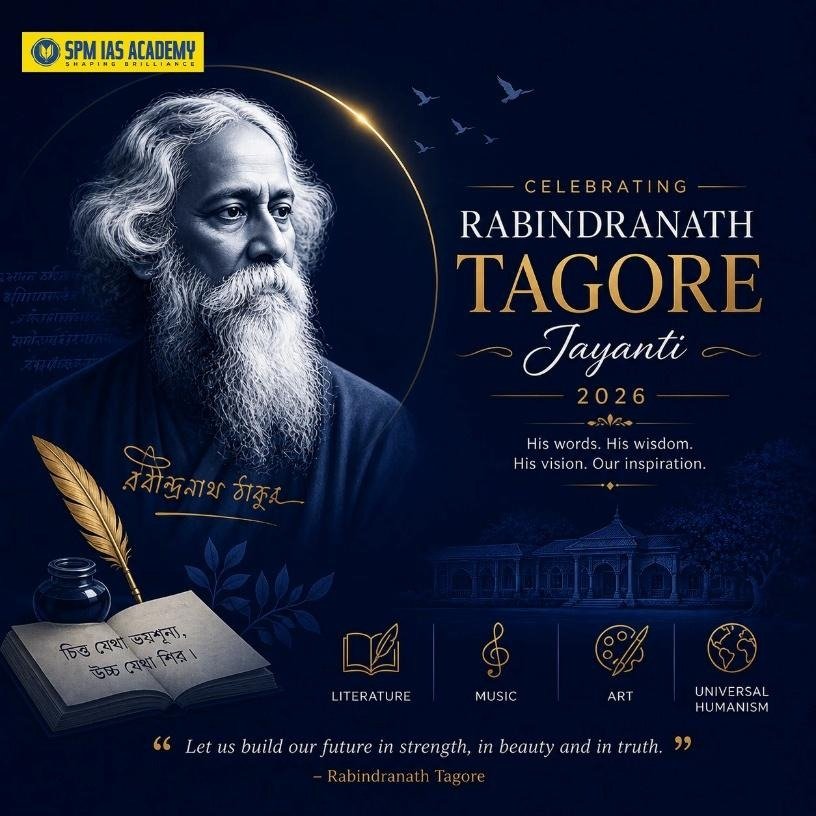
Rabindranath Tagore was born on May 7, 1861, in Kolkata. He came from the famous Tagore family of the Jorasanko Thakur Bari. Tagore was a multi-talented genius of modern India. He wrote novels, poems, short stories, novels, songs, and plays. Moreover, he was a painter, educator, and social reformer. Tagore passed away on August 7, 1941, in Kolkata.
Students often ask about facts and ideas of Tagore in UPSC prelims and mains. Therefore, knowing about key facts related to his life and his ideas is very important.
- Full Name: Rabindranath Tagore
- Born: May 7, 1861, Jorasanko, Kolkata
- Died: August 7, 1941, Kolkata
- Pen Name / Title: Gurudev, Kabiguru, Biswakabi
- Composed Jana Gana Mana and Amar Shonar Bangla, shaping national identity across South Asia.
- Nobel Prize: Literature, 1913 (first Asian to win the Nobel Prize)
- Famous Work: Gitanjali (Song Offerings) – won the Nobel Prize
- Transformed Bengali literature through poetry, songs, novels, and essays marked by lyrical beauty and philosophical depth; became the first non-European Nobel laureate in Literature.
- Founded: Visva-Bharati University, Santiniketan, West Bengal (1921) to promote holistic, creative, and experiential education rooted in cultural exchange.
- Produced over 2,500 paintings and sketches, establishing himself as a significant modern Indian artist exploring themes of nature, spirituality, and human emotion.
- Advocated universal humanism, criticized narrow nationalism, and promoted global peace, cultural harmony, and ethical progress.
Early Life and Education of Rabindranath Tagore
Born on May 7, 1861, in Calcutta, Tagore grew up in a distinguished and intellectually vibrant household. His father, Debendranath Tagore, was a key figure of the Brahmo Samaj, and his mother Sarada Devi nurtured a culturally rich environment at home. Surrounded by literature, music, and philosophical discussions, Tagore absorbed creativity and critical thinking from an early age.
He did not follow a conventional academic path. His family preferred home-based, holistic learning over rigid classroom education. Although he briefly attended formal schools and later spent some time at University College London, he did not complete a degree. Instead, he pursued self-learning, guided by curiosity and exposure to diverse ideas.
This unconventional upbringing shaped Tagore’s personality. He developed a deep appreciation for nature, art, and human values, rather than rote education. His early experiences laid the foundation for his later work as a poet, philosopher, and educationist, and influenced his vision of creative and freedom-based learning systems.
Rabindranath Tagore Jayanti 2026: Why Is It Significant?
Rabindranath Tagore Jayanti 2026 holds deep cultural and national significance.
- Rabindranath Tagore shaped the identity of modern India through his art and ideas. Furthermore, his ideas on education, nationalism, and humanism remain relevant even today. As a result, this day is observed in schools, colleges, and cultural organizations all over India.
- From an exam perspective, Tagore’s legacy covers multiple subjects. His works appear in Indian history, art, culture, and modern India sections. Therefore, Rabindranath Tagore Jayanti 2026 is a perfect time to revise these topics.
Tagore’s Philosophy of Education:
Tagore reimagined education as a living, breathing experience rather than a rigid system. He moved learning beyond closed classrooms into the openness of nature, where curiosity could grow freely. He opposed rote memorization and instead encouraged students to question, explore, and create. For him, education meant shaping the whole person—mind, body, and emotions—through freedom and imagination. Music, art, dance, and drama were not extras but essential tools to make learning joyful and meaningful.
- Tagore strongly believed in a natural and free style of education. He started his school Patha Bhavana at Santiniketan in 1901.
- To bring this vision to life, he founded Visva-Bharati University as a space where ideas from different cultures could meet and grow together. His approach aimed to produce individuals who think independently, respect diversity, and carry a deep sense of humanity in an interconnected world. Later, this school grew into Visva-Bharati University in 1921. The university blended Indian and Western knowledge traditions. Therefore, it became a model for holistic education in India.
- Tagore’s concept of ‘Tapovan’ education connects nature with learning.
Shantiniketan and Rabindranath Tagore
Shantiniketan began as a quiet spiritual retreat founded in 1863 by Debendranath Tagore. Rabindranath Tagore later transformed it into a vibrant centre of learning and culture. In 1901, he established an experimental school here, breaking away from the rigid colonial system of education. He introduced open-air classes, encouraged learning in harmony with nature, and created an environment where freedom, creativity, and curiosity guided the process of education.
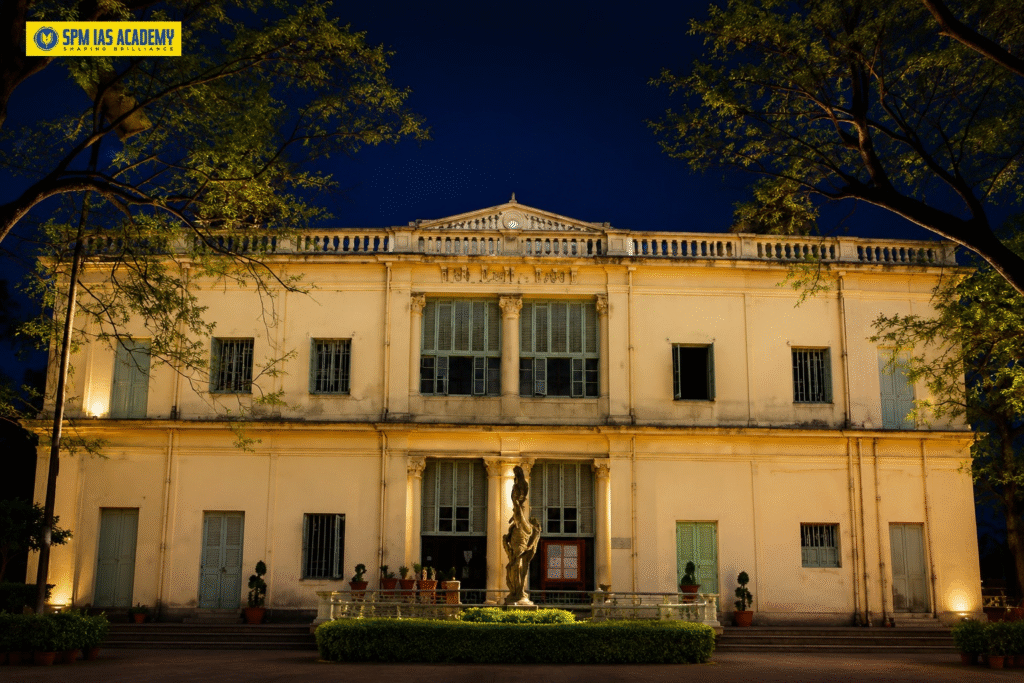
Over time, Shantiniketan evolved into a global hub of intellectual and cultural exchange with the establishment of Visva-Bharati University. It became a place where Indian traditions met international ideas, fostering art, literature, and philosophy. Recognizing its unique legacy, Shantiniketan was declared a UNESCO World Heritage Site in 2023. Today, it stands as a symbol of Tagore’s vision—an education rooted in nature, enriched by culture, and open to the world.
Literature of Rabindranath Tagore
Rabindranath Tagore’s literary world flows with lyrical beauty, emotional depth, and philosophical insight. He reshaped Bengali literature and gave it a modern, global voice that connected deeply with both Indian and international audiences. His writing moves effortlessly between personal reflection and universal themes such as love, identity, nature, and spirituality, making his work timeless and widely relevant.
- Poetry: Works like Gitanjali, Manasi, Sonar Tari, and Balaka reflect spiritual depth and emotional richness; Gitanjali earned him the Nobel Prize in 1913.
- Novels: Gora, Ghare-Baire, and Chokher Bali explore identity, nationalism, and social reform.
- Dramas: Plays such as Visarjan, Muktadhara, and Valmiki-Pratibha blend poetic expression with strong social themes.
- Short Stories: Collections like Galpaguchchha portray everyday life with deep human sensitivity and realism.
National Anthems Composed by Rabindranath Tagore
Jana Gana Mana was composed by Tagore in 1911 and first publicly sung at the Calcutta Session of the Indian National Congress on 27 December 1911. It was later adopted as the national anthem of India in 1950. The song expresses the idea of a unified India, where diverse regions and cultures come together under a shared civilizational identity. Its solemn tone and structured composition reflect collective unity, dignity, and national integration.
Amar Shonar Bangla was written by Tagore in 1905 during the Swadeshi movement against the Partition of Bengal. It was later adopted as the national anthem of Bangladesh in 1971. The song expresses deep emotional attachment to the land, nature, and cultural roots of Bengal. While Jana Gana Mana represents broader national unity, Amar Shonar Bangla reflects regional identity and cultural belonging. Together, these two anthems highlight Tagore’s ability to blend patriotism with emotional and cultural depth.
1905: Resistance and Rakhi Bandhan by Rabindranath Tagore
In 1905, when Lord Curzon partitioned Bengal, Tagore responded in a way that touched both heart and society. He refused to see resistance only as political protest. Instead, he turned it into a shared emotional experience. He transformed Rakhi Bandhan into a powerful symbol of unity, where Hindus and Muslims tied rakhis to show trust, brotherhood, and rejection of the British “divide and rule” policy. It became a moment where culture itself became resistance.
During this same period, he wrote Amar Shonar Bangla. The song carried deep affection for Bengal’s land, people, and identity. It strengthened emotional unity and gave people a sense of belonging that went beyond politics.
1913: The Nobel Prize
In 1913, Tagore received global recognition when he won the Nobel Prize in Literature for Gitanjali. This made him the first non-European Nobel laureate in literature. His poems, translated into English with the support of W.B. Yeats, moved Western readers with their simplicity and spiritual depth.
- His writing expressed universal human emotions beyond borders.
- It blended spirituality, nature, and inner reflection in simple language.
- The award gave Indian literature a respected global identity.
- It established Tagore as a world voice of humanism, not just nationalism.
1919: Renunciation of Knighthood
The Jallianwala Bagh Massacre in 1919 deeply disturbed Tagore. He felt that honour from a colonial power had no meaning after such brutality. He responded with a moral protest rather than a political speech.
He wrote a strong letter to the Viceroy, Lord Chelmsford, and returned his knighthood. This act reflected his belief that dignity and conscience stand above titles. It became one of the most powerful symbolic protests in India’s freedom movement, showing that resistance can also come through moral courage and silence-filled defiance.
Rabindra Sangeet
Yes, yes—songs like “Tumi Robe Nirobe” gently linger in the heart, speaking in silence more than words ever could. Rabindra Sangeet carries that same quiet intensity across its vast collection of over 2,200 songs by Rabindranath Tagore. Whether it is “Amaro Porano Jaha Chay”, “Akash Bhora Surjo Tara”, or “Jokhon Porbe Na Mor Payer Chinho”, each song captures emotions with clarity and depth. Tagore placed poetry at the center, allowing melody to flow naturally around it, creating a style that feels simple yet profoundly moving.
These songs form a unique genre, blending classical ragas with Baul folk influences and subtle Western touches. Organized in Gitabitan into themes like Puja, Prem, Prakriti, and Swadesh, Rabindra Sangeet reflects devotion, love, nature, and patriotism in their purest forms. Tagore even developed Swaralipi to preserve their structure, ensuring that the unity of word and tune remains intact. More than music, Rabindra Sangeet lives as a cultural rhythm—deeply embedded in everyday life, emotions, and identity across Bengal and beyond.
How Is Rabindranath Tagore Jayanti 2026 Celebrated Across India?
Celebrations of Rabindranath Tagore Jayanti 2026 are taking place all over India. Kolkata leads the festivities with grand cultural programs. People gather at Jorasanko Thakur Bari, Tagore’s ancestral home, to pay tribute. Santiniketan in Birbhum district hosts large community celebrations on May 9. Moreover, thousands of tourists travel to Bolpur and Santiniketan for the occasion.
Across the country, schools and cultural clubs organise events. Children perform Rabindra Nritya and recite Tagore’s poems. Cultural committees perform Prabhat Pheri, a morning procession with songs. Moreover, higher educational institutions will hold seminars and webinars on Tagore’s philosophy and legacy.
What was Rabindranath Tagore’s core idea of nationalism?
Tagore defined nationalism as a moral and human-centered idea. He separated the nation from society. He described the nation as a political and economic structure driven by power and self-interest. He described society as a natural system based on culture, relationships, and shared values. In his book Nationalism (published in 1917), he described nationalism as a “mechanical” construct that overlooks the human spirit. He argued that true progress lies in social harmony, cultural richness, and ethical living, not in political dominance. He emphasized that India should build on its civilizational ethos rather than imitate Western models.
Why did Tagore criticize Western-style nationalism?
Tagore criticized Western nationalism as a “great menace” shaped by imperialism and the context of the First World War. He argued that it promoted greed, power, and exploitation over human welfare. He saw it as a source of belligerent foreign policy and colonial expansion. He believed it reduced individuals to instruments of the state and weakened moral consciousness. In his lectures such as Nationalism in the West and Nationalism in Japan, he warned that such systems create division rather than unity. He concluded that Western nationalism had a deadening effect on living humanity and conflicted with ethical and spiritual values.
How did Tagore’s views differ from Mahatma Gandhi?
Tagore viewed nationalism through a universal and humanistic lens, while Gandhi treated it as a practical tool for political liberation. Gandhi emphasized Swaraj, Swadeshi, and organized resistance against colonial rule. Tagore criticized any rigid or exclusionary application of these ideas. He opposed nationalism that encouraged irrational or narrow thinking. Gandhi focused on collective discipline and national unity. Tagore focused on individual freedom, cultural openness, and global humanism. Despite differences, both upheld non-violence, ethical conduct, and concern for the poor.
Why is Tagore’s nationalism relevant for ethics today?
Tagore’s ideas promote humanism over imperialism and universalism over narrow identity. He argued that real human development occurs through culture, cooperation, and moral growth, not through political power. He urged India to avoid aggressive, industrial nationalism and follow its tradition of tolerance. He supported the idea of global brotherhood (Vasudhaiva Kutumbakam). His philosophy helps address modern challenges like nationalism-driven conflict, intolerance, and polarization. It supports ethical governance based on empathy, inclusivity, and global responsibility, making it highly relevant for UPSC Ethics and contemporary policy debates.
Rabindranath Tagore: Quick Revision Notes for UPSC, APSC and Other State PCS Exams
On the occasion of Rabindranath Tagore Jayanti 2026, use these quick notes. They will help you during last-minute revision for UPSC and state PCS exams.
- Tagore’s father was Debendranath Tagore, a Brahmo Samaj leader.
- Tagore started writing poetry at the age of eight.
- His first published poem was ‘Abhilasha’ published in 1874.
- He wrote more than 2,000 songs known as Rabindra Sangeet.
- He was awarded with knighthood in 1915 by King George V for contributions to literature. But in 1919, he renounced knighthood in protest against the Jalliawala Bagh massacre.
- Tagore was the first person from Asia to win the Nobel Prize in any category.
Rabindranath Tagore Jayanti 2026 Celebrations: National and Global Impact
In 2026, celebrations of Rabindranath Tagore Jayanti are especially significant. This year marks the 165th birth anniversary of the great poet. As a result, events are happening both in India and abroad. Several universities globally are holding academic seminars on his work. His philosophy of universalism is seeing fresh interest in academic circles.
In West Bengal, tens of thousands of visitors are expected to visit Jorasanko and Santiniketan. Young artists across India are sharing their renditions of Rabindra Sangeet online. Schools are coaching students in Rabindra Nritya for stage performances. Hence, Rabindranath Tagore Jayanti 2026 is truly a national cultural event.
Quotes of Rabindranath Tagore – Important for UPSC, APSC
Rabindranath Tagore’s words continue to inspire people across the world. His quotes reflect deep thoughts on life, freedom, education, and human values. Moreover, these quotes are very useful for UPSC, APSC mains exams especially for Essay Paper. Here are some of the most important quotes of Rabindranath Tagore:
- “Where the mind is without fear and the head is held high.” This quote highlights the importance of freedom and courage in society.
- “You can’t cross the sea merely by standing and staring at the water.” It teaches us to take action instead of waiting.
- “Faith is the bird that feels the light when the dawn is still dark.” This quote shows the power of hope and belief.
- “Let your life lightly dance on the edges of time like dew on the tip of a leaf.” It expresses the beauty and simplicity of life.
- “The highest education is that which does not merely give us information but makes our life in harmony with all existence.” This reflects Tagore’s philosophy of holistic education.
Therefore, Tagore’s quotes continue to guide people towards wisdom, creativity, and meaningful living.
Ekla Chalo Re: The Courage to Walk Alone
Jodi tor daak shune keu na ashe tobe ekla cholo re
Ekla cholo, ekla cholo, ekla cholo, ekla cholo r
At some stage of life, most of us have paused on these lines and felt their weight. Ekla Chalo Re by Rabindranath Tagore speaks directly to those quiet moments when support fades and doubt grows. It does not promise comfort; it asks for courage. It tells you to keep walking when others hesitate, to trust your conviction when voices fall silent. The song turns loneliness into strength and hesitation into resolve. It reminds us that some paths demand solitude, and in those moments, choosing to move forward alone becomes an act of quiet bravery.
Conclusion:
In conclusion, Rabindranath Tagore Jayanti 2026 celebrates the life and legacy of one of India’s greatest thinkers and writers. Moreover, it creates awareness about his contributions to Indian literature, education, and culture. Therefore, this day reminds us of Tagore’s timeless ideas on humanism, nationalism, and creativity.
Furthermore, understanding the facts and ideas related to Rabindranath Tagore is very important for UPSC, APSC, and other competitive exams.
Source:
Rabindranath Tagore Jayanti 2026 is celebrated on May 7, 2026 across India. However, in West Bengal and Bangladesh, people celebrate it on Pachishe Boishakh (May 9, 2026).
Rabindranath Tagore was a poet, philosopher, and Nobel Prize-winning writer. Additionally, he wrote Gitanjali and composed the national anthems of India and Bangladesh.
People celebrate Rabindranath Tagore Jayanti with cultural programs, poetry recitations, and Rabindra Sangeet performances. Moreover, schools and universities organise events and seminars.
Rabindranath Tagore Jayanti falls on 9th May in West Bengal and Bangladesh because they follow the Bengali calendar. Therefore, they celebrate it on Pachishe Boishakh, which corresponds to May 9 in 2026.
Rabindranath Tagore was born on May 7, 1861, according to the Gregorian calendar. However, according to the Bengali calendar, his birthday is observed on Pachishe Boishakh, which falls on May 9 in 2026.
Rabindranath Jayanti is celebrated to honour the birth anniversary of Rabindranath Tagore. Moreover, it recognises his contributions to Indian literature, music, education, and culture. Therefore, people celebrate his legacy across India and beyond.

Behind every article at SPM IAS Academy is a team of skilled content writers and subject experts committed to making preparation easier for aspirants. From answering common doubts to breaking down complex issues and current affairs, we create content that is accurate, easy to understand, and directly useful for UPSC, APSC, and other competitive exams.