
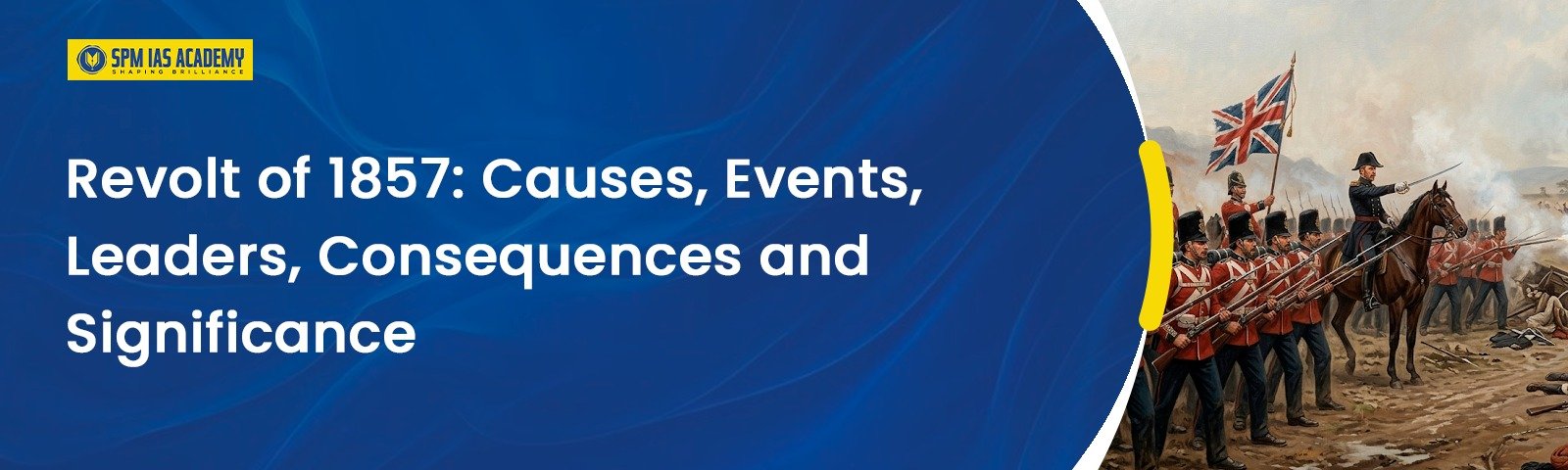
The Revolt of 1857, also known as the First War of Indian Independence, was the first major uprising against British rule in India. It began in Meerut in May 1857 and quickly spread to Delhi, Kanpur, Lucknow, Jhansi, and other regions. The revolt emerged due to political annexations, economic exploitation, military objections, and social-religious interference by the British East India Company. Although the revolt ultimately failed, it marked a turning point in Indian history by ending Company rule and bringing India under direct control of the British Crown.
The revolt exposed deep political, economic, military, and social grievances against the British East India Company. For UPSC, APSC, and APPSC aspirants, the Revolt of 1857 is a core topic under Modern Indian History.
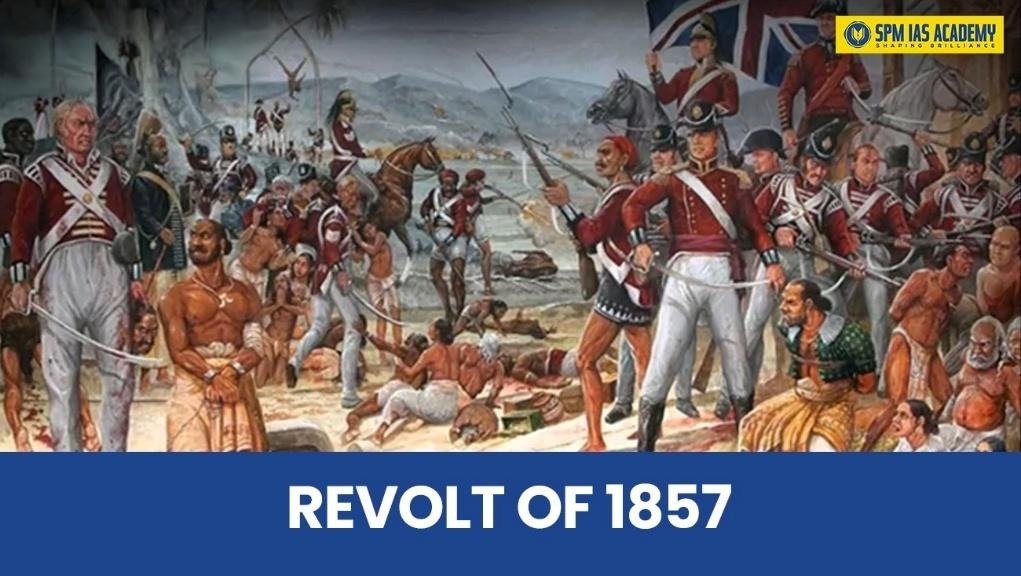
Revolt of 1857 – First War of Indian Independence or Sepoy Mutiny?
The Revolt of 1857 was one of the most important events in modern Indian history. It began as a military uprising but soon turned into a widespread rebellion against British rule. Many historians call it the First War of Indian Independence, while others describe it as the Sepoy Mutiny of 1857.
Background of the Revolt of 1857:
Before 1857, the British East India Company had expanded its control over large parts of India. However, its policies created dissatisfaction among rulers, soldiers, peasants, and artisans.
Therefore, anger was already building up before the revolt began.
Causes of the Revolt of 1857:
The Revolt of 1857 did not occur suddenly. Instead, a combination of political, economic, military, and social factors gradually created widespread resentment. The major causes are explained below:
1. Political Causes:
- Firstly, the British introduced the Doctrine of Lapse under Lord Dalhousie. It allowed the annexation of princely states without a natural heir.
- Moreover, they annexed important states such as Jhansi, Satara, and Nagpur, thereby weakening Indian rulers.
- In addition, the annexation of Awadh in 1856 created deep anger, as it was considered unjust and humiliating.
- As a result, many Indian rulers lost their kingdoms and authority. This intensified political dissatisfaction.
2. Economic Causes:
- Secondly, the British destroyed traditional industries, especially handicrafts and textiles, through discriminatory policies.
- Furthermore, heavy land revenue policies burdened peasants, forcing many into debt and poverty.
- At the same time, zamindars and landlords lost their traditional privileges, due to changes in revenue settlements.
- Consequently, economic exploitation increased resentment among peasants, artisans, and landlords alike.
3. Military Causes:
- Thirdly, Indian sepoys faced discrimination in salary and promotion, despite forming the majority of the army.
- Moreover, they were denied higher ranks, which were reserved for British officers.
- In addition, sepoys were required to serve overseas, which violated religious beliefs for many soldiers.
- Thus, dissatisfaction steadily grew within the army, creating a fertile ground for rebellion.
4. Social and Religious Causes:
- Additionally, the British introduced social reforms without adequate local support, which created suspicion among Indians.
- Many people feared forced religious conversion, especially due to missionary activities.
- Furthermore, reforms like the abolition of Sati and the introduction of Western education were misunderstood by conservative sections.
- Therefore, people believed that the British were interfering with their customs and traditions.
5. Immediate Cause – Greased Cartridges:
- Finally, the immediate trigger was the introduction of the Enfield rifle, which required biting the cartridge before loading.
- The cartridges were rumoured to be greased with cow and pig fat, which deeply offended Hindu and Muslim soldiers.
- As a result, religious sentiments were hurt, leading to open defiance by sepoys.
- Hence, the revolt first began within the army at Meerut in May 1857.
Thus, a combination of political annexations, economic exploitation, military grievances, social fears, and the immediate cartridge controversy collectively led to the outbreak of the Revolt of 1857.
Beginning and Spread of the Revolt of 1857:
The Revolt of 1857 began on 10 May 1857 in Meerut, when Indian sepoys rose against British officers after refusing to use the controversial greased cartridges. Following the outbreak in Meerut, the rebels quickly marched to Delhi, where they captured the city and declared Bahadur Shah Zafar as the Emperor of India. This proclamation gave the revolt a symbolic leadership and strengthened its political character.
Subsequently, the uprising spread rapidly to other major centres. Kanpur, under the leadership of Nana Sahib, became a significant hub of resistance. Similarly, Lucknow witnessed intense fighting, particularly under Begum Hazrat Mahal. In Jhansi, Rani Lakshmibai emerged as one of the most prominent leaders of the revolt. Meanwhile, Bareilly and Gwalior also experienced strong rebellion against British authority.
Thus, what began as a military uprising in Meerut soon transformed into a widespread revolt across northern and central India.
Who were the Important Leaders of the Revolt of 1857?
The Revolt of 1857 witnessed the emergence of several prominent leaders across different regions. Although each centre had strong leadership, there was limited coordination among them.
- Firstly, in Delhi,Bahadur Shah Zafar was proclaimed the symbolic Emperor of India, providing political legitimacy to the revolt.
- General Bakht Khan played a key military role in organizing rebel forces and leading resistance against the British.
- Secondly, in Kanpur,Nana Sahib emerged as a major leader and challenged British authority.
- Tantia Tope, a close associate of Nana Sahib, led several military campaigns with strategic skill and persistence.
- Moreover, in Jhansi, Rani Lakshmibai became one of the most iconic figures of the revolt, bravely defending her kingdom against British forces.
- Similarly, in Lucknow, Begum Hazrat Mahal took leadership after the annexation of Awadh and actively organized resistance against the British administration.
However, despite strong regional leadership, the absence of a unified command and coordinated strategy ultimately weakened the overall effectiveness of the revolt.
Why the Revolt of 1857 Failed:
Although the Revolt of 1857 spread across many regions, it ultimately failed due to several important reasons:
- Firstly, there was a lack of unified leadership.
Different regions had their own leaders, but they did not work under a single central command. - Secondly, the revolt lacked a clear national plan or common ideology.
The rebels fought for regional or personal grievances rather than a unified national objective. - Moreover, participation remained largely confined to northern and central India.
Southern India and several other regions did not actively join the uprising. - In addition, some Indian rulers and zamindars supported the British.
Their loyalty provided the British with crucial military and logistical assistance. - Furthermore, the British possessed superior military strength and better resources.
They had modern weapons, organized command structures, and effective communication systems. - Consequently, the British were able to gradually regain control and suppress the revolt by 1858.
Consequences of the Revolt of 1857:
The Revolt of 1857 brought significant changes in British policy and administration in India. The major consequences are explained below:
- Firstly, the rule of the East India Company came to an end.
In 1858, the British Crown assumed direct control over India through the Government of India Act, 1858. As a result, India became a part of the British Empire. - Secondly, the Queen’s Proclamation of 1858 was issued.
- It assured non-interference in religious matters.
- It promised equal protection under the law to Indian subjects.
- It recognized the rights of princely states and ended aggressive annexation policies.
Therefore, the British attempted to gain the loyalty of Indian rulers and people.
- Moreover, the British reorganized the army.
They increased the proportion of European soldiers and reduced the number of Indian sepoys in key positions. Consequently, they aimed to prevent future large-scale rebellions. - Furthermore, there was a significant change in administrative policy.
The British adopted the policy of “divide and rule” to create divisions among different communities. As a result, communal tensions gradually increased in later years.
Thus, the Revolt of 1857 marked a turning point in Indian history and led to major political, military, and administrative reforms under direct British Crown rule.
Was It a Sepoy Mutiny or First War of Independence?
In relation to the Revolt of 1857, historians have different views. British historians called it a Sepoy Mutiny. On the other hand, Indian nationalist historians called it the First War of Independence.
The revolt had both military and popular elements. However, it lacked a modern national character.
Thinkers and Scholars’ Opinions on the Revolt of 1857:
Historians and thinkers have interpreted the Revolt of 1857 in different ways. Some called it a mere military mutiny, while others described it as the First War of Indian Independence. Their views reflect ideological positions, time periods, and historical perspective.
1. British Colonial Historians – “Sepoy Mutiny”:
- John Lawrence and several early British officials described it as a “Sepoy Mutiny.”
- Sir John Seeley argued that it was not a national revolt but a military rebellion without broad public support.
- According to colonial historians, the uprising lacked unified leadership and national consciousness.
- Therefore, they minimized its political significance.
2. Nationalist Historians – “First War of Independence”:
- Vinayak Damodar Savarkar strongly described the revolt as the “First War of Indian Independence”.
- He argued that it was a planned and patriotic struggle against foreign rule.
- S.N. Sen also supported the view that it represented a national movement, though not fully organized.
- Nationalist historians emphasized unity between Hindus and Muslims during the revolt.
3. Moderate View – “A Popular but Limited Uprising”:
- R.C. Majumdar disagreed with calling it the First War of Independence.
- He argued that it was not a national struggle because it lacked pan-Indian participation.
- However, he accepted that it was more than just a military mutiny.
4. Marxist Historians – “Feudal Reaction”:
- Karl Marx, writing in the New York Daily Tribune, saw it as a revolt against British economic exploitation.
- Later Marxist historians described it as a struggle led by feudal chiefs and displaced rulers against colonialism.
- They focused on economic causes like land revenue policies and exploitation of peasants.
5. Modern Perspective – “Complex and Multi-Dimensional Revolt”:
- Modern historians describe the Revolt of 1857 as a multi-causal and regionally diverse uprising.
- It involved sepoys, peasants, zamindars, artisans, and dispossessed rulers.
- However, it lacked a unified national ideology.
Significance of the Revolt of 1857:
The Revolt of 1857 holds great historical importance in India’s freedom struggle. Its significance can be understood through the following points:
- Firstly, it marked the beginning of organized resistance against British rule. Although earlier rebellions had occurred, the Revolt of 1857 was the first large-scale and coordinated uprising across multiple regions.
- Secondly, it awakened political consciousness among Indians. People from different sections of society – soldiers, peasants, rulers, and civilians – began to realize the need to challenge colonial authority.
- Moreover, it exposed the weaknesses of British rule in India. The revolt revealed administrative gaps, military vulnerabilities, and growing public dissatisfaction.
- Furthermore, it inspired later freedom movements. Subsequent nationalist leaders drew lessons from the revolt and organized more structured and widespread movements against British rule.
Therefore, the Revolt of 1857 became a major turning point in Indian history, laying the foundation for India’s long struggle for independence.
Stay updated with UPSC preparation by regularly following reliable currentaffairs resources and analytical updates.
Conclusion: Revolt of 1857 – Foundation of India’s Freedom Struggle
The Revolt of 1857 was a major milestone in India’s freedom struggle. It began as a sepoy uprising but soon transformed into a broader rebellion against British rule. Although it failed, it ended the rule of the East India Company and brought India under direct Crown control.
For UPSC, APSC, and APPSC aspirants, topics such as Revolt of 1857, First War of Indian Independence are highly important. Understanding the Revolt of 1857 helps in building a strong foundation in Modern Indian History.
Students preparing for modern history topics like the Revolt of 1857 can benefit from coaching classes for upsc in assam.
Sources:
Frequently Asked Questions:
The Revolt of 1857 was the first large-scale uprising against British rule in India. It began on 10 May 1857 in Meerut and is also known as the First War of Indian Independence or the Sepoy Mutiny of 1857.
The main causes of the Revolt of 1857 included political annexations under the Doctrine of Lapse, economic exploitation, military discrimination against sepoys, social-religious interference, and the immediate trigger of greased cartridges.
Key leaders of the Revolt of 1857 included Bahadur Shah Zafar, Rani Lakshmibai, Nana Sahib, Tantia Tope, Begum Hazrat Mahal, and General Bakht Khan.
The Revolt of 1857 failed due to lack of unified leadership, absence of a clear national plan, limited regional participation, support to the British by some rulers, and superior British military strength.
The Revolt of 1857 is called the First War of Indian Independence because it was the first major organized resistance against British colonial rule and inspired later national freedom movements.

Behind every article at SPM IAS Academy is a team of skilled content writers and subject experts committed to making preparation easier for aspirants. From answering common doubts to breaking down complex issues and current affairs, we create content that is accurate, easy to understand, and directly useful for UPSC, APSC, and other competitive exams.