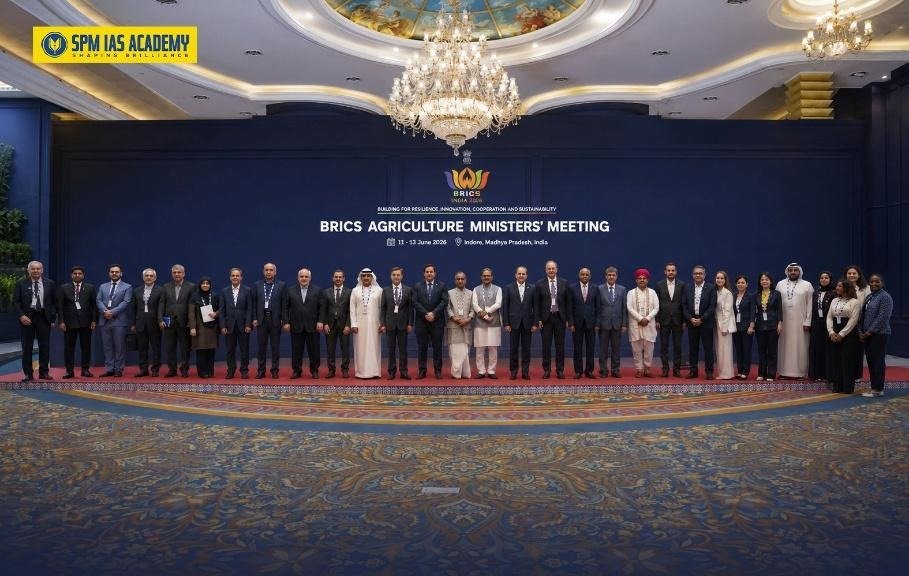
The BRICS Indore Declaration was adopted during the BRICS Agriculture Ministers’ Meeting held in Indore, Madhya Pradesh, in June 2026. The declaration focuses on food security, farmer welfare, sustainable agriculture, climate-resilient farming, digital agriculture, and agricultural trade. The BRICS Indore Declaration is an important current affairs topic for UPSC, APSC and other State PCS exams.
For aspirants, the BRICS Indore Declaration is important because it connects International Relations, Agriculture, Economy, Environment and Science and Technology. It also shows India’s leadership role in global agricultural cooperation during its BRICS Presidency.
What is the BRICS Indore Declaration?
The BRICS Indore Declaration is a joint agricultural charter adopted by BRICS member countries in Indore, Madhya Pradesh. It aims to strengthen cooperation in the agriculture sector.
The BRICS Indore Declaration keeps farmers at the centre of policy-making. Moreover, it promotes food security, nutritious diets, climate-resilient agriculture, digital farming, agricultural innovation and sustainable development.
In simple words, the BRICS Indore Declaration gives BRICS countries a common framework to work together on modern agricultural challenges. These challenges include climate change, rising food demand, seed security, technology gaps and sustainable farming.
Why was the BRICS Indore Declaration in the News?
The BRICS Indore Declaration came into news after BRICS Agriculture Ministers adopted it during the 2026 meeting in Indore. The meeting was held under India’s BRICS Presidency.
India used this platform to highlight farmer-centric development. It also pushed for stronger cooperation in digital agriculture, regenerative farming, farmers’ seed rights and agricultural knowledge-sharing.
This makes the declaration important not only for agriculture but also for India’s global diplomacy.
What are the Four Main Priorities of the BRICS Indore Declaration
The BRICS Indore Declaration focuses on four broad priorities. These priorities are useful for both Prelims and Mains.
1. Farmers
The declaration places farmers at the centre of agricultural policies. It recognises their role in food production, rural economy and sustainable farming.
2. Food Security
BRICS countries have a large share in global population and agricultural land. So, cooperation among them can help improve global food availability and nutrition security.
3. Climate-Resilient Agriculture
Climate change is affecting crop patterns, rainfall and soil health. The declaration promotes climate-smart and resilient farming practices.
4. Technology
The declaration supports digital tools such as artificial intelligence, geospatial technology, data-based solutions and digital public infrastructure in agriculture.
Four Major Initiatives under the BRICS Indore Declaration
The BRICS Indore Declaration is not only a statement of intent. It also proposes important institutional initiatives.
BRICS Network of Centres of Excellence on Agro-Ecology and Regenerative Agriculture
- This initiative will promote cooperation in natural farming, organic farming, regenerative agriculture and agro-ecology.
- It will help BRICS countries share research, training and best practices. In India, the Indian Institute of Farming Systems Research, Modipuram, will play an important role as a Centre of Excellence on natural farming.
This is important for UPSC GS Paper 3 because it links agriculture with sustainability, soil health and climate change adaptation.
BRICS Network on Digital Agriculture
- The BRICS Indore Declaration also supports a BRICS Network on Digital Agriculture. This network will promote the use of AI, geospatial technology, digital public infrastructure and data-driven farming solutions.
- IIT Delhi will coordinate this network from India.
This initiative is important because digital agriculture can help farmers improve productivity, reduce input costs and make better decisions. It can also support precision farming and better weather-based advisories.
Global Forum on Farmers’ Rights in Seed Systems
- Another important initiative is the Global Forum on Farmers’ Rights in Seed Systems.
- This forum will focus on farmers’ seed rights, indigenous seeds, traditional knowledge and biodiversity conservation. It recognises that farmers are not only producers but also protectors of seed diversity.
For exam purposes, this point connects with food security, biodiversity, intellectual property rights and traditional knowledge systems.
BRICS AgriN Network
- The BRICS Indore Declaration also proposes BRICS AgriN. It stands for Agro Input, Genetic Resources and Information Network.
- This network will help BRICS countries share information on agricultural inputs, seed varieties, genetic resources and technical knowledge. It will also support capacity-building and practical cooperation in agriculture.
This is useful for Mains answers on agricultural innovation, global cooperation and sustainable food systems.
Importance of the BRICS Indore Declaration for India
The BRICS Indore Declaration strengthens India’s role as a voice of the Global South. It shows that India is not only discussing agriculture at the national level but also shaping global agricultural cooperation.
India has a large farming population. So, farmer welfare remains central to its domestic policy. Through this declaration, India has linked farmer welfare with global food security and climate resilience.
The declaration also supports India’s push for natural farming, digital public infrastructure and technology-led agricultural reforms.
BRICS Indore Declaration and Global Food Security
The BRICS Indore Declaration has wider global importance. BRICS countries together represent a large share of the world’s population, agricultural land and foodgrain production.
Therefore, cooperation among BRICS nations can influence global food markets, supply chains and nutrition security.
In a world facing climate stress, conflicts and supply chain disruptions, such agricultural cooperation becomes highly relevant.
India’s BRICS Presidency
India assumed BRICS Presidency on 1st January, 2026. This is the fourth time India assumed the Presidency of BRICS (18th BRICS Summit). Moreover, it led the group earlier in 2012 (4th BRICS Summit), 2016 (8th BRICS Summit), 2021 (13th BRICS Summit).
In 2026, India holds the Presidency of 18th BRICS Summit. India’s BRICS Chairship 2026 is guided by the theme “Building for Resilience, Innovation, Cooperation and Sustainability.” The theme reflects India’s focus on people-centric global cooperation. Moreover, it aims to strengthen BRICS partnership in areas such as economic resilience, emerging technologies, multilateral cooperation, climate action and sustainable development.
- Resilience: It focuses on strengthening economic, social and institutional capacity to face global uncertainties. Moreover, it aims to address supply chain disruptions, health challenges and climate risks.
- Innovation: Promotes the use of digital public infrastructure, fintech, artificial intelligence and knowledge-sharing for better service delivery and future-ready growth.
- Cooperation: It aims to deepen BRICS engagement through policy coordination, development finance, trade facilitation, global governance reforms and people-centric partnerships.
- Sustainability: Supports collective action on climate change, green finance, energy transition and sustainable development in line with national and global priorities.
What is BRICS?
BRICS is a group of eleven major emerging markets and developing countries. It includes Brazil, Russia, India, China, South Africa, Egypt, Ethiopia, Indonesia, Iran, Saudi Arabia and the United Arab Emirates. It works as an important platform for consultation and cooperation. Moreover, BRICS allows member countries to discuss global and regional issues. It also helps them coordinate on political, economic and governance-related matters at the international level.
What is the historical background of BRICS?
- In 2001, British economist Jim O’Neill coined the term “BRIC” to identify a group of emerging market economies. He introduced the concept to highlight the growing economic potential of these countries.
- Later on, Goldman Sachs, his employer, actively promoted and popularised the term “BRIC” to strengthen its global recognition.
- In 2006, BRIC was formally introduced during the first meeting of BRIC Foreign Ministers on the sidelines of the United Nations General Assembly in New York.
- Later, in 2009, the first BRIC Summit took place in Yekaterinburg, Russia. This summit gave the grouping a stronger institutional shape.
- In 2010, the founding members agreed to expand BRIC by including South Africa. As a result, the grouping became BRICS.
- After that, in 2011, South Africa attended the 3rd BRICS Summit in Sanya, China, as a full member.
- In January 2024, Egypt, Ethiopia, Iran, Saudi Arabia and the United Arab Emirates became full members of BRICS.
- Further, in January 2025, Indonesia also joined BRICS as a full member.
- In 2025, Belarus, Bolivia, Kazakhstan, Cuba, Malaysia, Nigeria, Thailand, Uganda, Uzbekistan and Vietnam joined BRICS as Partner Countries.
Conclusion
The BRICS Indore Declaration is a significant step in global agricultural cooperation. It places farmers at the centre and connects food security with technology, climate resilience, seed rights and sustainable farming.
For UPSC, APSC and State PCS aspirants, the topic is highly relevant because it provides strong examples for both Prelims and Mains. It also reflects India’s growing leadership in shaping global discussions on agriculture and food security.
Source:
FAQs on BRICS Indore Declaration
The BRICS Indore Declaration is a joint agricultural charter adopted by BRICS countries during the Agriculture Ministers’ Meeting in Indore in June 2026.
It is important because it promotes food security, farmer welfare, sustainable agriculture, digital farming and climate-resilient agriculture.
It was adopted in Indore, Madhya Pradesh.
The four priorities are farmers, food security, climate and technology.

Behind every article at SPM IAS Academy is a team of skilled content writers and subject experts committed to making preparation easier for aspirants. From answering common doubts to breaking down complex issues and current affairs, we create content that is accurate, easy to understand, and directly useful for UPSC, APSC, and other competitive exams.