

The Assam Assembly has passed the Assam Prohibition of Polygamy Bill, 2025. It has made Assam the second state in the country after Uttarakhand to legislate specifically against the practice of having more than one spouse. The Bill aims to prohibit polygamy and all forms of polygamous marriages within Assam. The law marks a major step toward women’s empowerment and legal reform in the State.
This article explains the Bill, its key provisions, exemptions, penalties, and supporting demographic data. Students preparing for APSC, UPSC or other competitive exams will find this summary extremely useful.
What is the Assam Prohibition of Polygamy Bill, 2025?
- The Assam Legislative Assembly introduced the Assam Prohibition of Polygamy Bill, 2025 during the winter session of 2025. The government passed it with the aim to eliminate polygamy from the State.
- The Act defines ‘polygamy’ as entering a new marriage while a prior marriage is still legally valid.
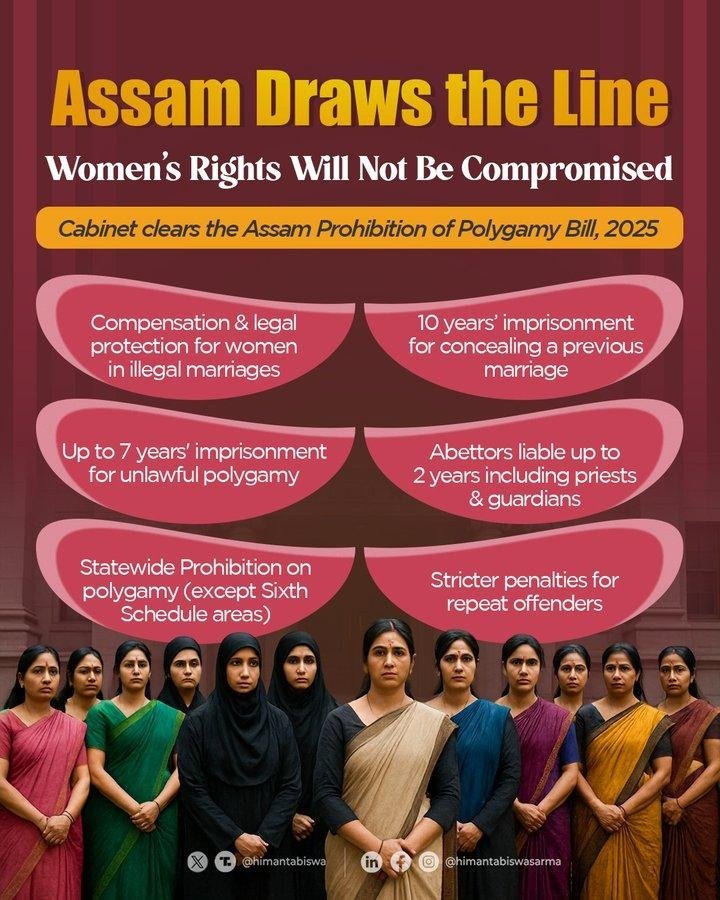
- The Bill makes polygamy a punishable offence. The punishment can extend up to seven years of imprisonment.
- However, the punishment increases to ten years if the person hides an existing marriage before marrying again.
- The law also includes provisions for compensation to affected women.
- Moreover, the Act applies to residents of Assam and also to individuals living outside the State who own property or receive benefits in Assam.
Why Did the Government Introduce This Bill?
- The government has stated that the Bill focuses on women’s empowerment.
- It does not target any religion or community. Instead, it aims to protect women from exploitation and unlawful marriages.
- Furthermore, the Bill seeks to establish clear legal consequences for concealment, forced marriage, and repeated violations.
- The Act brings several stakeholders, including gaonburahs, clerics, qazis, village heads, and guardians, within its regulatory framework.
Which Areas Are Exempted from the Bill?
The Bill does not apply to the Sixth Schedule regions of Assam. These areas include:
- The Bodoland Territorial Region (BTR)
- Areas under Karbi Anglong Autonomous District Council
- Dima Hasao Autonomous District Council
Additionally, the Bill does not apply to Scheduled Tribe communities whose customary laws permit multiple marriages. These exemptions respect constitutional protections and traditional practices.
Key Features of the Assam Prohibition of Polygamy Bill, 2025:
The Bill contains several major provisions. Each aims to deter unlawful marriages and protect victims.
- Clear Definition of Polygamy: The Act defines polygamy as marrying again while a prior marriage continues to exist. The first marriage must be legally dissolved or annulled before entering a second marriage.
- Strict Punishments: The punishment for polygamy can reach 7 years. However, concealment of an existing marriage increases the punishment to 10 years and a fine.
- Liability for Abettors: The law punishes people who knowingly support or conceal such marriages. Gaonburahs, clerics, parents, guardians, and anyone who delays information may face action.
- Penalties for Hiding Information: People who hide information from police may face up to two years of imprisonment and fines up to ₹1 lakh.
- Penalties for Solemnising Prohibited Marriages: Clerics or community leaders who solemnise illegal marriages may face fines up to ₹1.5 lakh.
- Compensation for Women: The Act includes a dedicated mechanism to offer compensation to victim women. This framework aims to support women financially and legally.
- Restrictions on Government Benefits: A person convicted under the Act becomes ineligible for government jobs, State-funded schemes, and elections in Assam.
How Will the Bill Impact Assam?
The Bill will have social, legal, and administrative impacts across Assam.
- Stronger Legal Protection for Women: The Act empowers women with legal support and compensation. It discourages forced or hidden marriages.
- Increased Accountability: Village heads, clerics, and guardians now share legal responsibility. Therefore, communities must adopt transparent marriage practices.
- Decline in Unlawful Marriages: The Bill introduces strict punishments. Consequently, unlawful marriages are likely to decline over time.
- Legal Awareness Across Assam: The law will increase awareness about marriage rights and responsibilities.
- Future Social Reforms: The Act may set the foundation for more reforms related to marriage, inheritance, and women’s rights.
Conclusion:
The Assam Prohibition of Polygamy Bill, 2025 marks a significant step towards legal reform. It aims to protect women, regulate marriage practices, and discourage unlawful marriages. Although the Bill excludes Sixth Schedule areas and Scheduled Tribes, it sets a strong framework for legal and social accountability across the State. With clear punishments, compensation mechanisms, and strict eligibility rules, the Act seeks to create a safer environment for women.
Sources:
- https://www.thehindu.com/news/national/assam/assam-assembly-passes-bill-to-ban-polygamy/article70330583.ece
- https://www.ndtv.com/india-news/assam-government-passes-bill-to-ban-polygamy-9710538
- https://indianexpress.com/article/india/assam-assembly-passes-assam-prohibition-of-polygamy-bill-2025-10389512/
The Assam Prohibition of Polygamy Bill 2025 is a new State law that bans polygamy and makes entering a second marriage without dissolving the first a criminal offence.
The Act prescribes up to 7 years of imprisonment, which may extend to 10 years if the individual hides an existing marriage before marrying again.
No. The Act does not apply to Sixth Schedule areas like BTR, Karbi Anglong, and Dima Hasao and to Scheduled Tribes whose customary laws permit multiple marriages.
Apart from the offender, clerics, gaonburahs, parents, guardians, or anyone who abets or hides information about illegal marriages may face penalties.