
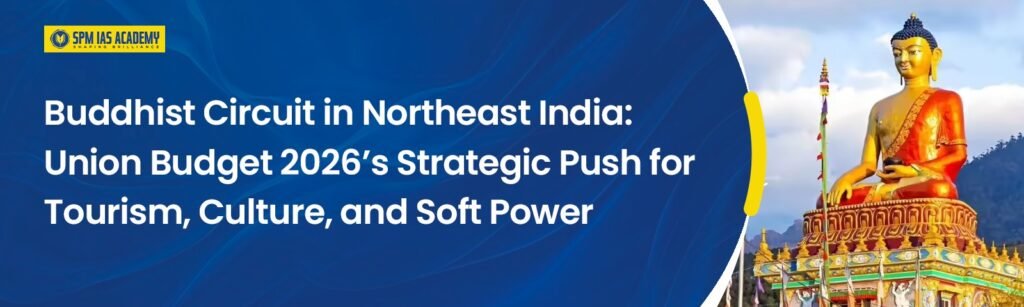
The Union Budget 2026 marks a major shift in India’s cultural and strategic outreach with the announcement to develop the Buddhist Circuit in Northeast India. Beyond tourism infrastructure, the initiative strengthens India’s Act East Policy, boosts Northeast tourism, and enhances India’s soft power diplomacy with SAARC and ASEAN nations. It makes this a crucial topic for UPSC, APSC, APPSC, and other competitive exams.
Introduction: Union Budget 2026 and the Buddhist Circuit Vision
During the Union Budget 2026 presentation in Parliament, Finance Minister Nirmala Sitharaman announced a focused plan to develop the Buddhist Circuit in Northeast India. This initiative covers Arunachal Pradesh, Sikkim, Assam, Manipur, Mizoram, and Tripura.
At first glance, the plan appears to be a heritage and tourism development project. However, on closer examination, it carries deep strategic, cultural, and diplomatic significance. By leveraging Buddhism – India’s ancient civilisational gift to Asia, the government aims to strengthen cultural diplomacy, regional connectivity, and international goodwill.
Buddhist Circuit in Northeast India: More Than Tourism Infrastructure
A Cultural Initiative with Strategic Depth:
To begin with, the Buddhist Circuit project seeks to:
- Preserve monasteries and ancient religious sites.
- Develop pilgrimage interpretation centres.
- Upgrade tourism and transport infrastructure.
At the same time, it acts as a tool of cultural diplomacy. Buddhism is a shared civilisational heritage across Asia, and India is positioning itself as its historical custodian.
Importantly, the timing of this announcement matters. As the Northeast witnesses geopolitical sensitivities and strategic competition, India’s emphasis on shared civilisational values offers a non-confrontational and inclusive diplomatic approach.
Northeast India: India’s Civilisational Bridge to Southeast Asia:
Historically, Northeast India has functioned as a cultural and civilisational corridor between South Asia and Southeast Asia.
This role emerged due to Himalayan Mountain passes, Brahmaputra Valley River systems and ancient trade and pilgrimage routes.
As a result, the region enabled the exchange of Goods and ideas, Religious Philosophies and Artistic and monastic traditions.
Therefore, developing the Buddhist Circuit revives the Northeast’s historical role as a gateway of civilisations.
Arunachal Pradesh: Heartland of Living Buddhism:
Buddhism has flourished in Arunachal Pradesh, especially in its western regions.
Key Highlights:
- Dominance of Mahayana and Vajrayana Buddhism.
- Strong links with Tibet and Bhutan.
- Presence of the iconic Tawang Monastery, one of the largest monasteries in the world.
Moreover, tribes such as the Monpa and Sherdukpen reflect a deep assimilation of Buddhist values with indigenous beliefs. Numerous monasteries and meditation centres across Arunachal Pradesh underline its spiritual significance.
Sikkim: Sacred Geography of Tibetan Buddhism
Since the 17th century, Sikkim has emerged as a major centre of Tibetan Buddhism.
Important Monasteries are:
- Rumtek Monastery
- Pemayangtse Monastery
These monasteries belong to the Nyingma and Kagyu schools, closely linked to Guru Padmasambhava, who introduced Vajrayana Buddhism. His sacred geography connects Sikkim, Bhutan, Arunachal Pradesh, and Tibet, transcending modern political boundaries.
Assam: The Forgotten Buddhist Legacy of Kamarupa
Although less discussed, Assam holds an important place in Buddhist history.
Historical Evidence:
- Archaeological remains from ancient Kamarupa show Buddhist art and architecture.
- Accounts of Chinese traveller Xuanzang, who documented Buddhist scholarship in Assam.
The Brahmaputra Valley acted as a transit corridor for monks and traders, spreading Buddhist ideas towards Myanmar and Southeast Asia.
Manipur and Tripura: Borderland Buddhist Influences
Both Manipur and Tripura display evidence of Buddhist cultural interactions.
- Influence of Theravada and Mahayana Buddhism.
- Strong links with Myanmar and Bengal-Assam cultural zones.
- Archaeological remains indicating trans-regional religious exchange.
These regions highlight the pan-Asian Buddhist network centred around India.
Guru Padmasambhava and the Trans-Asian Buddhist Network:
A recurring figure in Northeast Buddhist history is Guru Padmasambhava, known as the Second Buddha of Vajrayana Buddhism.
He established:
- A vast spiritual network connecting Northeast India, Tibet, Bhutan, Nepal, and Southeast Asia.
- Monastic traditions that continue to shape regional identities.
Thus, the Buddhist Circuit strengthens a living civilisational continuum, not a static heritage site.
Act East Policy and the ‘Rising Northeast’:
The Buddhist Circuit aligns seamlessly with India’s Act East Policy and the vision of a Rising Northeast.
Policy Linkages:
- Improved connectivity and tourism.
- Infrastructure-led development.
- Cultural exchanges with Southeast Asia.
By promoting Buddhist heritage tourism, India strengthens relations with:
- SAARC countries: Nepal, Sri Lanka, Bhutan.
- ASEAN countries: Thailand, Myanmar, Vietnam.
The India–Nepal Buddhist Circuit collaboration further expands pilgrimage routes and regional cooperation.
Soft Power and India’s Cultural Diplomacy:
Buddhism as a Soft Power Tool:
The Buddhist Circuit enhances India’s soft power by projecting values of Peace, Compassion and Coexistence.
Unlike hard power, this approach builds long-term trust and goodwill.
Supporting Initiatives:
- Display of sacred Buddha relics.
- Revival of Nalanda as a global learning centre.
- Buddha Relic Expositions in Sri Lanka, Thailand, Mongolia, and Vietnam.
These initiatives, supported by the Ministry of Culture and the International Buddhist Confederation (IBC), have attracted millions of devotees.
Economic and Social Impact on Northeast India:
Beyond diplomacy, the Buddhist Circuit promises tangible economic benefits:
- Firstly, Growth in tourism and hospitality.
- Secondly, employment generation for local youth.
- Thirdly, Boost to small businesses and artisans.
- At the same time, it will improve transport and connectivity.
As infrastructure improves, the Northeast integrates more deeply into regional and global economic networks.
For structured guidance, explore leading UPSC coaching in Assam for focused civil services preparation.
A Civilisational Heritage Corridor for Peace:
The Buddhist Circuit represents a civilisational heritage corridor stretching from the Gangetic plains to Southeast Asia.
By focusing on shared heritage rather than narrow nationalism, the project:
- Promotes regional peace.
- Encourages cultural dialogue.
- Reduces conflict through shared identity.
This approach reflects India’s civilisational philosophy in foreign policy.
Conclusion: Why the Buddhist Circuit Matters Beyond Tourism
The Union Budget 2026 Buddhist Circuit initiative goes far beyond heritage tourism. It strategically repositions Northeast India as a civilisational bridge between South and Southeast Asia. It strengthens India’s soft power diplomacy and supports economic development through tourism and connectivity.
By integrating spirituality with infrastructure and diplomacy, India reinforces its historical role as the cradle of Buddhism and a promoter of peace in Asia. For UPSC, APSC, APPSC, and other competitive exam aspirants, this initiative offers a powerful case study of how culture, economy, and foreign policy intersect in modern governance.
Aspirants can strengthen preparation through expert-led UPSC coaching in north east India programs.
Sources:
Frequently Asked Questions:
The Buddhist Circuit in Northeast India is a tourism and heritage initiative announced in Union Budget 2026 to develop Buddhist monasteries, pilgrimage centres, and connectivity across Arunachal Pradesh, Sikkim, Assam, Manipur, Mizoram, and Tripura.
The Buddhist Circuit in Northeast tourism boosts spiritual tourism, improves infrastructure, creates local employment, and positions the Northeast as a global destination for Buddhist pilgrims from Asia.
The project strengthens the Act East Policy by deepening cultural ties with SAARC and ASEAN countries, especially Buddhist-majority nations like Thailand, Myanmar, Sri Lanka, and Vietnam.
The Buddhist Circuit enhances India’s soft power diplomacy by promoting shared Buddhist values of peace, compassion, and coexistence, helping India build long-term goodwill in Asia.
The topic is highly relevant for UPSC, APSC, and APPSC as it links culture, tourism, Act East Policy, soft power, regional development, and foreign relations, making it useful for GS, Essay, and Interview answers.