
The Dandi March, also called the Salt March or Salt Satyagraha, was a landmark event in India’s freedom struggle. Mahatma Gandhi led this historic march from 12 March 1930 to 6 April 1930. The movement directly challenged the British salt monopoly through nonviolent civil disobedience. By breaking the Salt Law at Dandi, Gandhi converted a simple act into a powerful national revolution. The Dandi March marked the formal beginning of the Civil Disobedience Movement in India.
What is the Background of the Dandi March?
Political Developments Before 1930:
To understand the Dandi March, one must examine the political context of the late 1920s. In December 1929, the Indian National Congress adopted the Purna Swaraj resolution at Lahore. This resolution declared complete independence as the ultimate goal of the freedom movement. On 26 January 1930, Indians celebrated Independence Day across the country.
Subsequently, the Congress Working Committee authorized Gandhi to initiate civil disobedience. Gandhi carefully selected the British Salt Act of 1882 as the starting point of resistance. The Act granted the British government exclusive rights over salt production and sale. It also imposed a tax that burdened the poorest sections of society.
Why did Gandhi Chose Salt as the Symbol of Protest?
Initially, many leaders doubted the effectiveness of protesting against salt. However, Gandhi had a strategic vision behind his choice. Salt was an essential commodity used daily by every Indian. Therefore, the issue touched both the rich and the poor equally.
Moreover, the salt tax represented colonial economic exploitation in its simplest form. Gandhi believed that a common and basic issue would unite the masses. He also understood that salt would create emotional and moral appeal. Consequently, the salt tax became a powerful symbol of resistance.
Philosophy Behind the Dandi March – Satyagraha
The Dandi March was deeply rooted in Gandhi’s philosophy of Satyagraha. The word combines “Satya” meaning truth, and “Agraha” meaning insistence. Gandhi believed that Truth and Non-violence were the strongest weapons against injustice.
He maintained that pure means would produce pure ends. Therefore, he insisted on strict discipline and nonviolent conduct throughout the movement. Earlier movements, such as the Non-Cooperation Movement, had faced setbacks due to violence. However, the Bardoli Satyagraha of 1928 restored Gandhi’s faith in disciplined mass resistance.
How Mahatma Gandhi made the Preparation for Dandi March?
Letter to Lord Irwin:
On 2 March 1930, Gandhi wrote to Viceroy Lord Irwin outlining eleven demands. This included reduction of land revenue, abolition of the salt tax and reduction of military expenditure. Gandhi expressed willingness to suspend the march if the demands were accepted.
However, the Viceroy ignored the letter and refused negotiation. As a result, Gandhi announced the launch of the Salt Satyagraha.
Mobilization and Media Strategy:
Gandhi carefully planned the march to maximize public participation. He issued regular statements to newspapers and invited international journalists. Film companies documented the march, increasing its global visibility.
Expectations rose as Gandhi described the movement as a life-and-death struggle. Thousands gathered at Sabarmati Ashram to witness the beginning of the march.
The 24-Day Dandi March: Route and Progress
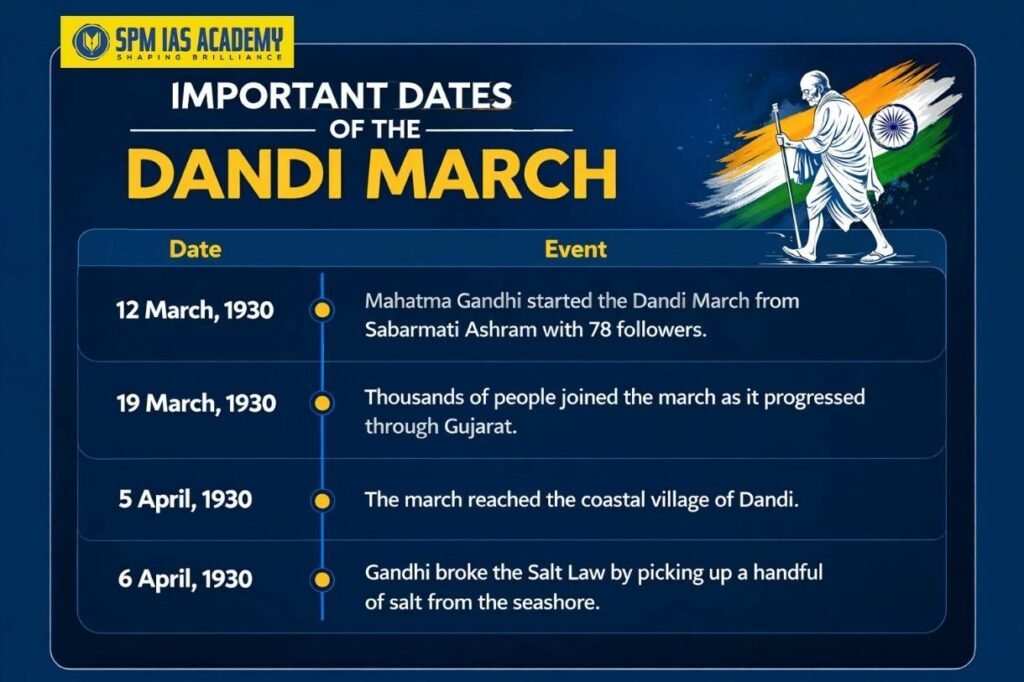
On 12 March 1930, Gandhi began the march from Sabarmati Ashram with 78 to 80 disciplined volunteers. The march covered approximately 387 kilometres across Gujarat. It passed through four districts and forty-eight villages.
Each day, Gandhi addressed large gatherings in villages. He explained the injustice of the salt tax in simple language. Volunteers collected donations and enrolled new participants.
Crowds grew larger at every stop. At Surat, nearly 30,000 people welcomed the marchers. By the time Gandhi reached Dandi, over 50,000 people had assembled.
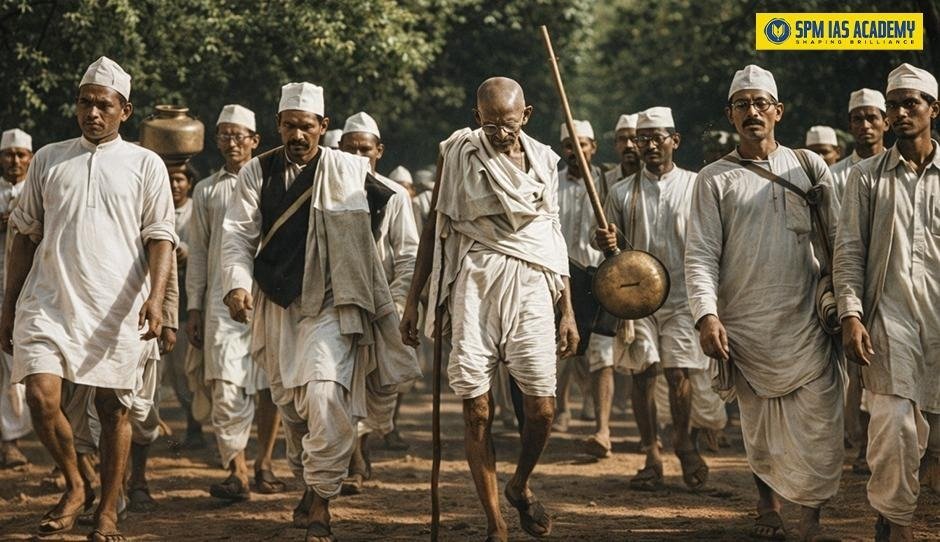
The marchers wore white khadi, symbolizing self-reliance and unity. The procession became known as the “White Flowing River.”
Breaking the Salt Law at Dandi:
On 6 April 1930, Gandhi reached the seashore at Dandi. After a prayer, he picked up a lump of salty mud. He boiled it to produce salt. This simple act openly violated the British Salt Law.
Gandhi declared that he was shaking the foundations of the British Empire. The symbolic act triggered mass civil disobedience across India.
Millions began making salt along the coastline. Illegal salt was sold openly in markets. British cloth was boycotted and burned in public gatherings.
Expansion into the Civil Disobedience Movement:
The Salt Satyagraha quickly evolved into a nationwide Civil Disobedience Movement. Over sixty thousand Indians were arrested within weeks. Peasants refused to pay land revenue in Gujarat and other regions.
In Bengal, people refused to pay chowkidar taxes. In forest regions, people defied restrictive forest laws. The British government responded with censorship and repression.
However, the movement continued to spread. The British authorities were confused by the disciplined nonviolent resistance.
Role of Women in the Movement:
The Civil Disobedience Movement witnessed unprecedented participation of women. Although only men marched initially, women actively supported the movement. They manufactured and sold illegal salt across the country.
Women also picketed liquor shops and foreign cloth stores. Leaders like Sarojini Naidu emerged as prominent figures. British reports acknowledged women’s participation as a serious new development.
This marked a turning point in women’s involvement in the national movement.
Dharasana Satyagraha and International Reaction:
After Dandi, Gandhi planned to raid the Dharasana Salt Works. However, he was arrested on the night of 4-5 May 1930. Despite his arrest, volunteers continued the protest under Sarojini Naidu’s leadership.
British police brutally beat unarmed protesters with steel-tipped lathis. American journalist Webb Miller reported the incident in graphic detail. His report appeared in over 1,350 newspapers worldwide.
The global reaction damaged Britain’s moral standing. International sympathy for India increased significantly.
Other Parallel Movements:
The Salt Satyagraha inspired parallel protests across India. C. Rajagopalachari led the Vedaranyam Salt March in Tamil Nadu. In Peshawar, Khan Abdul Ghaffar Khan led nonviolent protests.
During the Qissa Khwani Bazaar incident, British troops fired on peaceful protesters. Some Indian soldiers refused orders to shoot civilians. These events highlighted the strength of nonviolent resistance.
What were the Impacts of Dandi March?
Immediate Impact:
- Firstly, the Dandi March brought unprecedented global attention to India’s freedom struggle.
- Moreover, Time Magazine declared Mahatma Gandhi “Man of the Year” in 1930, highlighting his international influence.
- Consequently, the British government felt shaken by the moral strength and mass appeal of satyagraha.
- Furthermore, negotiations between Gandhi and Lord Irwin led to the signing of the Gandhi-Irwin Pact in 1931.
- As a result, Gandhi attended the Second Round Table Conference in London to represent the Indian National Congress.
Long-Term Impact:
- Although India did not achieve independence immediately, the movement fundamentally transformed the freedom struggle.
- In addition, it united Indians across caste, class and religious divisions, thereby strengthening national unity.
- Significantly, it proved that nonviolent resistance could effectively challenge a powerful colonial empire.
- Over time, the Dandi March inspired global civil rights movements.
- For instance, leaders such as Martin Luther King Jr. later adopted similar methods of peaceful protest in their struggles for justice.
Important Dates of the Dandi March:
Assam’s Contribution in Dandi March 1930:
- Firstly, Leeladhar Barua of North Guwahati joined Mahatma Gandhi as one of the followers in the historic Dandi March from Sabarmati Ashram. Thereby, he directly represented Assam in the march.
- Secondly, since Assam had no coastline to violate the Salt Law, leaders decided to defy the British Forest Laws as an alternative form of protest.
- Moreover, the APCC adopted the all-India programme of 1930-32. This programme included defiance of repressive laws and boycott of foreign goods, opium, and liquor.
- On 22 March 1930, Ambikagiri Raychoudhury publicly appealed to the masses to begin Civil Disobedience by violating forest regulations.
- Leaders including Kiran Bala Bora, Jyotiprasad Agarwala, and Amiya Kumar Das gathered at Judge’s Field in Guwahati to express support for the Dandi March.
- On 12 March 1930, people in Kaliabor (Nowgong district) organized a symbolic 30-mile march to Nowgong. Similar processions also took place in Sibsagar, thereby showing provincial solidarity with the national movement.
- Furthermore, after the Dandi March, the Assam Provincial Congress Committee (APCC), following the directives of the All India Congress Committee (AICC), prepared to launch the Civil Disobedience Movement in the province.
- Bishnuram Medhi, President of the APCC, led the movement sincerely. He worked closely with leaders such as Hem Chandra Barua, Dr. Bhubaneswar Barua, Omeo Kumar Das, Siddhinath Sarma, Debeswar Sarma, Rajendra Nath Barua, Harendra Chandra Chowdhury, and Lakshmidhar Sarma.
- Younger Congress leaders such as Bijoy Chandra Bhagavati, Mahendra Mohan Choudhury, Debendranath Sarma, Lakshmidhar Bora, Dwarikanath Goswami, and Puma Sarma actively initiated and strengthened the Civil Disobedience Movement in Assam.
- Women played a significant role in picketing, organizing meetings and defying British authority. Notably, Guneswari Devi and Muktabala Baishnabi were among the first women to court arrest. Furthermore, leaders like Chandraprabha Saikiani and Durgaprova Bora actively strengthened the movement.
- Consequently, through symbolic marches, law violations, organized protests and mass participation, Assam significantly contributed to the spread of the Civil Disobedience Movement in Northeast India.
Conclusion: Dandi March as a Turning Point
The Dandi March of 1930 remains a defining moment in the Indian freedom struggle. It converted the demand for Purna Swaraj into a mass-based Civil Disobedience Movement. By breaking the Salt Law, Gandhi challenged the moral legitimacy of British rule.
The Dandi March demonstrated the power of Satyagraha, nonviolent protest and collective action. It reshaped India’s political consciousness and weakened British authority. For students preparing for competitive examinations like UPSC CSE, APSC, understanding the Dandi March, Salt Satyagraha, and Civil Disobedience Movement is essential for mastering Modern Indian History.
Source:
https://www.britannica.com/event/Salt-March
https://www.mkgandhi.org/articles/salt_satya.php
FAQs on DANDI March
The Dandi March (1930) was a 24 day nonviolent protest led by Mahatma Gandhi against the British salt tax. It marked the beginning of the Civil Disobedience Movement and became a turning point in the Indian freedom struggle.
The Dandi March started on 12 March 1930 from Sabarmati Ashram and ended on 6 April 1930 at Dandi, when Gandhi broke the Salt Law by making salt from seawater.
Gandhi chose salt because it was an essential daily commodity used by all Indians. The British Salt Act of 1882 imposed heavy taxes, making it a powerful symbol of colonial economic exploitation.
The Dandi March covered approximately 387 kilometres (240 miles) from Sabarmati Ashram to Dandi in Gujarat, passing through 48 villages over 24 days.
The Dandi March united millions of Indians. It led to mass civil disobedience and attracted global attention. Moreover, it strengthened the demand for Purna Swaraj and weakened British moral authority in India.