
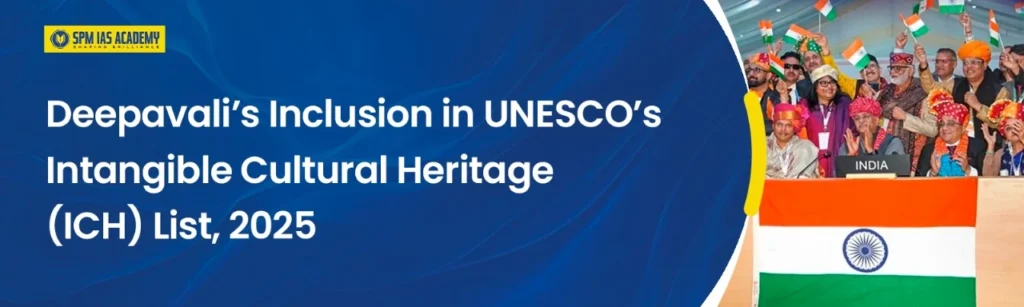
Deepavali, one of India’s most cherished festivals, has earned global recognition. UNESCO has officially inscribed Deepavali on the Representative List of the Intangible Cultural Heritage of Humanity for 2025. This inclusion strengthens India’s cultural presence worldwide and offers rich learning value for UPSC, APSC, and other State PCS exams.
This article explains all key facts, processes, and significance related to Deepavali’s inclusion in UNESCO’s Intangible Cultural Heritage (ICH) list.

Why in the News?
Deepavali entered the UNESCO Intangible Cultural Heritage List in 2025.
India submitted its nomination dossier in 2023 for the 2024-25 evaluation cycle.
The decision was announced during the 20th Session of the Intergovernmental Committee held at Red Fort from December 8 to 13, 2025.
This achievement follows the inclusion of Garba from Gujarat and Durga Puja from West Bengal in previous years.
What Is UNESCO’s Intangible Cultural Heritage List?
- UNESCO’s Intangible Cultural Heritage List safeguards living traditions, skills, and cultural expressions.
- It preserves practices passed down through generations and highlights their global value.
- The list covers five domains:
- Oral traditions
- Performing arts
- Social practices, rituals, and festivals
- Knowledge related to nature and the universe
- Traditional craftsmanship
- Currently, around 700 elements from 140 countries are inscribed.
- With Deepavali added, India now holds 16 elements on the Representative List.
- India has also nominated Chhath Puja of Bihar for the next cycle.
Criteria for Deepavali’s Inclusion in UNESCO’s ICH List:
UNESCO’s Intangible Cultural Heritage (ICH) inscription is governed by the 2003 Convention and focuses on safeguarding living cultural traditions. For an element to qualify, it must be recognized by the concerned community, transmitted across generations, and provide a sense of identity and continuity.
Eligible elements may fall under categories such as oral traditions, performing arts, social practices and rituals, knowledge related to nature and the universe, and traditional craftsmanship.
Importantly, all nominated elements must respect human rights, promote mutual respect, and support sustainable development.
Core Criteria for Inscription:
- Compliance with the Definition of ICH: The element must constitute a practice, expression, performance, knowledge system, or skill along with associated objects or cultural spaces recognized by communities as part of their living heritage.
- Intergenerational Transmission: The heritage must be transmitted from one generation to another and continuously recreated in response to the community’s environment, historical experiences, and social interactions.
- Identity and Cultural Continuity: The element should contribute to a sense of identity and continuity within the community while encouraging respect for cultural diversity and human creativity.
- Community Participation and Consent: The nomination must demonstrate active community involvement and include their free, prior, and informed consent (FPIC) for inscription and safeguarding initiatives.
- Compatibility with Global Norms: The element must be consistent with international human rights standards and align with the principles of mutual respect and sustainable development.
Significance of Deepavali’s Inclusion in UNESCO ICH List:
- Deepavali’s global recognition carries strong cultural and socio-economic benefits.
- The inscription increases international visibility for the festival.
- It highlights India’s ancient cultural ethos in the modern era.
- Moreover, it strengthens the cultural identity of the Indian diaspora worldwide.
Key Advantages of Deepavali’s Inclusion in UNESCO ICH List:
- It unlocks access to the ICH Fund for safeguarding and documentation.
- It supports sustainable livelihood opportunities for artisans and craft communities.
- It encourages preservation of traditional practices linked with Deepavali.
- It boosts tourism and promotes cultural exchange initiatives.
- It inspires communities to protect and celebrate their cultural heritage.
Conclusion:
Deepavali’s inclusion in the UNESCO Intangible Cultural Heritage List marks a proud cultural milestone for India. It recognizes the festival as a living tradition enriched by community participation and historical continuity. The inscription also brings global attention to India’s diverse cultural fabric.
Sources:
- https://ich.unesco.org/en/lists
- https://indianexpress.com/article/explained/explained-culture/diwali-unesco-heritage-list-10413269/
Deepavali was included because it is a living cultural tradition recognized by communities, transmitted across generations, and providing identity, continuity, and social cohesion.
UNESCO officially inscribed Deepavali on the Representative List of the Intangible Cultural Heritage of Humanity in 2025.
Deepavali falls under social practices, rituals, and festive events, one of the five domains of UNESCO’s Intangible Cultural Heritage.
With the inclusion of Deepavali, India now has 16 elements on UNESCO’s Representative List of Intangible Cultural Heritage.
The recognition enhances global visibility, strengthens cultural diplomacy, supports heritage preservation, and promotes sustainable livelihoods linked to traditional practices.