
What are the fundamental rights?
Fundamental rights are the cornerstone of Indian democracy. These are a set of constitutionally guaranteed liberties that protect individuals from arbitrary state action. Enshrined in Part III (Articles 12 to 35) of the Indian Constitution, these rights are enforceable in courts, distinguishing them from the non-justiciable Directive Principles of State Policy (Part IV).
Inspired by the Bill of Rights of the United States and the Universal Declaration of Human Rights, the framers under Dr. B.R. Ambedkar recognized fundamental rights as the bedrock of a free, equal, and just society.
Originally, the Constitution contained seven fundamental rights. The Right to Property (Article 31) was deleted by the 44th Constitutional Amendment Act, 1978, making it a mere legal right under Article 300A. Today, there are six fundamental rights.
| UPSC Tip: Fundamental rights are enforceable against the state (Article 12). However, some rights — Articles 15(2), 17, 23, and 24 — are also enforceable against private individuals. This distinction is frequently tested in UPSC. |
Part III as the Magna Carta of India
Part III of the Constitution is often called the Magna Carta of India because it guarantees fundamental rights to citizens. The term “Magna Carta” comes from the historic charter issued by King John in 1215, which was one of the earliest written documents recognizing the rights and liberties of people.
The Six Fundamental Rights — At a Glance
| Articles | Right | Key Provisions |
|---|---|---|
| 14–18 | Right to Equality | Equality before law, non-discrimination, abolition of untouchability and titles |
| 19–22 | Right to Freedom | Six freedoms incl. speech, assembly, movement, residence; protection against arbitrary arrest |
| 23–24 | Right Against Exploitation | Prohibition of human trafficking, forced labour, and child labour in hazardous industries |
| 25–28 | Right to Freedom of Religion | Freedom to profess, practice, and propagate religion; manage religious affairs |
| 29–30 | Cultural & Educational Rights | Minorities’ right to conserve language/culture and establish educational institutions |
| 32 | Right to Constitutional Remedies | ‘Heart and soul’ of Constitution (Ambedkar) — right to move SC to enforce FRs |
Article 12 — Definition of ‘State’
Article 12 defines ‘State’ for the purposes of Part III. It includes:
- The Government and Parliament of India
- The Government and Legislature of each State
- All local authorities (municipalities, panchayats, district boards)
- Other authorities within India or under the control of the Government of India
Under Article 12 of the Constitution of India, the term “other authorities” has been broadly interpreted to include not just government departments but also bodies created by law. In Rajasthan State Electricity Board v. Mohan Lal, the Supreme Court held that statutory corporations can be treated as “state.” To decide this, courts use the test of “deep and pervasive state control,” which simply means that if the government has strong control over an organization’s decisions, funding, and management, it will be considered part of the State.
| UPSC PYQ Q: Which of the following is/are included in the definition of ‘State’ under Article 12 of the Indian Constitution? 1. Government and Parliament of India 2. Government and Legislature of States 3. Local authorities 4. Private companies under Government control UPSC Prelims (Conceptual) Key Answer/Approach: 1, 2, and 3 are clearly included. Private bodies are included only if they are an instrumentality or agency of the state (test from Pradeep Kumar Biswas v. IICB, 2002). |
Article 13 of the Indian Constitution: The Guardian of Fundamental Rights
Article 13 of the Indian Constitution is a foundational pillar that protects the fundamental rights of Indian citizens. Falling under Part III of the Constitution, it establishes that any law — pre-existing or newly enacted — that violates or abridges fundamental rights shall be considered void to the extent of that violation. The article is broadly divided into four clauses:
- Article 13(1) invalidates pre-constitutional laws that conflict with fundamental rights;
- Article 13(2) prohibits the State from enacting any future laws that curtail these rights;
- Article 13(3) provides a wide definition of “law,” encompassing ordinances, orders, bye-laws, regulations, customs, and usages; and
- Article 13(4) explicitly excludes constitutional amendments made under Article 368 from its purview.
Judicial Review and Constitutional Supremacy under Article 13
One of the most significant aspects of Article 13 is that it forms the constitutional basis for judicial review in India. It empowers courts to strike down any legislation inconsistent with fundamental rights. This makes Article 13 a key instrument for upholding constitutional supremacy and ensuring no authority — legislative or executive — can override citizens’ rights. When read alongside Article 12, which defines “State,” Article 13 gives citizens a direct mechanism to hold the government accountable. Its broad definition of “law” ensures that not only formal statutes but also executive orders, customs, and usages are subject to constitutional scrutiny.
Article 13 and Landmark Judgments
Article 13 is very important because it acts as a guard against unconstitutional laws. It ensures that if any law violates Fundamental Rights, the courts can strike it down. Because of this, it has played a key role in shaping Indian constitutional law through several landmark judgments.
In I.C. Golaknath v. State of Punjab, the Supreme Court initially held that even constitutional amendments could be treated as “law” under Article 13, meaning Parliament could not use amendments to reduce Fundamental Rights.
Later, in Kesavananda Bharati v. State of Kerala, the Court changed this approach and introduced the Basic Structure Doctrine, holding that while Parliament can amend the Constitution, it cannot destroy its core structure.
This idea was further strengthened in Minerva Mills Ltd. v. Union of India, where the Court again confirmed that Parliament’s power to amend is limited and must respect the Constitution’s basic structure.
In L. Chandra Kumar v. Union of India, the Court went further and held that judicial review itself is part of the basic structure, meaning courts will always have the power to check unconstitutional laws.
Article 13, along with these judgments, ensures that Parliament cannot override Fundamental Rights or destroy the core values of the Constitution. It acts as a strong safeguard against misuse of power by the state.
Features of Fundamental Rights
Fundamental Rights are the core protections given by the Constitution, and they come with some important features:
- Protected by the Constitution:
These rights are guaranteed by the Constitution itself, which makes them stronger than ordinary legal rights. - Available to citizens and non-citizens (in some cases):
Some rights are only for Indian citizens (like Article 19), while others are for everyone, including foreigners and even legal persons like companies. - Not absolute or permanent:
These rights are not unlimited. Parliament can change or limit them, but only through a constitutional amendment. - Reasonable restrictions allowed:
The State can impose restrictions, but they must be reasonable, and the courts decide whether they are fair or not. - Justiciable in nature:
If your rights are violated, you can go to court for enforcement.- You can even directly approach the Supreme Court under Article 32.
- Suspension during Emergency:
- Rights can be suspended during a National Emergency
- But Articles 20 and 21 can never be suspended
- Article 19 can be suspended only during war or external aggression, not during internal emergency (armed rebellion)
- Restriction for armed forces and similar services (Article 33):
Parliament can limit these rights for armed forces, police, intelligence agencies, etc., to maintain discipline. - During martial law:
Rights can be restricted in areas where military rule is imposed under abnormal conditions.
Fundamental rights are powerful, but they come with checks and balances—they protect individuals while allowing the state to maintain order when needed.
Right to Equality (Articles 14–18)
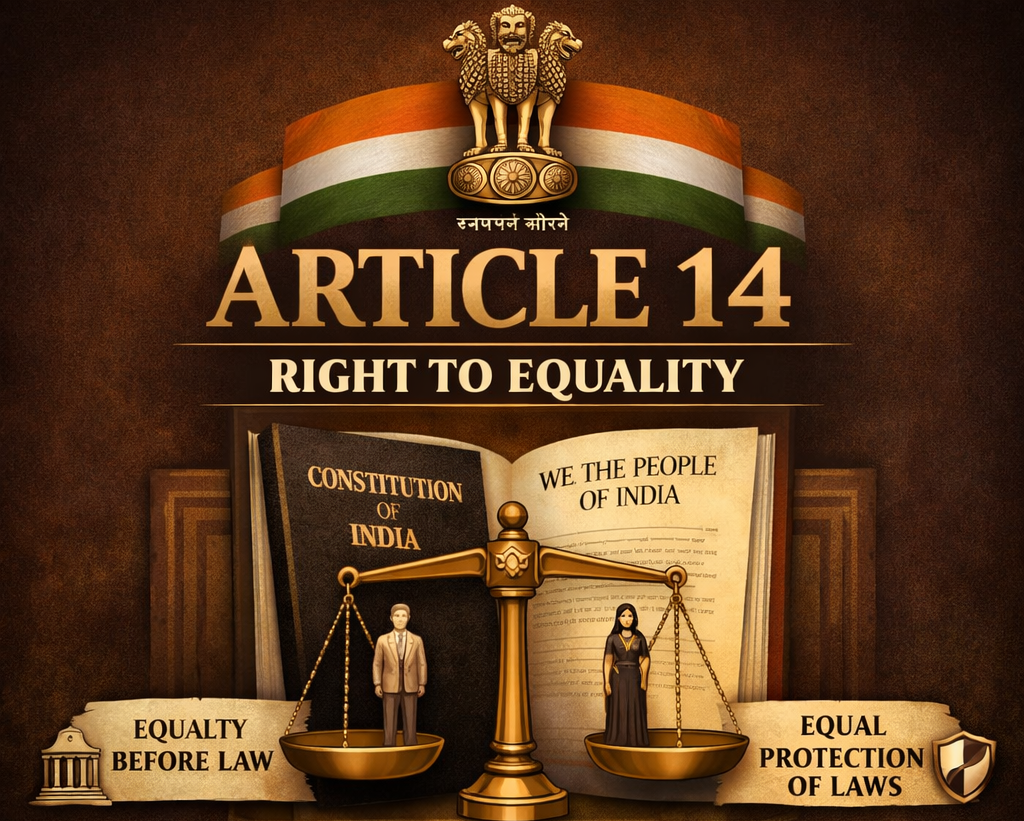
Article 14 — Equality Before Law
Article 14 guarantees two concepts:
(i) Equality before the law—a concept borrowed from British common law, and
(ii) Equal protection of laws — a positive concept from the US 14th Amendment.
However, this doesn’t mean everyone must be treated exactly the same. The courts allow something called reasonable classification, which means the government can treat different groups differently if two conditions are met: (1) there is a clear and sensible reason to separate the groups (intelligible differentia), and (2) this difference is logically connected to the purpose of the law (rational relation).
| UPSC PYQ — Mains 2019 Q: The Doctrine of Reasonable Classification is an exception to equality. Critically examine the conditions under which classification is permissible under Article 14.UPSC Mains GS Paper II, 2019 Key Answer/Approach: Explain the twin tests — intelligible differentia + rational nexus. Quote E.P. Royappa v. State of Tamil Nadu (1974) which added the ‘arbitrariness’ doctrine: anything arbitrary violates Article 14. |
Article 15 — Prohibition of Discrimination (in simple words):
- The State cannot treat you unfairly based on:
- Religion
- Race
- Caste
- Sex
- Place of birth
- However, the Constitution allows special support for certain groups:
- Article 15(3): Special provisions can be made for women and children
- The government can make laws that give extra protection or benefits to women and children.
- Example:
- Free education schemes only for girls
- Reserved seats for women in buses or local bodies
- Maternity leave benefits for working women
These are valid because they aim to protect and uplift women and children.
- Article 15(4): Reservations can be provided for SEBCs, SCs, and STs
- Example:
- Reserved seats in government colleges for SC/ST/OBC students
- This helps reduce historical disadvantage.
- Example:
- Article 15(6) (added by the 103rd Amendment, 2019):
- Provides 10% reservation for Economically Weaker Sections (EWS)
- This was upheld by the Supreme Court in Janhit Abhiyan v. Union of India
- Normally, the law says “don’t discriminate,” but Articles 15(3), 15(4), and 15(6) allow the government to give extra help to certain groups to make things more equal in reality.
Article 16 — Equality in Public Employment
Basic rule: Everyone should get a fair and equal chance when applying for government jobs.
Example: A government job cannot be denied just because of your religion, caste, or gender.
Reservations are allowed: The Constitution allows reservations in government jobs for backward classes (like SC, ST, OBC) to ensure real equality.
Example: Reserved posts for SC/ST candidates in government recruitment.
- 50% limit on reservations: In Indra Sawhney v. Union of India, the Supreme Court said:
- Total reservations in most cases should not exceed 50%
- This keeps a balance between equality and reservation
Article 16 ensures equal job opportunities but also allows limited reservations to help disadvantaged groups.
Article 17 — Abolition of Untouchability
- Basic rule: “Untouchability” is completely abolished and its practice is a crime. No one can treat another person as “untouchable.”
- What it means in real life:
- You cannot stop someone from entering temples, shops, or public places because of caste
- You cannot refuse to serve or interact with someone on that basis
Example: If a shopkeeper refuses to serve a person because of their caste, it is illegal.
- Laws that enforce this:
- Protection of Civil Rights Act, 1955 — punishes acts of untouchability
- SC/ST (Prevention of Atrocities) Act, 1989 — gives stronger protection and stricter punishment for offenses against SC/ST communities
- Special point: Unlike many fundamental rights, Article 17 also applies to private individuals, not just the government.
Untouchability is not just wrong—it is a punishable crime, and everyone (even private persons) must follow this rule.
Article 18 — Abolition of Titles
The State cannot give titles like “Raja,” “Nawab,” or “Sir” that create inequality among citizens.
- What is allowed:
- Military titles (like Major, Colonel)
- Academic titles (like Dr., Professor)
- What about national awards?
Awards like Bharat Ratna, Padma Vibhushan, etc., are not considered titles because:- They are honours, not ranks
- You cannot use them as prefixes or suffixes to your name
- Example:You can receive the Bharat Ratna, but you cannot write “Bharat Ratna Rahul” as a title.
The Constitution removes special status titles to maintain equality but allows honors and achievements to be recognized.
New Criminal Laws and Freedom of Speech — Article 19 Concerns
India’s new criminal framework, including the Bharatiya Nyaya Sanhita (BNS), has replaced the colonial-era IPC. While it modernises terminology, it also introduces provisions that raise constitutional concerns.
- The BNS includes offenses such as:
- Acts that may endanger sovereignty, unity, and integrity of India
- Broadly worded provisions that resemble earlier sedition-like restrictions
Although sedition as a term has been removed, critics argue that similar effects remain through broader wording, which may still restrict free speech.
This is important under Article 19 because:
- Free speech can be limited for national security and public order
- But overly broad laws may lead to chilling effect on dissent
- Courts often have to balance security vs. democratic expression
This shows how Article 19 continues to evolve through law-making and judicial interpretation, especially in areas of political speech and dissent.
| UPSC PYQ — Prelims 2021 Q: Which of the following is/are considered part of the ‘Basic Structure’ of the Constitution? 1. Right to Equality (Article 14) 2. Secularism 3. Free and Fair Elections — Select: (a) 1 only (b) 1 and 2 only (c) 2 and 3 only (d) 1, 2, and 3 Key Answer/Approach: Answer: (d) 1, 2, and 3. Article 14, secularism, and free elections are all recognized as part of the Basic Structure (Kesavananda Bharati and subsequent cases). |
5. Right to Freedom (Articles 19–22)
Article 19 — Six Fundamental Freedoms
Article 19(1) guarantees six freedoms to citizens only (not aliens):
| Clause | Freedom | Permissible Restrictions | ||
|---|---|---|---|---|
| 19(1)(a) | Speech and Expression | Sovereignty, security, public order, decency, contempt, defamation, incitement | ||
| 19(1)(b) | Peaceful Assembly | Sovereignty, integrity, public order | ||
| 19(1)(c) | Form Associations | Sovereignty, integrity, public order, morality | ||
| 19(1)(d) | Move Freely | General public interest, ST protection | ||
| 19(1)(e) | Reside and Settle | General public interest, ST protection | ||
| 19(1)(g) | Profession/Trade/Business | Public interest; professional qualifications; State monopoly on trade | ||
| UPSC Tip: Article 19(1)(f) — right to acquire, hold and dispose of property — was deleted by the 44th Amendment, 1978. | ||||
Protection Against Conviction, Article 20
– It protects people from unfair punishment in criminal cases.
- Three important protections:
- Ex-post-facto law: You cannot be punished for something that was not a crime when you did it.
Example: If something becomes illegal today, you can’t be punished for doing it last year. - Double jeopardy: You cannot be punished twice for the same offense.
Example: If a court has already punished or acquitted you, you can’t be tried again for the same crime. - Self-incrimination: You cannot be forced to give evidence against yourself.
Example: Police cannot force you to confess or say something that proves you are guilty.
- Ex-post-facto law: You cannot be punished for something that was not a crime when you did it.
- Special point:
Articles 20 and 21 cannot be suspended even during a national emergency.
Article 20 ensures that even a person accused of a crime is treated fairly and justly by the law.
Article 21 — Protection of Life and Personal Liberty
No person can be deprived of their life or personal freedom except according to a valid legal procedure.
- What the court clarified: In Maneka Gandhi v. Union of India, the Supreme Court said that this “procedure” must not be arbitrary—it must be just, fair, and reasonable.
- Rights included under Article 21 (expanded by courts):
- Right to live with dignity
- Right to livelihood (means of earning)
- Right to privacy
- Right to health
- Right to legal aid
- Right against handcuffing without reason
- Right to a speedy trial
- Right to a clean environment
Article 21 is very wide—it not only protects life, but ensures that a person can live a dignified and meaningful life, and any law affecting it must be fair.
| UPSC PYQ — Mains 2023 Q: ‘Right to Privacy is a fundamental right.’ Examine the statement in light of K.S. Puttaswamy v. Union of India (2017).UPSC Mains GS Paper II, 2023 Key Answer/Approach: The nine-judge bench unanimously held that privacy is a fundamental right under Article 21. Overruled M.P. Sharma (1954) and Kharak Singh (1962). Three aspects—informational, spatial, and decisional. Restrictions must pass legality, necessity, and proportionality tests. |
Article 21A — Right to Education
- What it says: Every child aged 6 to 14 years has the fundamental right to free and compulsory education.
- When it was added:Inserted by the 86th Constitutional Amendment, 2002.
- How it is implemented: Through the Right of Children to Free and Compulsory Education Act, 2009 (RTE Act).
- What “free and compulsory” means:
- Free: No child has to pay fees for basic schooling
- Compulsory: It is the government’s duty to ensure every child goes to school
- Example:A government school cannot deny admission or charge fees to a child between 6–14 years.
Education for children is not just a policy—it is a guaranteed right, and the government must make sure every child gets it.
Article 21 — Recent Expansions of Rights (Evolving Interpretation)
Article 21, which protects the right to life and personal liberty, has grown over time through Supreme Court judgments. It now includes several modern and evolving rights that reflect changing society, technology, and environmental concerns.
Recent expansions of Article 21
Right against climate change (environmental protection as part of life):
In a recent Supreme Court judgment (2024), the Court recognised that people have a right to be protected from the harmful effects of climate change. The idea is simple: if pollution, heatwaves, or environmental damage threaten human life, health, or equality, then it directly violates Article 21. This links the right to life with a safe and sustainable environment.
Right to digital access and internet:
The Supreme Court has also expanded Article 21 to include access to digital services and the internet as part of a dignified life. In today’s world, education, jobs, healthcare, and communication depend heavily on digital access. So, denying internet access without strong justification can violate both Article 21 (life and dignity) and Article 19 (freedom of expression and information).
Reproductive autonomy and abortion rights:
In recent rulings, the Court has recognized that a woman’s reproductive choices, including abortion rights, are part of personal liberty under Article 21. This means the State cannot interfere with a woman’s bodily autonomy without strong legal justification. The focus is on privacy, dignity, and self-decision-making.
Other evolving rights under Article 21:
- Right to a healthy environment:
The right to breathe clean air, live in pollution-free surroundings, and access clean water has been recognised as part of the right to life. - Right to die with dignity (passive euthanasia):
The Court has held that in certain cases, withdrawing life support is allowed, recognising a person’s dignity at the end of life. - Right to clean energy:
Judicial interpretation has linked Article 21 with access to clean and sustainable energy sources, especially where environmental harm affects public health.
Article 21 is no longer limited to just “survival.” It now protects a modern life of dignity, covering health, environment, technology, privacy, and personal choice.
Article 22 — Protection Against Arbitrary Arrest
- It protects people from being arrested or detained unfairly.
- Rights after arrest:
- You must be told the reason for your arrest
- You have the right to consult a lawyer
- You must be produced before a magistrate within 24 hours
- Example: Police cannot pick someone up and keep them locked up for days without telling why or taking them to court.
- Preventive detention (exception):
In some cases, a person can be detained before committing a crime to prevent danger (like threats to security).
- Such a person can be detained for up to 3 months without review
- After that, an Advisory Board must approve further detention
- Example: If authorities believe someone may cause serious harm to public order, they can detain them preventively, but with limits.
Furthermore, Article 22 ensures that arrest is not misused, but also allows limited preventive detention in special situations.
Data Privacy and the DPDP Act — Article 21 in the Digital Era
The recognition of privacy as a fundamental right in K. S. Puttaswamy v. Union of India completely changed the constitutional understanding of personal liberty under Article 21. Moreover, the Court held that privacy is essential to dignity, autonomy, and freedom of choice, which directly led to India’s modern data protection framework.
Furthermore, this judicial recognition paved the way for the Digital Personal Data Protection Act, 2023 (DPDP Act), which regulates how personal data is collected, stored, and used.
- The Act aims to:
- Protect personal data of individuals
- Ensure consent-based data processing
- Make organisations accountable for data misuse
- Establish a Data Protection Board for enforcement
However, there are concerns that the Act gives wide exemptions to the State, especially for national security and public order. Critics argue that such exemptions may weaken informational privacy, allowing excessive government access to personal data.
Simple idea: Privacy is now a constitutional right, but its protection depends heavily on how strictly data laws are enforced.
Right Against Exploitation (Articles 23–24)
Another key point is that these provisions are the Constitution’s way of saying that no person should be forced, bought, or pushed into work against their will and that children deserve protection, not labor.
Article 23 focuses on protecting people from exploitation. Further, it clearly bans practices like human trafficking and forced labor. So, if someone is made to work without proper pay, or under pressure, threat, or debt, it is illegal. For example, bonded labor—where a person keeps working endlessly to repay a loan—is not allowed.
- Prohibits human trafficking and begar (unpaid forced work)
- Bans all forms of forced labour, even if some payment is given but under pressure
- Allows compulsory service for public purposes, but without any discrimination
Article 24 shifts the focus to children and their protection. It recognizes that childhood is meant for learning and growth, not labor. So, it strictly prohibits employing children below 14 years in dangerous jobs like factories or mines. Over time, laws have gone further to restrict child labour in almost all occupations.
- Children below 14 years cannot work in hazardous jobs
- Laws now broadly prevent child labour in most occupations
- Emphasis is on education and safety, not earning
The Constitution is making a basic promise here: no one should be forced to work unfairly, and children should never have to trade their childhood for survival.
| UPSC PYQ — Prelims 2020 (Pattern) Q: Consider: 1. Article 23 prohibits all forms of forced labor, including begar. 2. Article 24 prohibits child employment below 14 only in factories and mines. 3. Article 23 is enforceable against private individuals, too. Which are correct? Key Answer/Approach: Answer: 1 and 3. Statement 2 is incorrect — ‘hazardous employment’ is interpreted broadly by the SC. Statement 3 is correct—a rare instance where a fundamental right binds private individuals. |
Right to Freedom of Religion (Articles 25–28)
Certainly, these articles are about giving every person the freedom to believe what they want, follow their religion, and not be forced into someone else’s beliefs.
Article 25 is the starting point. Moreover, it says every person has the freedom of conscience—that means you can choose your beliefs—and the right to profess, practice, and propagate your religion. So you can follow your religion openly and even share it with others. But there’s an important limit: you cannot force or pressure someone to convert. In addition, this was made clear in Rev. Stainislaus v. State of M.P.. Courts also use something called the essential religious practice test to decide which practices are truly part of a religion and deserve protection.
- You can follow and spread your religion, but not force others
- Only essential religious practices get full protection
Article 26 gives rights to religious groups (not just individuals). In addition, it allows them to manage their own religious affairs, run institutions, and own property without unnecessary interference.
Since Religious groups can manage temples, mosques, churches, etc, they can own and manage property
Additionally, Article 27 protects people from being forced to financially support a religion they may not follow.
- No one can be made to pay taxes specifically to promote a particular religion
Article 28 keeps religion separate from State-funded education.
- Since No religious instruction in fully government-funded schools, this ensures education stays neutral and inclusive
Hence, you are free to believe and follow any religion—but without forcing others, and the State must stay neutral and fair to all religions.
| UPSC PYQ — Mains 2022Q: Discuss the ‘essential religious practices’ doctrine in Indian constitutional law. How has the Supreme Court applied this in the Sabarimala case? Key Answer/Approach: Test asks whether a practice is ‘essential and integral’ to religion (Shirur Mutt, 1954). In Sabarimala (2018), the majority held that exclusion of women aged 10-50 was not an essential practice. The matter was referred to a 9-judge bench in 2019. Discuss tension between Articles 25-26 and Articles 14-15. |
8. Cultural and Educational Rights (Articles 29–30)
These articles are about protecting identity—your language, culture, and the right to pass it on through education.
Owing to Article 29, it says that any group of people with a distinct language, script, or culture has the right to preserve it. This is not just for minorities—even a majority group in a particular area can claim this right. It also protects individuals by saying that no one can be denied admission to a government or government-funded educational institution just because of religion, race, caste, or language.
- Any group can protect its language and culture
- No unfair denial of admission in state institutions
However, Article 30 is more specific—it gives minorities (religious or linguistic) the right to set up and run their own educational institutions. Together with this helps them maintain their identity and educate their community in their own way.
- Only minorities can establish and manage institutions of their choice
- Helps preserve cultural and religious identity through education
Key difference:
- Article 29 applies to all groups (majority or minority)
- Article 30 is a special right only for minorities
Everyone has the right to protect their culture, but minorities get an extra right to build and run their own educational institutions to keep their identity alive.
| UPSC PYQ — Prelims 2018 Q: Which is/are the exclusive rights of linguistic minorities? 1. Right to conserve their language 2. Right to establish educational institutions 3. Protection against denial of admission on grounds of language — (a) 1 only (b) 1 and 2 only (c) 2 only (d) 1, 2, and 3 Key Answer/Approach: Answer: (c) 2 only. The right under Article 30 to establish educational institutions is exclusively for minorities. Rights 1 and 3 (Article 29) are available to all citizens. |
9. Right to Constitutional Remedies (Article 32)
When your fundamental rights are violated, these articles give you the power to go to court and get them enforced.
Article 32 is so important that B. R. Ambedkar called it the “heart and soul of the Constitution.” It allows you to directly approach the Supreme Court if your fundamental rights are violated.
- You can go straight to the Supreme Court
- It is itself a fundamental right
- The Court can issue orders (writs) to protect your rights
Article 226 gives similar powers to the high courts, but it is even broader.
- You can approach the High Court not just for fundamental rights, but also for other legal rights
- It has a wider scope than Article 32
If your rights are violated, Article 32 and 226 ensure you are not helpless—you can go to court and get justice.
Writs under Fundamental Rights (Articles 32 & 226)
However, Writs are constitutional remedies used to enforce Fundamental Rights. B. R. Ambedkar called Article 32 of the Indian Constitution the “heart and soul” of the Constitution. Along with this, Article 226 of the Indian Constitution empowers the High Courts to issue writs for the enforcement of Fundamental Rights as well as other legal rights.
| Writ | Meaning | Purpose | Against |
|---|---|---|---|
| Habeas Corpus | To have the body | Release unlawfully detained person | Public & private |
| Mandamus | We command | Directs public body to perform legal duty | Public authorities |
| Prohibition | To forbid | Stops lower court exceeding jurisdiction | Judicial/quasi-judicial |
| Certiorari | To certify | Quashes orders of inferior courts | Judicial/quasi-judicial |
| Quo Warranto | By what authority | Inquires into legality of claim to public office | Public office holders |
| UPSC PYQ — Prelims 2015 Q: Consider: 1. Writ of Mandamus can be issued by the SC for the enforcement of FRs only. 2. Habeas Corpus can be issued against private individuals also. 3. Quo Warranto is issued only against holders of public offices under the State. Which is/are correct? Answer: 2 only. Explanation: Statement 1 is incorrect → Mandamus enforces legal duty, not restricted only to Fundamental Rights. Statement 2 is correct → Habeas Corpus can be issued even against private individuals. Statement 3 is incorrect → It must be a public office created by the Constitution/statute, not just “under the State” | |||
Suspension & Restrictions During Emergency
During a National Emergency under Article 352, some rights can be restricted, but not all.
- Article 19 (freedoms like speech, movement, etc.):
It gets automatically suspended, but only when the emergency is declared on grounds of war or external aggression.- Example: The government can limit free speech or movement for security reasons.
- Articles 20 and 21 (protection in criminal law and right to life & liberty): The 44th Constitutional Amendment of India strengthened this protection, ensuring that these can never be suspended, even during an emergency.
- Example: You still cannot be punished unfairly (Article 20), and your life and personal liberty must be protected (Article 21).
Even in the worst situations, the Constitution allows some restrictions, but it never takes away basic human protections like life and fair justice.
| Feature | Article 358 | Article 359 |
|---|---|---|
| When applicable | War/external aggression only | Any ground of National Emergency |
| How activated | Automatic suspension | Requires Presidential Order specifying rights |
| Rights suspended | Article 19 only | Any FR except Articles 20 and 21 |
| Duration | Entire duration of Emergency | As specified in Presidential Order |
Landmark Supreme Court Judgments
Kesavananda Bharati v. State of Kerala
This is considered the most important constitutional case in India.
The Court said: Parliament can amend the Constitution, but it cannot destroy its “basic structure.”
- Introduced the Basic Structure doctrine
- Things like equality (Art. 14), judicial review, and fundamental rights cannot be removed
Parliament is powerful, but not all-powerful.
Maneka Gandhi v. Union of India
This case changed how we understand Article 21.
Further, the Court said any law affecting life or liberty must be fair, just, and reasonable, not arbitrary.
- Linked Articles 14, 19, and 21 into a “golden triangle”
- Made fundamental rights more meaningful and interconnected
Notwithstanding, the government can’t take away your freedom using unfair laws.
Indra Sawhney v. Union of India
This case shaped India’s reservation system.
- Allowed 27% reservation for OBCs
- Introduced the 50% cap on total reservations
- Said the “creamy layer” (well-off people) in OBCs should not get reservation
Simple idea: Reservations are valid, but they must be balanced and fair.
K. S. Puttaswamy v. Union of India
A major modern judgment. Together with that, the Court declared that the right to privacy is a fundamental right under Article 21.
- Any restriction must pass tests of legality, necessity, and proportionality
Of course. The Constitution protects your personal life and choices.
Navtej Singh Johar v. Union of India
This case decriminalized consensual same-sex relationships.
- Said constitutional morality is more important than public opinion
- Based on Articles 14, 15, 19, and 21
The Constitution protects individual dignity and choice, even if society disagrees.
One-line takeaway:
These cases show how the Supreme Court has expanded and protected fundamental rights, making the Constitution more practical, humane, and relevant over time.
More UPSC PYQs on Fundamental Rights
| UPSC PYQ — Prelims 2014 Q: The right to education under Article 21A was inserted by which constitutional amendment? (a) 81st (b) 86th (c) 91st (d) 93rd Key Answer/Approach: Answer: (b) 86th Amendment, 2002. It also inserted Article 45 as a Directive Principle and Article 51A(k) as a Fundamental Duty. |
| UPSC PYQ — Prelims 2023 Q: Which reflects the most appropriate relationship between law and liberty? (a) More laws = less liberty (b) No laws = no liberty (c) If there is liberty, people must make laws (d) If laws are followed, liberty is protected Key Answer/Approach: Answer: (b). Reflects the constitutional view — liberty without law is license, not freedom. Articles 20, 21, and 22 safeguard liberty through procedural protections. |
| UPSC PYQ — Mains 2020 Q: Examine the significance of the Writs jurisdiction of the Supreme Court and High Courts as protectors of fundamental rights. Compare Article 32 and Article 226. Key Answer/Approach: Key: Article 32 is a FR itself; Article 226 is a constitutional right. HC under Art. 226 has wider jurisdiction — can issue writs for any ‘other purpose’ beyond FRs. Quote Romesh Thappar v. Madras (1950). |
| UPSC PYQ — Mains 2016 Q: What are the restrictions being imposed on the freedom of the press in India? How far are they justified? UPSC Mains GS Paper II, 2016 Key Answer/Approach: Freedom of the press flows from Art. 19(1)(a) — recognized since Romesh Thappar (1950). Restrictions under Art. 19(2). Discuss RTI, Official Secrets Act, sedition debates, and internet shutdowns in the contemporary context. |
Fundamental Rights vs Directive Principles
| Feature | Fundamental Rights (Part III) | Directive Principles (Part IV) |
|---|---|---|
| Justiciability | Justiciable — enforceable in courts | Non-justiciable — courts cannot enforce |
| Nature | Negative (restrain State action) | Positive (direct State action) |
| Character | Individual rights | Community welfare rights |
| Conflict | Post-Minerva Mills (1980): harmony required; both must be read together | Cannot override FRs but can guide their interpretation |
| Inspiration | USA Bill of Rights, Ireland | Irish Constitution, Gandhian philosophy |
UPSC Exam Strategy
High-Priority Areas for Prelims:
- Article numbers and their provisions (especially 14, 19, 21, 32)
- Grounds of restrictions under Article 19 clauses
- Five types of writs and their purposes
- Provisions that can/cannot be suspended during Emergency
- Constitutional amendments relating to FRs: 44th, 86th, 103rd
High-Priority Areas for Mains:
- Evolution of Article 21 through judicial interpretation
- FR vs DPSP relationship and their harmonization
- Right to Privacy, Right to Education in contemporary context
- Reservation policy, EWS quota, and equality jurisprudence
- Freedom of speech in the digital age — sedition, internet shutdowns
| UPSC Tip: Always approach Fundamental Rights questions from three angles—the constitutional text, the Supreme Court’s interpretation, and the contemporary policy/social context. Furthermore, quoting landmark cases significantly strengthens the main answer. |
Ongoing Policy and Constitutional Debates
Fundamental rights continue to shape major national debates in India:
- Uniform Civil Code (UCC):
A major debate under Article 44, raising questions about equality (Article 14) versus cultural and religious freedom (Articles 25–30). - Internet shutdowns and free speech:
In Anuradha Bhasin v. Union of India, the Supreme Court held that internet restrictions must be necessary, proportionate, and time-bound, linking digital access with Article 19 and Article 21. - Gender rights and marriage equality:
Ongoing petitions on same-sex marriage highlight tensions between constitutional morality and legislative policy. The Court has also expanded reproductive rights under Article 21, reinforcing bodily autonomy and dignity.
Conclusion
At last, fundamental Rights are not static rules—they are constantly evolving. Moreover, today, they cover privacy, digital life, speech in the digital age, gender equality, and personal autonomy, making them central to modern constitutional debates and highly important for UPSC preparation.

Behind every article at SPM IAS Academy is a team of skilled content writers and subject experts committed to making preparation easier for aspirants. From answering common doubts to breaking down complex issues and current affairs, we create content that is accurate, easy to understand, and directly useful for UPSC, APSC, and other competitive exams.