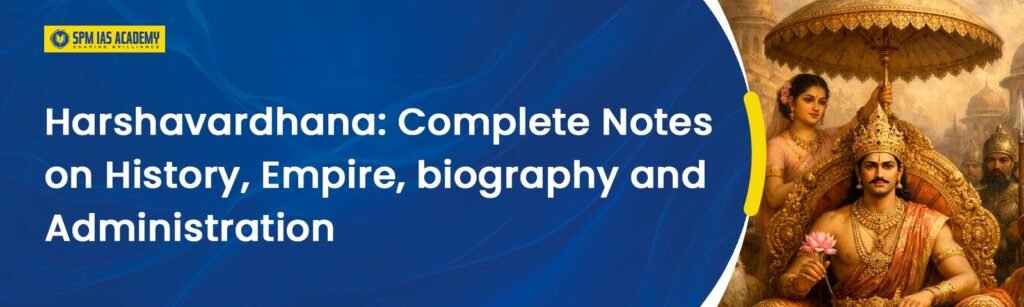
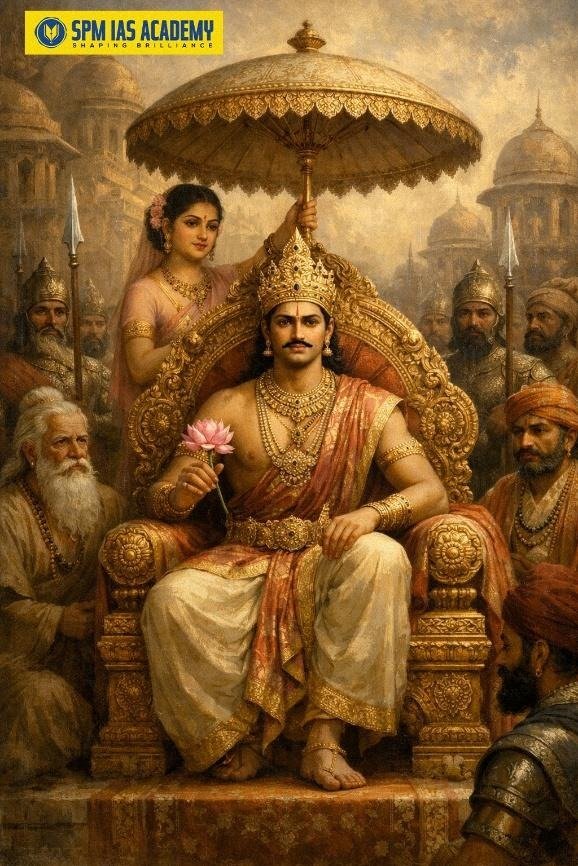
Harshavardhana is one of the most important rulers in Ancient Indian History. He ruled northern India from 606 CE to 647 CE. He was the last great emperor before India entered the early medieval period. Every year, UPSC Prelims, APSC, and State PCS exams include questions connected to his reign, his sources, his administration, or his literary contributions. This article covers everything you need to know about King Harshavardhana.
Students preparing for civil services can explore apsc upsc coaching in Assam for structured guidance, mentorship, and exam-focused preparation.
Harshavardhana – Quick Facts at a Glance
| Fact | Detail |
| Full Name | Harshavardhana |
| Other Name | Siladitya |
| Born | 590 CE, Thanesar (present-day Haryana) |
| Died | 647 CE (no heir) |
| Dynasty | Pushyabhuti Dynasty, also called the Vardhana Dynasty |
| Reign | 606 CE to 647 CE |
| Capital | Kannauj (Kanyakubja) |
| Father | Prabhakaravardhana |
| Elder Brother | Rajyavardhana |
| Sister | Rajyashri |
| Religion | Started as a Shaivite Hindu; later converted to Mahayana Buddhism |
| Court Poet | Banabhatta |
Who was Harshavardhan? Early Life and Rise to the Throne
Harshavardhana was born on 4 June 590 CE to King Prabhakaravardhana and Queen Yashomati in Thanesar. He belonged to the Pushyabhuti dynasty, also known as the Vardhana dynasty. His elder brother was Rajyavardhana and his younger sister was Rajyashri.
After the great Gupta Empire collapsed in the mid-6th century, northern India broke into many small kingdoms. The Pushyabhutis were one such regional power that gradually grew stronger under Prabhakaravardhana.
Harshavardhana Dynasty – The Events That Brought Harsha to Power
When Prabhakaravardhana died in 605 CE, Rajyavardhana became king. However, a crisis quickly arose. The Gauda king Shashanka, who ruled Bengal, killed Rajyavardhana through treachery. He also captured Rajyashri, Harsha’s sister, and imprisoned her.
As a result, Harshavardhana, then only 16 years old, became king in 606 CE. He immediately formed an alliance with Bhaskar Varman, the king of Kamarupa (present-day Assam), to challenge Shashanka. Together, they forced Shashanka to retreat. Harsha also personally rescued his sister from the forests of Vindhya just before she could commit sati.
Timeline of Key Events
| Year | Event |
| 590 CE | Harshavardhana is born to King Prabhakaravardhana in Thanesar. |
| 605 CE | Prabhakaravardhana dies. Rajyavardhana becomes king. Shashanka captures Rajyashri. |
| 606 CE | Shashanka kills Rajyavardhana. Harsha, aged 16, becomes king. He is crowned Maharajadhiraja. He allies with Bhaskar Varman of Kamarupa. |
| 612 CE | Harsha gains full control of Punjab and expands his empire rapidly across north India. |
| 618-619 CE | Battle of Narmada. Harsha attempts to expand southward but is defeated by Chalukya king Pulakeshin II. The Narmada River becomes the fixed southern boundary. |
| 629-645 CE | Chinese Buddhist pilgrim Hiuen Tsang (Xuanzang) visits India and spends years at Harsha’s court. |
| 641 CE | Harsha sends an Indian embassy to Tang China, establishing formal diplomatic relations. |
| 643 CE | Harsha organises the great Buddhist assembly at Kannauj, presided over by Hiuen Tsang. |
| 647 CE | Harshavardhana dies without an heir. The Vardhana dynasty ends. North India fragments once more. |
The Extent of Harshavardhana Empire
At its peak, Harshavardhana’s empire covered a vast stretch of northern India. He controlled Punjab, Kannauj, Bengal, Bihar, and Orissa. His empire extended from the Himalayas in the north to the Narmada River in the south. In the east, his ally Bhaskar Varman of Kamarupa extended his influence further. The king of Nepal also paid tribute to Harsha.
Who defeated Harshavardhana?
However, Harsha’s attempt to expand south of the Narmada failed. In 618-619 CE, the Chalukya king Pulakeshin II stopped him decisively at the Battle of Narmada. As a result, the Narmada River became the permanent southern boundary of his empire. This defeat is recorded in the Aihole Inscription of Pulakeshin II.
Because of his dominance over northern India, Harsha earned the title ‘Uttarapatha Svara’, meaning lord of the north.
Harsha’s Administration
Harshavardhana ran a more feudal and decentralised administration compared to earlier empires like the Mauryas or Guptas. He personally toured his empire regularly to check on the welfare of his people and deliver justice directly.
Key Administrative Officers:
| Officer Title | Role |
| Mahasandhivigrahika | Minister responsible for foreign affairs and decisions about peace or war |
| Simhanada | Commander of the cavalry |
| Sena | Commander of the elephant corps |
| Sarva-palli-pati | Chief officer of all villages |
| Vanapalas | Forest guardians who protected frontier areas and forests |
Revenue and Taxation
Harsha collected a land tax of one-sixth of the agricultural produce from farmers. He then divided this revenue into four equal parts:
- One part for administrative expenses.
- One part for scholars and learned men.
- One part for rewarding people who showed exceptional merit.
- One part for religious activities and charity.
The revenue terms used during his reign included bhaga, bhoga, kara, and hiranya. These dues are similar to those used during the Gupta period. UPSC Prelims sometimes asks about these terms.
Harshavardhana’s Religion: From Shiva to Buddha
Harsha’s religious journey is a fascinating story. He began as a devout worshiper of Lord Shiva. Over time, under the influence of Chinese monk Hiuen Tsang and his own growing interest in Buddhist philosophy, he converted to Mahayana Buddhism.
Despite his personal conversion, Harsha never forced his faith on others. He showed deep tolerance for Hinduism, Buddhism, and Jainism. All three faiths flourished during his reign. This spirit of tolerance made his court at Kannauj one of the most cosmopolitan centres in the ancient world.
The Two Famous Assemblies of Harshavardhana
1. The Kannauj Assembly (643 CE)
Harsha organised a grand Buddhist council at Kannauj in 643 CE. Hiuen Tsang presided over this assembly. Thousands of scholars, monks, and religious leaders from across the country attended. Through this assembly, Harsha promoted the principles of Mahayana Buddhism to the wider world.
2. The Prayag Assembly (Every Five Years)
Every five years, Harsha held a great assembly at Prayag (present-day Allahabad) near the confluence of the Ganga, Yamuna, and Saraswati rivers. During each assembly, he distributed his entire treasury among monks, scholars, the poor, and the needy. Hiuen Tsang attended the sixth such assembly and described it in great detail. He noted that after one such event, Harsha gave away so much wealth that he had to borrow his sister’s jewels to cover himself – a remarkable demonstration of his commitment to charity.
Literature and Culture
Harshavardhana was not only a warrior and an administrator. He was also a gifted writer and a great patron of learning. His court at Kannauj became one of the most vibrant intellectual centres of the ancient world, attracting poets, scholars, artists, and religious thinkers from across Asia.
Harsha’s Own Literary Works
Harshavardhana himself wrote three Sanskrit plays. These works reveal his talent as a poet and his deep interest in human emotions and Buddhist values.
| Play | Theme |
| Ratnavali | A romantic Sanskrit drama; one of his most celebrated works |
| Priyadarshika | Another romantic drama set in a royal court |
| Nagananda | A Buddhist-inspired drama about self-sacrifice; influenced by Jataka stories |
Who was the court poet of Harshavardhana?
Banabhatta: The Royal Court Poet
Banabhatta served as Harsha’s Asthana Kavi, meaning the chief court poet. He produced two legendary works that serve as primary historical sources for Harsha’s reign.
Harshacharita
Harshacharita is the biography of Harshavardhana written by Banabhatta. Historians consider it the earliest Sanskrit historical biography in India. It is one of the most important primary sources for Harsha’s early life, his rise to power, and the political conditions of his time.
Kadambari
Kadambari is a rich romantic novel written in Sanskrit prose. Many literary historians consider it the world’s first novel. It is a masterpiece of classical Sanskrit literature and a testament to the high literary culture of Harsha’s court.
Hiuen Tsang: India Seen Through Chinese Eyes
Chinese Buddhist pilgrim Hiuen Tsang, also spelled Xuanzang, visited India between 629 and 645 CE. He spent several years at Harsha’s court and also studied at Nalanda University under the great scholar Silabhadra. His travel account, known as Si-yu-ki (Record of Western Regions), is an invaluable historical source.
Hiuen Tsang praised Harsha for his justice, generosity, and deep religious devotion. He described in rich detail the social conditions, economic life, religious practices, and the state of education across Harsha’s vast empire. For historians today, his account is as important as Banabhatta’s Harshacharita.
Harshavardhana and Nalanda University
Harshavardhana was one of the greatest patrons of Nalanda University, the ancient world’s most celebrated centre of learning, located in present-day Bihar. He donated generously to Nalanda, built monasteries there, and supported its scholars. During his reign, Nalanda attracted students and monks from China, Southeast Asia, and across the Indian subcontinent.
Hiuen Tsang studied at Nalanda and described it as a grand institution where thousands of students and monks studied Buddhist philosophy, logic, medicine, and Sanskrit literature. Harsha’s generous patronage helped Nalanda maintain its position as a world-class seat of learning.
Diplomatic Relations with Tang China
Harshavardhana maintained active diplomatic ties with Tang China, which was ruled by Emperor Taizong at the time. In 641 CE, Harsha sent an Indian embassy to the Tang court in China. In return, the Tang emperor sent several embassies to Harsha’s court between 640 and 647 CE.
These diplomatic exchanges promoted cultural contact, Buddhist scholarship, and political prestige for both kingdoms. Chinese records, including the Old Tang History and the New Tang History, document these exchanges in detail. The visits of Hiuen Tsang further strengthened the cultural connection between Harsha’s India and Tang China.
After Harsha’s death in 647 CE, the Chinese ambassador Wang Xuance arrived in India to visit the court. He discovered that a minister named Arunasva had seized the throne after Harsha’s death. Wang Xuance then raised a small force from Nepal and Tibet, defeated Arunasva, and sent him as a prisoner to China. This episode shows how significant Harsha’s ties with China had become.
The Decline and End of the Vardhana Dynasty
Harshavardhana died in 647 CE without a direct heir. His death immediately created a power vacuum across northern India. The empire fragmented into many smaller kingdoms once again – the same pattern that had followed the collapse of the Mauryan and Gupta empires.
The fall of the Vardhana dynasty marks the clear end of the ancient period of Indian history. Early medieval India, with its many regional kingdoms and eventual arrival of Turco-Afghan rulers, begins from this turning point. For UPSC and State PCS, Harsha’s death is therefore a significant historical marker.
Conclusion:
In conclusion, Harshavardhana remains a crucial figure in Ancient Indian History, especially for UPSC, APSC, and State PCS preparation. Overall, his reign reflects a significant transition from the post-Gupta period to early medieval India, making it highly relevant for conceptual clarity and exam-oriented understanding. Moreover, his administrative system, religious tolerance, literary contributions, and diplomatic relations with China collectively highlight the multidimensional nature of his rule.
Furthermore, understanding topics such as the Harshavardhana empire, Battle of Narmada, Banabhatta’s Harshacharita, and Hiuen Tsang’s accounts helps aspirants connect static history with analytical questions in competitive exams. In addition, his alliance with Kamarupa strengthens the relevance of this topic for APSC aspirants, especially from Northeast India.
Regularly reading current affairs helps aspirants connect historical concepts with dynamic topics asked in UPSC exams.
Therefore, aspirants should revise Harshavardhana thoroughly to improve accuracy in prelims and depth in mains answers. Ultimately, mastering such high-weightage topics in Ancient Indian History for UPSC/APSC can significantly boost overall exam performance and help build a strong foundation for advanced historical analysis.
Source:
Frequently Asked Questions:
Harshavardhana was a powerful ruler of northern India who ruled from 606 CE to 647 CE. Moreover, he became the last great emperor before the early medieval period.
Pulakeshin II, the Chalukya ruler, defeated Harshavardhana in the Battle of Narmada. As a result, the Narmada River became the southern boundary of his empir
Harshavardhana wrote three Sanskrit plays – Ratnavali, Priyadarshika, and Nagananda. Additionally, these works reflect his deep interest in literature and culture.
The Chinese traveller Hiuen Tsang visited Harshavardhana’s court and documented his administration and society in detail. Consequently, historians consider his accounts highly valuable.
Banabhatta served as the court poet of Harshavardhana. Moreover, he wrote Harshacharita, which provides detailed insights into the king’s life and reign, making it an important historical source.
Banabhatta wrote the biography of Harshavardhana. Moreover, his work Harshacharita provides detailed information about the king’s life, rise to power, and political conditions of the time, making it a key historical source.