
What Is the Hit and Run case new law?
The hit and run new law is part of the Bharatiya Nyaya Sanhita (BNS), 2023, which replaced the colonial-era Indian Penal Code (IPC). Under Section 106(2) of the BNS, a driver who flees an accident scene without reporting to the nearest police station faces imprisonment of up to 10 years and a fine. A driver who reports the accident faces a lesser punishment of up to 5 years under Section 106(1). This law is directly relevant to UPSC Prelims and Mains, APSC, and all State PCS exams under the topics of Polity, Governance, and Internal Security.
Quick Facts: Hit and Run case law
| Item | Details |
| Law Name | Bharatiya Nyaya Sanhita (BNS), 2023 |
| Replaces | Indian Penal Code (IPC) of colonial era |
| Total Sections in BNS | 358 Sections |
| Introduced | December 2023 |
| Key Section | Section 106(2) – Up to 10 years imprisonment + fine |
| Section 106(1) | Up to 5 years imprisonment (for drivers who report to police) |
| Old Law – IPC 304A | Up to 2 years imprisonment for causing death by negligence |
| Old Law – IPC 279 | Up to 6 months imprisonment for rash driving |
| NCRB Data (2022) | 47,806 hit-and-run cases; 50,815 deaths |
| India’s global share | 1% of vehicles but 10% of global road accident deaths |
| GDP Loss | 5 to 7% of India’s GDP lost due to road accidents annually |
| States with Protests | Maharashtra, West Bengal, Chhattisgarh, Punjab |
Background – Why Did India Need This Law?
Hit-and-run cases form a large portion of road accidents in India. In most of these cases, drivers flee the accident spot because they fear police inquiry, punishment, and the risk of mob violence. As a result, victims do not receive immediate medical help, and many of them lose their lives.
Before the Bharatiya Nyaya Sanhita came into force in 2023, two laws governed hit-and-run cases in India – the Motor Vehicles Act, 1988, and the Indian Penal Code (IPC). However, the penalties under these laws were very lenient. Therefore, the government introduced stricter provisions to hold drivers more accountable and to deter reckless behaviour on roads.
What Is a Hit and Run case?
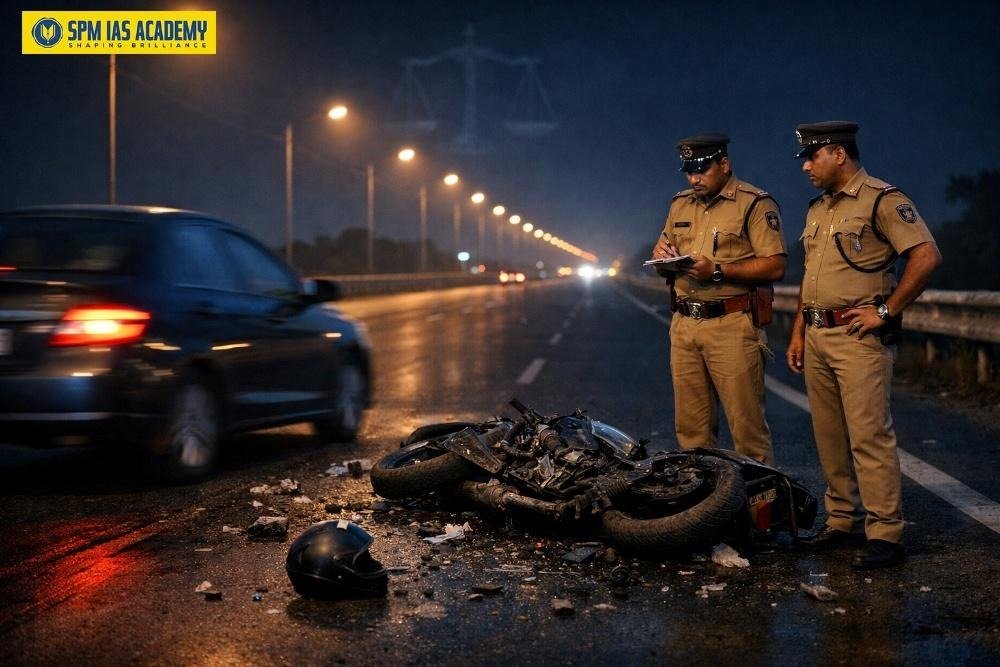
A hit-and-run accident occurs when a motor vehicle collides with a person, another vehicle, or property, and the driver leaves the scene without stopping to help the injured person or without reporting the incident to the nearest police station. These cases are treated as serious offences because they often cause injuries or deaths and because drivers carry a moral and legal duty to provide assistance in such situations.
Hit and Run Law Before the BNS – The Old Legal Framework
Before the BNS came into effect, two laws handled hit-and-run cases:
Motor Vehicles Act, 1988
This Act made it mandatory for drivers involved in accidents to stop their vehicle immediately, provide assistance to the injured person, and report the incident to the nearest police station. However, the Act did not impose strong criminal penalties on drivers who fled the scene.
Indian Penal Code (IPC)
- Section 279 – Rash Driving: This section dealt with rash or reckless driving that endangered human life. The maximum punishment was only 6 months of imprisonment, a fine, or both.
- Section 304A – Causing Death by Negligence: This section covered cases where a driver’s rash or negligent driving caused someone’s death. The maximum punishment was only 2 years of imprisonment, a fine, or both.
Clearly, these provisions were not strong enough to deter drivers from fleeing accident scenes. The lenient penalties failed to address the seriousness of hit-and-run offences. Consequently, the government introduced the BNS with much stricter provisions.
Why Was a New Hit and Run Case Law Needed? – Key Reasons
1. Rising Road Accidents in India
- According to NCRB data, India reported 47,806 hit-and-run cases in 2022, resulting in 50,815 deaths.
- Road accidents in India are increasing at 12% per year, while fatalities are rising at 9.4% year on year.
- On average, India witnesses 19 deaths every hour due to road accidents – that is 1 death every 3.5 minutes.
- National and State highways make up only 5% of India’s total road network but account for more than 50% of all road accident deaths.
2. India’s Share in Global Road Accidents
- India has around 1% of the world’s total vehicles but contributes to 10% of all global road accident deaths.
- India loses 5 to 7% of its GDP every year due to road accidents – a massive economic burden.
3. Increasing Driver Accountability
Under the old IPC, the maximum punishment for causing death by rash driving was only 2 years. This was not enough to deter drivers. Therefore, stricter laws were necessary to hold drivers accountable for their actions on the road.
4. Empowering Victims
Stronger legal provisions were also needed to ensure that victims of road accidents receive proper compensation and justice. The old law did not adequately protect the interests of victims and their families.
Hit and Run case new law – Provisions Under BNS 2023
The Bharatiya Nyaya Sanhita, 2023, introduced two key provisions for hit-and-run cases under Section 106:
Section 106(2) of BNS – The Stricter Provision
Section 106(2) applies to drivers who flee the accident scene without reporting the incident to the nearest police station. Such drivers face imprisonment of up to 10 years along with a fine. This is the main provision that triggered widespread protests across the country.
Section 106(1) of BNS – The Lesser Punishment
Section 106(1) applies to drivers who cause death due to rash driving but who report the accident to the police. Such drivers face a lesser punishment of imprisonment of up to 5 years. This provision deliberately incentivises drivers to report accidents rather than flee.
Comparison: Hit and Run Case – Old Law vs New Law
| Provision | Old Law (IPC) | New Law (BNS) |
| Rash driving (no death) | IPC Sec 279 – up to 6 months | BNS Sec 106(1) – up to 5 years (if reported) |
| Causing death (reported) | IPC Sec 304A – up to 2 years | BNS Sec 106(1) – up to 5 years |
| Causing death (fled scene) | IPC Sec 304A – up to 2 years | BNS Sec 106(2) – up to 10 years + fine |
Significance of the New Hit and Run Law
- Separate punishments for reporting and fleeing: The law creates a direct incentive for drivers to report accidents rather than flee. This one change can save many lives by ensuring victims get help faster.
- Stronger accountability: The 10-year jail term under Section 106(2) is a powerful deterrent. It sends a clear message that fleeing an accident scene is a serious crime.
- Moral responsibility: The new law enforces the moral duty of drivers to assist accident victims. It treats fleeing the scene as a deliberate act of callousness, not just an oversight.
- Potential to save lives: If more drivers report accidents, victims will receive medical help faster. This can significantly reduce deaths caused by delayed treatment.
Concerns and Criticism – Why Drivers Protested
Transporters and commercial vehicle drivers in states like Maharashtra, West Bengal, Chhattisgarh, and Punjab organised large-scale protests against the new law. They demanded the withdrawal or amendment of Section 106(2) of the BNS. Their concerns are as follows:
1. Unjust and Disproportionate Penalty
Protesters argue that 10 years imprisonment is too harsh and disproportionate for an accident. An accident, they say, is often not intentional. Therefore, treating it the same as a deliberate crime is unfair.
2. Unfair Blame on Commercial Vehicle Drivers
Commercial vehicle drivers, especially truck and bus drivers, argue that the law unfairly targets them. Even when an accident is not their fault, they are often blamed because they drive heavy vehicles. The new law may worsen this negative perception.
3. Conflict with Article 20(3) – Right Against Self-Incrimination
The requirement to report an accident to the police may conflict with Article 20(3) of the Constitution, which states that no person accused of an offence shall be compelled to be a witness against himself. Critics argue that forcing drivers to self-report may violate this Fundamental Right.
4. Risk of Misuse
There is a fear that police and affected parties may misuse the strict provisions of the new law to extract bribes or unjust compensation from drivers, even in cases where the driver was not at fault.
5. No Protection Against Mob Violence
One of the main reasons drivers flee accident scenes is the fear of mob violence. Angry crowds often attack drivers at accident spots before the police arrive. However, the new law does not provide any safety provisions or protocols to protect drivers from mob attacks. This is a serious gap.
6. Mismatch with the Motor Vehicles (Amendment) Act, 2019
Section 161 of the Motor Vehicles (Amendment) Act, 2019 prescribes a compensation of Rs 2 lakh to victims of hit-and-run deaths and Rs 50,000 for grievous hurt. The BNS provisions do not clearly align with this existing compensation framework, creating a legal inconsistency.
7. Challenging Work Conditions of Drivers
Drivers argue that the law does not take into account the difficult conditions under which they work – long driving hours, poor road infrastructure, lack of rest stops, and natural hazards like poor visibility due to fog. Many accidents happen because of these systemic problems, not because of driver negligence alone.
8. Exception for Doctors – Against Equality
Section 106(2) of the BNS includes an exception for medical professionals. Doctors involved in accidents due to rash or negligent driving face a maximum punishment of only 2 years, not 10 years. Protestors argue that this exception violates the principle of equality before law and is discriminatory.
Way Forward – What Should Be Done?
Given the concerns raised by drivers and transporters, experts and critics suggest the following reforms to make the hit and run law more effective and fair:
- More elaborate and differentiated provisions: The law should clearly distinguish between rash driving, negligent driving, and accidental incidents. A comprehensive consultation with all stakeholders, especially drivers, should take place before implementation.
- Clear reporting procedure: The law must specify exactly how drivers should report an accident to the police and what evidence they need to prove their innocence. Ambiguity in reporting procedures increases the risk of misuse.
- Differentiation based on accident outcome: The law should prescribe separate and proportionate penalties for cases resulting in death, grievous hurt, or minor injuries. Currently, the law does not make this distinction clearly enough.
- Emergency response protocol: The law should include provisions for protecting drivers from mob violence, particularly at the site of accidents. A standardised emergency response protocol would also help victims get timely medical assistance.
- Improved road infrastructure: Reducing road accidents requires more than strict laws. India urgently needs better road design, improved lighting, clear signage, and more rest areas for long-distance drivers.
- Separate provisions for minor injuries: Cases involving only minor injuries should not attract the same severe penalties as cases involving death. The law needs proportionate punishment at every level.
Conclusion:
In conclusion, the hit and run new law in India under the Bharatiya Nyaya Sanhita 2023 strengthens road safety and driver accountability by introducing stricter penalties and encouraging accident reporting. As a result, it has the potential to reduce fatalities and improve victim support.
However, concerns related to harsh punishment, misuse, and lack of driver protection highlight the need for balanced implementation. Therefore, the government must ensure clear procedures, proportionate penalties, and better road safety systems.
Overall, understanding topics like hit and run law 2023, BNS Section 106, road safety laws in India, and criminal law reforms is essential for UPSC, APSC, and State PCS preparation.
CITATIONS
- What’s the new law on hit-and-run cases and why transporters were protesting against it
- Assam transporters’ union begin 48-hour strike against new hit-and-run law
- Hit and run law: Commercial, public vehicles off roads in Assam as 48-hour transport strike begins
- Strict Punishment For Hit-And-Run Cases? What New Bill Says
- Criminal law reform acts to come into effect from July 1 but govt keeps in abeyance provision on hit-and-run cases
Prelims Practice Question:
Q. With reference to the Bharatiya Nyaya Sanhita (BNS) Act, 2024, which of the following provisions specifically addresses the punishment for hit and run offenses?
A) Section 106(2)
B) Section 187, Motor Vehicles Act, 1988
C) Section 304A, Indian Penal Code
D) Section 376, Indian Penal Code
Mains Practice Question:
Q. Critically examine the recent amendments in the Hit and Run Law under the Bharatiya Nyaya Sanhita (BNS) Act, 2024. How do these changes impact road safety, the accountability of offenders, and the rights of victims? Discuss the challenges in the implementation of this law and suggest measures to address them.

Behind every article at SPM IAS Academy is a team of skilled content writers and subject experts committed to making preparation easier for aspirants. From answering common doubts to breaking down complex issues and current affairs, we create content that is accurate, easy to understand, and directly useful for UPSC, APSC, and other competitive exams.