
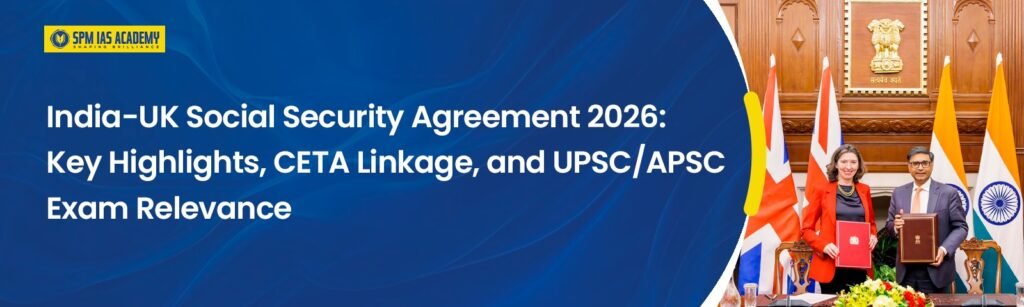
The India-UK Social Security Agreement (SSA) marks an important step in strengthening bilateral relations between India and the United Kingdom. The agreement aims to prevent double social security contributions for employees on short-term overseas assignments of up to 36 months. It forms part of the broader India–UK Comprehensive Economic and Trade Agreement (CETA).
For UPSC, APSC, APPSC, and other State PCS exams, this development is highly relevant under International Relations, Economy, Indian Diaspora, and Trade Agreements.
What Is the India–UK Social Security Agreement (SSA)?
The Government of India and the Government of the United Kingdom of Great Britain and Northern Ireland signed the Social Security Agreement (SSA) in New Delhi.
Vikram Misri, the Foreign Secretary of India and Lindy Cameron, British High Commissioner to India signed the agreement. This agreement ensures that employees working temporarily in each other’s countries will pay social security contributions in only one country, not both.
Why Was the India-UK Social Security Agreement Needed?
- Firstly, a large number of Indian professionals and skilled workers take up short-term assignments in the UK. Likewise, many UK professionals work temporarily in India.
- Previously, these employees were required to contribute to the social security systems of both countries. This significantly increased their financial burden.
- As a result, employers also faced higher operational costs while deploying staff abroad.
- Therefore, the agreement was introduced to avoid double social security contributions for employees on temporary assignments.
- Consequently, it helps to reduce the financial pressure on both workers and employers.
- Moreover, it enhances the competitiveness of Indian companies operating in the global market.
- Finally, it promotes ease of doing business and strengthens India–UK economic cooperation.
What are the Key Features of the India-UK SSA:
1. Avoidance of Double Contribution:
Employees on temporary assignments (up to 36 months) will contribute only in their home country’s social security system.
2. Certificate of Coverage (CoC):
Workers can obtain a Certificate of Coverage (CoC) from authorities like the Employees’ Provident Fund Organisation. It will prove that they are already covered under their home country’s social security system.
3. Linked with Trade Agreement (CETA):
The agreement forms part of the India-UK Comprehensive Economic and Trade Agreement (CETA) signed in July 2025. Both governments committed to finalizing the SSA during the CETA negotiations.
4. Implementation Timeline:
The SSA will come into effect along with CETA, likely during the first half of the implementation year.
What Is a Social Security Agreement (SSA)?
A Social Security Agreement (SSA) is a bilateral arrangement between two countries. It aims to regulate social security contributions and protect the interests of workers on overseas assignments.
- Firstly, India signs Social Security Agreements to protect Indian professionals and skilled workers who are working abroad for short durations.
- Secondly, these agreements ensure the portability of social security benefits. It means workers can transfer or retain their benefits when they return to India.
- Moreover, Social Security Agreements help avoid double social security contributions, thereby reducing financial burden on both employees and employers.
- In addition, they contribute to strengthening economic and trade partnerships between India and other countries.
- Ultimately, such agreements promote global workforce mobility and support the expansion of India’s growing service sector in the international market.
What Is the Double Contributions Convention (DCC)?
According to the UK government, this reciprocal social security arrangement is referred to as the Double Contributions Convention (DCC). It is designed to simplify cross-border employment and reduce financial duplication.
- Firstly, the DCC ensures that employees pay social security contributions in only one country at a time, rather than in both.
- Consequently, it prevents the problem of double payment and reduces financial stress on workers posted abroad.
- Moreover, employers are protected from unnecessary financial liabilities arising from overlapping contribution requirements.
- As a result, businesses gain greater confidence to expand their operations internationally and deploy talent across borders more efficiently.
Importance for India–UK Relations:
This agreement strengthens India–UK ties in several ways:
- Boosts Trade and Investment:
Since it is linked with CETA, it enhances economic cooperation. - Supports Skilled Workforce Mobility:
Indian IT professionals, consultants, engineers, and financial experts will benefit significantly. - Strengthens Service Sector Collaboration:
India’s service sector plays a major role in exports. This agreement supports smoother operations abroad. - Enhances Strategic Partnership:
India and the UK share strong ties in trade, education, defense, and technology.
Aspirants can strengthen such topics through UPSC coaching in Assam focused on international relations and economy.
Conclusion:
The India-UK Social Security Agreement 2026 represents a major step in strengthening India-UK bilateral relations. It prevents double social security contributions, supports workforce mobility, and enhances trade cooperation under CETA.
For UPSC, APSC, APPSC, and State PCS aspirants, this topic is crucial under International Relations, Indian Economy, and Current Affairs. Regular analysis of such bilateral agreements will improve your answer-writing quality and conceptual clarity.
Comprehensive coverage of agreements like SSA is emphasized in UPSC coaching in north east India programs.
Mains Practice Question:
“Discuss the significance of the India–UK Social Security Agreement in strengthening bilateral economic relations. How does it reflect India’s evolving trade diplomacy?”
Sources:
Frequently Asked Questions:
The India-UK Social Security Agreement 2026 is a bilateral agreement between India and the United Kingdom. Notably, it aims to prevent double social security contributions for employees on short-term overseas assignments (up to 36 months). Most importantly, it forms a part of the India-UK Comprehensive Economic and Trade Agreement (CETA) and strengthens bilateral economic relations.
The India-UK Social Security Agreement was needed to avoid double payment of social security contributions by Indian and UK professionals. It reduces financial burden on employees and employers and improves ease of doing business, Moreover, it will enhance the competitiveness of Indian companies in the global market.
Under the India-UK Social Security Agreement, Indian professionals working in the UK for up to 36 months will contribute only to India’s social security system. By obtaining a Certificate of Coverage (CoC) from EPFO, they can avoid paying contributions in both countries. Therefore, it will save costs and ensure portability of benefits.
The Double Contributions Convention (DCC) is the UK’s term for the reciprocal arrangement under the India-UK Social Security Agreement. It ensures that employees and employers pay social security contributions in only one country at a time. Therefore, it will prevent financial duplication and support cross-border workforce mobility.
The India–UK Social Security Agreement 2026 is important for UPSC, APSC, APPSC, and other State PCS exams. It comes under topics such as International Relations, Indian Economy, Trade Agreements, and Indian Diaspora. It reflects India’s evolving trade diplomacy and economic cooperation framework with the United Kingdom.