
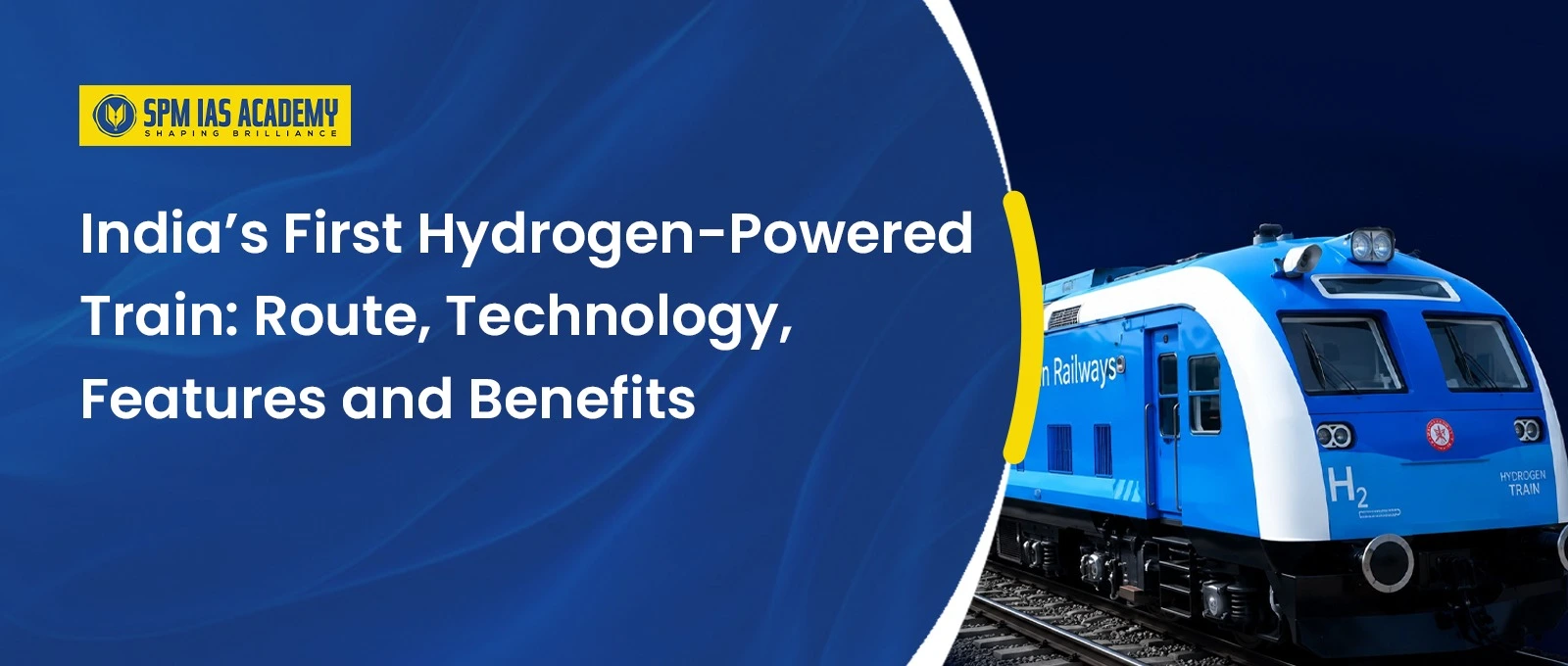
India’s first hydrogen powered train marks a major step in the country’s clean mobility journey. Prime Minister Narendra Modi flagged off the train from Jind in Haryana on 17 July 2026. The train will run on the Jind-Sonipat section of Northern Railway and demonstrates India’s growing focus on green transport, indigenous technology and low-carbon public mobility.
For UPSC, APSC and other State PCS exams, India’s first hydrogen powered train is important under Science and Technology, Environment, Energy, Infrastructure, Green Hydrogen Mission and Indian Railways modernisation.
What Is a Hydrogen Powered Train?
A hydrogen powered train is a train that generates electricity onboard by using hydrogen fuel cells. Instead of using diesel engines or drawing power from overhead electric lines, it uses hydrogen and oxygen to produce electricity. The process releases water vapour and heat as by-products, which makes it a cleaner alternative to diesel-powered trains.
How Hydrogen-Powered Train Works
- First, the train stores hydrogen in high-pressure cylinders. These cylinders safely supply hydrogen to the fuel cell system.
- Next, the fuel cell takes oxygen from the air. It then combines hydrogen with oxygen through an electrochemical reaction.
- As a result, the reaction generates electricity. The train uses this electricity to run its traction motors.
- Then, the traction motors power the movement of the train. This allows the train to operate without using diesel fuel.
- Finally, the train releases only water vapour as a by-product. Therefore, it reduces harmful tailpipe emissions and supports cleaner rail transport.
- Thus, hydrogen-powered trains can be useful on routes where full electrification is difficult, costly or time-consuming.
India’s First Hydrogen Powered Train: Key Facts
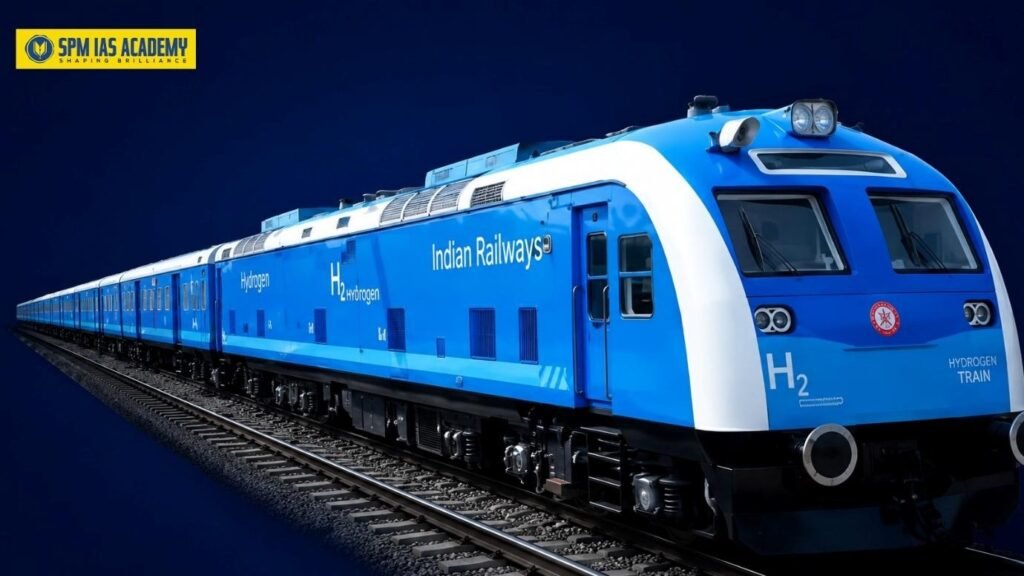
India’s first hydrogen powered train has been designed and developed indigenously. It reflects the goals of Atmanirbhar Bharat and supports Indian Railways’ shift towards sustainable mobility. According to PIB, the train was developed according to design approval and technical specifications prepared by the Research, Design and Standards Organisation (RDSO).
| Feature | Details |
| Train | India’s first hydrogen powered train |
| Flag-off date | 17 July 2026 |
| Route | Jind-Sonipat section, Haryana |
| Railway Zone | Northern Railway |
| Technology | Hydrogen fuel cell propulsion |
| Train composition | 2 Hydrogen Driving Power Cars and 8 Trailer Coaches |
| Total trainset | 10-car trainset |
| Propulsion system | 1200 kW hydrogen fuel cell propulsion |
| Maximum approved speed | 75 kmph |
| Design speed | 110 kmph |
| Passenger capacity | Around 2,600 passengers |
| Major infrastructure | Hydrogen storage and refuelling facility at Jind |
Route of India’s First Hydrogen Powered Train
India’s first hydrogen powered train will operate on the Jind-Sonipat route in Haryana. It will connect Jind Junction, Gohana Junction and Sonipat, while also serving intermediate stations.
Technology Behind India’s First Hydrogen Powered Train
- The technology behind India’s first hydrogen powered train is based on a Proton Exchange Membrane Fuel Cell, also called PEMFC.
- This fuel cell produces electricity by reacting hydrogen and oxygen across a special proton-conducting membrane. The process produces only water vapour and heat as by-products.
- Hydrogen is a high-energy fuel. Hydrogen has an energy value of 120 MJ/kg, compared to diesel’s 43 MJ/kg. This makes hydrogen attractive for transport applications where high energy density matters.
- Each Hydrogen Driving Power Car houses Fuel cells, Lithium iron phosphate batteries, Hydrogen storage cylinders and Control and monitoring systems.
The batteries support smooth operation, while fuel cells generate power during movement. As a result, the train can operate with lower direct emissions compared to diesel trains.
Hydrogen Infrastructure at Jind
- A hydrogen train cannot run without a proper hydrogen ecosystem. Therefore, Indian Railways has developed a dedicated hydrogen storage and refuelling facility at Jind, Haryana.
- This facility is India’s largest railway hydrogen storage and refuelling facility. It can store nearly 3,000 kg of hydrogen at a time. The Petroleum and Explosives Safety Organisation has granted the required licence for compressed hydrogen storage and dispensing. The ecosystem follows international standards such as NFPA-2 and the ISO 19880 series.
- The facility includes Hydrogen compression system, Standby compressor. Moreover, it also includes Technical support and critical spares, 24×7 monitoring system and Refuelling safety systems.
Thus, India’s first hydrogen powered train is not only a train project. It is also a pilot ecosystem for future hydrogen mobility.
Safety Features of India’s First Hydrogen-Powered Train
Hydrogen is a clean fuel, but it requires strict safety management. Therefore, Indian Railways has created a detailed safety and operational framework for the project.
- The train uses hydrogen leak detectors at key points. These detectors monitor hydrogen production, storage and dispensing areas to prevent leakage-related risks.
- It also uses flame detectors for continuous monitoring. As a result, the system can quickly detect fire-related hazards.
- Railway teams regularly inspect and clean the sensors. This ensures accurate detection and smooth functioning of the safety system.
- The train maintains non-stop ventilation inside the coaches and technical areas. This helps prevent hydrogen accumulation in enclosed spaces.
- The system automatically cuts off hydrogen supply during abnormal heat, flame or smoke. Thus, it reduces the risk of fire or explosion.
- The loco pilot gets real-time system health updates. This helps the pilot monitor the train’s safety status during operation.
- The loco pilot’s cabin also has an emergency movement mode. Therefore, the train can be moved safely during critical situations.
Overall, these features make hydrogen train operations safer. They combine technological innovation with strong safety governance.
Why India’s First Hydrogen Powered Train Matters
India’s first hydrogen powered train matters because it combines clean energy, indigenous engineering and railway modernisation. It also aligns with India’s larger climate and energy goals.
The train is important for the following reasons:
- Clean mobility: It reduces dependence on diesel-based traction.
- Low direct emissions: Hydrogen fuel cells release water vapour as the direct emission.
- Atmanirbhar Bharat: India designed and developed the train indigenously.
- National Green Hydrogen Mission: The project supports India’s green hydrogen ecosystem.
- Railway decarbonisation: It helps Indian Railways explore alternatives for non-electrified or difficult-to-electrify routes.
- Technology learning: The pilot will provide operational data for future hydrogen trains.
Now India has joined countries exploring hydrogen railway technology, including Germany, Japan, China and the United States.
India’s First Hydrogen Powered Train and Green Hydrogen Mission
- India launched the National Green Hydrogen Mission to promote green hydrogen production, use and export. Hydrogen trains can support this mission by creating demand for hydrogen in transport.
- However, the environmental benefit depends on how hydrogen is produced. If hydrogen comes from renewable energy, it becomes green hydrogen and reduces lifecycle emissions.
- But if it comes from fossil fuels, the climate benefit becomes limited. Therefore, India must link hydrogen transport with renewable energy expansion.
What are the Challenges Before Hydrogen Powered Trains in India?
Although India’s first hydrogen powered train is a major achievement, several challenges remain.
- High Cost: High cost remains a major challenge. Hydrogen fuel cells, storage cylinders and refuelling systems require heavy investment, which can increase project costs.
- Hydrogen Production: Moreover, India must scale up green hydrogen production. Only then can hydrogen trains deliver real climate benefits and reduce lifecycle emissions.
- Safety concerns: Safety also needs strong attention. Since hydrogen is highly flammable, railway systems must follow strict standards for storage, refuelling and operation.
- Infrastructure gap: In addition, hydrogen refuelling infrastructure is still limited. India needs more refuelling stations before hydrogen trains can operate on a larger scale.
- Technology maturity: Technology maturity is another concern. Hydrogen rail technology is still evolving globally, so India needs continuous testing and improvement.
- Operational testing: Furthermore, India needs long-term operational data. This data will help assess reliability, maintenance needs, fuel efficiency and cost-effectiveness.
- Competition from electrification: Finally, hydrogen trains must find the right use cases. Since Indian Railways has already electrified many routes, hydrogen trains may be more suitable for routes where full electrification is difficult or costly.
Therefore, hydrogen trains should not be seen as a replacement for all railway electrification. Instead, they should be treated as a complementary clean mobility option.
Conclusion
India’s first hydrogen powered train is a landmark step in India’s transition towards green mobility. It shows how Indian Railways can use new technologies to reduce emissions, test alternative fuels and support the National Green Hydrogen Mission. However, the long-term success of hydrogen trains will depend on green hydrogen availability, safety systems, cost reduction and practical route selection.
For UPSC, APSC and State PCS aspirants, this topic is a strong example of India’s clean energy transition, technological self-reliance and sustainable infrastructure planning.
Also Read:
Source:
FAQs on India’s First Hydrogen-Powered Train
A hydrogen powered train generates electricity onboard using hydrogen fuel cells. It combines hydrogen and oxygen to produce electricity, with water vapour and heat as by-products.
Prime Minister Narendra Modi flagged off India’s first hydrogen powered train from Jind in Haryana on 17 July 2026.
The train runs on the Jind-Sonipat section of Northern Railway in Haryana.
It promotes clean rail mobility, supports the National Green Hydrogen Mission, reduces diesel dependence and strengthens India’s indigenous railway technology.
India’s first hydrogen powered train is an indigenously developed hydrogen fuel cell train that runs on the Jind-Sonipat route in Haryana.

Behind every article at SPM IAS Academy is a team of skilled content writers and subject experts committed to making preparation easier for aspirants. From answering common doubts to breaking down complex issues and current affairs, we create content that is accurate, easy to understand, and directly useful for UPSC, APSC, and other competitive exams.