
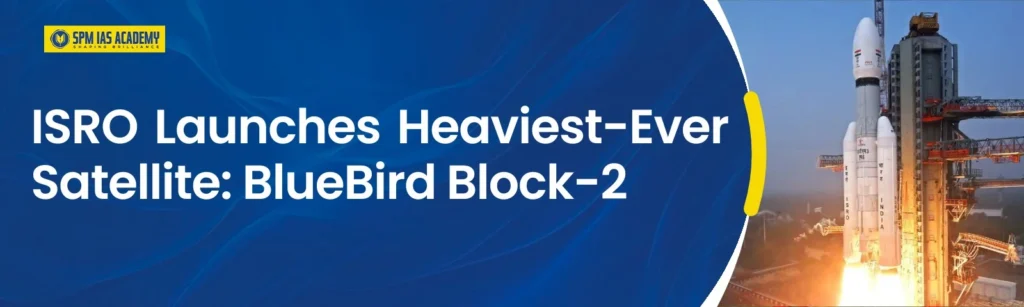
India has achieved another major milestone in space technology. The Indian Space Research Organisation (ISRO) successfully launched its heaviest-ever satellite, BlueBird Block-2, using the powerful LVM-3 launch vehicle. Weighing nearly 6,100 kg, this mission marks a significant leap in India’s commercial launch capabilities and strengthens its position in the global space market. Importantly, the same LVM-3 rocket is slated to be used for Gaganyaan, India’s first human spaceflight mission.
What is the BlueBird Block-2 Satellite?
The BlueBird Block-2 satellite has been designed by the US-based company AST SpaceMobile. It is intended to become the largest-ever commercial communication satellite deployed in Low Earth Orbit (LEO). This mission marks the 6th operational flight of LVM3.
Key Features of BlueBird Block-2 Satellite:
- Weight: ~6,100 kg
- Orbit: ~520 km Low Earth Orbit
- Type: Commercial LEO communication satellite
- Technology: Direct-to-mobile connectivity
- Unlike conventional satellites that depend on ground stations, BlueBird Block-2 can directly communicate with standard mobile phones. As a result, it will enable 4G and 5G voice calls, video calls, text messaging, and internet data & streaming.
This technology aims to deliver seamless connectivity anywhere on Earth, including remote and underserved regions.
Understanding Low Earth Orbit (LEO):
- Low Earth Orbit (LEO) refers to an orbit located below 1,000 km above Earth’s surface.
- The importances of Low Earth Orbit (LEO) are:
- Lower signal latency compared to geostationary orbit.
- Better support for real-time communication.
- Suitable for broadband internet constellations.
- Reduced launch and operational costs.
Why is ISRO’s BlueBird Block-2 Mission Significant:
- Strengthening India’s Commercial Launch Credentials: This mission becomes ISRO’s third commercial LVM-3 launch, following the successful deployment of OneWeb satellites in 2022 and 2023. Consequently, ISRO continues to establish itself as a reliable and cost-effective launch service provider.
- Heaviest Payload Ever Launched by ISRO: At 6,100 kg, BlueBird Block-2 surpasses the earlier record held by OneWeb satellite batches, which collectively weighed about 5,700 kg. Therefore, this mission sets a new benchmark for India’s heavy-lift capacity.
- Demonstration of LVM-3’s Versatility: Initially, ISRO designed LVM-3 for geosynchronous missions (~36,000 km). It has now proven its efficiency in placing very heavy payloads into LEO. This flexibility significantly enhances mission planning options.
- Rapid Launch Capability: Notably, this launch comes just weeks after CMS-03 communication satellite was placed in orbit on November 2. This represents the shortest gap between two LVM-3 launches, highlighting ISRO’s improved assembly speed and operational readiness.
- Cryogenic Engine Advancements: ISRO is actively working to increase the thrust of the cryogenic upper stage. This stage alone contributes nearly 50% of the velocity required for high-energy orbits. This improvement will directly benefit future Gaganyaan missions, heavy communication satellites and deep-space exploration.
ISRO’s LVM-3 (Launch Vehicle Mark-3):
- ISRO’s LVM-3 is a heavy-lift, three-stage launch vehicle designed to carry large payloads into high-energy orbits. It features two powerful solid strap-on boosters (S200), a liquid-fuelled core stage (L110), and a cryogenic upper stage (C25) that provides the final orbital velocity.
- With a lift-off mass of about 640 tonnes and a height of 43.5 metres, LVM-3 can place up to 4,200 kg of payload into Geosynchronous Transfer Orbit (GTO), making it ISRO’s most capable operational rocket.
- Over the years, LVM-3 has proven its reliability by successfully launching Chandrayaan-2, Chandrayaan-3, and two commercial OneWeb missions, which together deployed 72 satellites into orbit. These missions underline LVM-3’s growing role in India’s deep-space exploration and commercial launch ambitions.
Conclusion:
The launch of BlueBird Block-2 is not merely a technological but a strategic achievement. Through this mission, ISRO has demonstrated its ability to handle heavier payloads, faster turnaround times, and cutting-edge commercial missions at competitive costs. As India prepares for Gaganyaan and expands its role in the global space economy, the LVM-3 and BlueBird Block-2 mission stands as a defining moment in India’s space journey.
Sources:
- https://www.isro.gov.in/LVM3_M6_BlueBird_Block2_Mission.html
- https://www.thehindu.com/sci-tech/science/countdown-isros-bluebird-block-2-mission-lvm3-m6-rocket-us-communication-satellite/article70428818.ece
Also read :
BlueBird Block-2 is ISRO’s heaviest-ever satellite, weighing about 6,100 kg, designed by AST SpaceMobile. It is to provide direct-to-mobile 4G and 5G connectivity from Low Earth Orbit.
The mission is significant because it marks ISRO’s heaviest payload launch, strengthens India’s commercial launch capabilities, and showcases the versatility of the LVM-3 rocket for future human and commercial missions.
ISRO used the LVM-3 (Launch Vehicle Mark-3), India’s most powerful heavy-lift rocket, which will also be used for the Gaganyaan human spaceflight mission.
Unlike traditional satellites, BlueBird Block-2 enables direct communication with ordinary mobile phones, allowing voice calls, video calls, messaging, and data services without ground relay stations.
Low Earth Orbit offers lower signal latency, better real-time communication, and reduced costs, making it ideal for large satellite constellations providing global internet and mobile connectivity.