
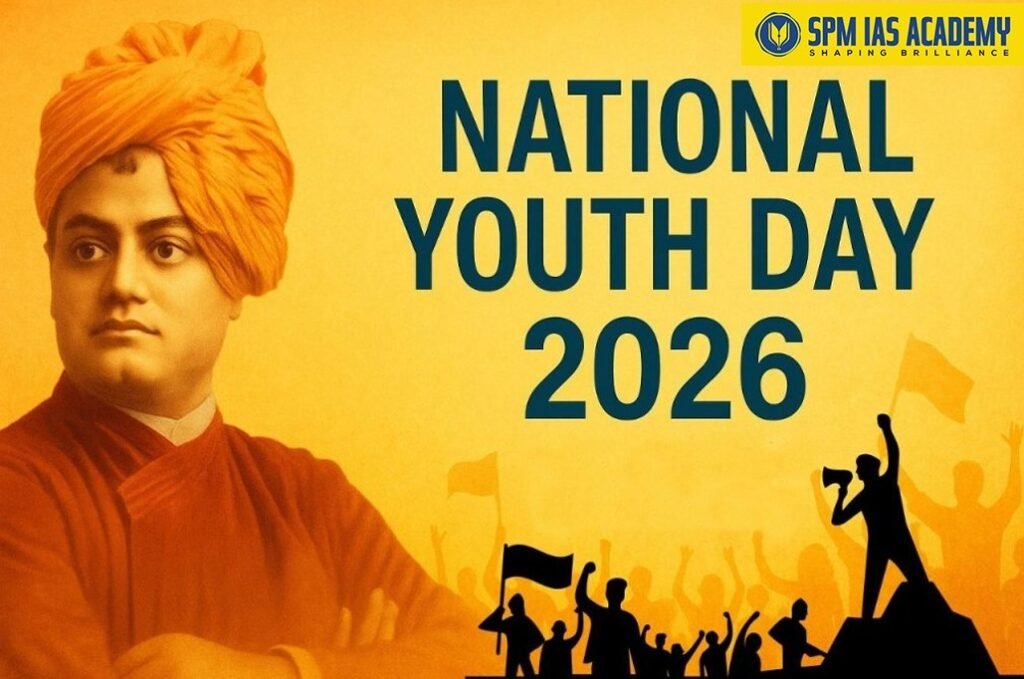
Every year on 12th January, India celebrates National Youth Day to honour the birth anniversary of Swami Vivekananda, one of the greatest spiritual leaders, thinkers, and nation-builders India has ever produced. National Youth Day is not merely a commemorative occasion. Instead, it serves as a powerful reminder of the role youth play in shaping India’s destiny.
In 2026, as India stands at the crossroads of demographic opportunity and global responsibility, National Youth Day assumes even greater importance. With around 65% of its population under the age of 35, India’s future depends largely on how its youth are educated, empowered, and ethically guided. With the theme of ‘Ignite the self, impact the world’, National Youth Day, 2026 focuses on the role of youth in democracy and government in Viksit Bharat. For students preparing for UPSC, APSC, APPSC and other competitive examinations, this day holds strong academic, philosophical, and motivational relevance.
Why is National Youth Day celebrated on 12th January?
India celebrates National Youth Day on 12th January to commemorate the birth anniversary of Swami Vivekananda, who was born in 1863 in Kolkata. The Government of India officially declared this day as National Youth Day in 1984, recognising that Swami Vivekananda’s thoughts were especially relevant for young minds.
Swami Vivekananda firmly believed that youths are the real strength of a nation. He emphasised character-building, fearlessness, self-belief, and service to humanity. He urged the youths to ‘arise, awake, stop not till the goal is reached’. By following this, one can achieve self-realization and perseverance. Therefore, dedicating his birthday to India’s youth was a conscious effort to inspire generations with his philosophy of strength, discipline, and national pride. As a result, 12th January has become a day to reflect on youth empowerment, leadership, and responsibility.
Swami Vivekananda – A Timeless Youth Icon:
Swami Vivekananda emerged as a global icon of Indian philosophy after his historic address at the World Parliament of Religions in Chicago in 1893. His message of universal brotherhood, tolerance, and spiritual humanism resonated across continents.
However, beyond spirituality, Vivekananda was deeply concerned about India’s social and political condition. He strongly argued that India’s regeneration would come through educated, confident, and morally upright youth.
He once asserted that one energetic youth is more powerful than a hundred inactive elders. This belief underlines why his ideas remain central to youth discourse even in the 21st century.
Core Ideas of Swami Vivekananda Relevant to Youth:
Swami Vivekananda’s teachings are remarkably practical and modern.
- First, he emphasised self-confidence and fearlessness. He urged young people to believe in their inner strength and reject inferiority complexes imposed by colonial or social structures.
- Second, he stressed education as character-building, not mere information gathering. According to him, true education develops moral courage, discipline, and empathy.
- Third, he advocated service to humanity. He said, “Service to man is service to God.” He believed that serving the poor and the marginalized was the highest form of worship.
- Finally, he encouraged national pride rooted in ethical values, not blind nationalism. This balanced worldview makes his philosophy extremely relevant for future administrators and leaders.
Objectives of National Youth Day:
National Youth Day serves several important objectives.
To begin with, it aims to inspire youth by spreading Swami Vivekananda’s ideals. Educational institutions organise seminars, debates, and youth conventions to discuss his vision.
Next, the day promotes youth participation in nation-building. It highlights the importance of leadership, innovation, and civic responsibility among young citizens.
Additionally, National Youth Day creates awareness about youth-centric government policies, including education reforms, skill development, and entrepreneurship initiatives. Most importantly, the day encourages self-reflection, urging youth to align personal ambition with social responsibility.
National Youth Day and India’s Demographic Dividend:
India enjoys a significant demographic dividend, with over 65% of its population below the age of 35. This demographic reality presents both opportunity and challenge.
If India invests in education, health, and skills, this youth population can drive economic growth, innovation, and global competitiveness. However, without proper guidance, unemployment, social unrest, and inequality may increase.
National Youth Day underscores the urgent need to convert demographic potential into productive human capital. Swami Vivekananda’s stress on disciplined strength offers valuable guidance in this context.
Role of Youth in Governance and Democracy:
India’s youth increasingly influence governance and democratic processes. Young voters, civil society activists, entrepreneurs, and administrators shape policy discourse at multiple levels.
In recent years, youth participation in areas such as digital governance, social entrepreneurship, climate action and public service delivery has increased significantly. National Youth Day, 2026 reinforces the idea that democracy thrives when youth engage constructively and ethically. For civil services aspirants, this connection between youth and governance is particularly important.
Swami Vivekananda’s Philosophy and Civil Services:
Civil services demand resilience, ethical courage, empathy, and lifelong learning. Interestingly, these qualities align closely with Swami Vivekananda’s teachings. His emphasis on fearless action, service-oriented leadership, and self-discipline mirrors the expectations placed on administrators. As a result, National Youth Day becomes especially meaningful for aspirants aiming to serve society through public administration.
National Youth Day 2026: Contemporary Relevance:
In 2026, India faces complex challenges such as climate change, digital transformation, economic inequality, and geopolitical uncertainty. Youth must respond with innovation, responsibility, and ethical clarity.
National Youth Day provides a platform to reassess youth aspirations. It helps to align personal goals with national priorities and promote inclusive and sustainable development. Swami Vivekananda’s vision offers a moral compass for navigating these challenges.
Conclusion – Youth as the Architects of India’s Future:
National Youth Day is not just a celebration of age or energy. It is a celebration of purpose, character, and responsibility. By honouring Swami Vivekananda, India reminds its youth that true strength lies in knowledge, service, and self-belief.
For aspirants preparing for competitive examinations, National Youth Day serves as both inspiration and guidance. It reinforces the idea that success must be rooted in values and directed towards public good.
As India moves forward, its youth will determine whether the nation merely grows or truly progresses. The National Youth Day on 12th January stands as a call to action – for learning, leadership, and lasting contribution.
Sources:
National Youth Day is celebrated on 12th January to commemorate the birth anniversary of Swami Vivekananda, whose ideas on youth empowerment, character-building, and nation-building continue to inspire India’s young population.
The Government of India officially declared 12th January as National Youth Day in 1984, recognising the relevance of Swami Vivekananda’s philosophy for guiding and motivating Indian youth.
National Youth Day highlights values such as ethical leadership, fearlessness, service to society, and disciplined character, qualities essential for UPSC, APSC, and other civil services aspirants.
With over 65% of India’s population below 35 years, National Youth Day emphasises transforming demographic potential into productive human capital through education, skills, and ethical guidance.
National Youth Day promotes self-confidence, character-based education, service to humanity, responsible nationalism, and active youth participation in nation-building.